

Appendix A ◾ 565
Square Root Model
This is based on the linear relationship between the square root of the growth rate and temperature, and is expressed as: √r = b(T − T min ), where r is rate of growth, b the slope of the regression
line, T the temperature of food, and T min the theoretical minimum temperature of growth. The
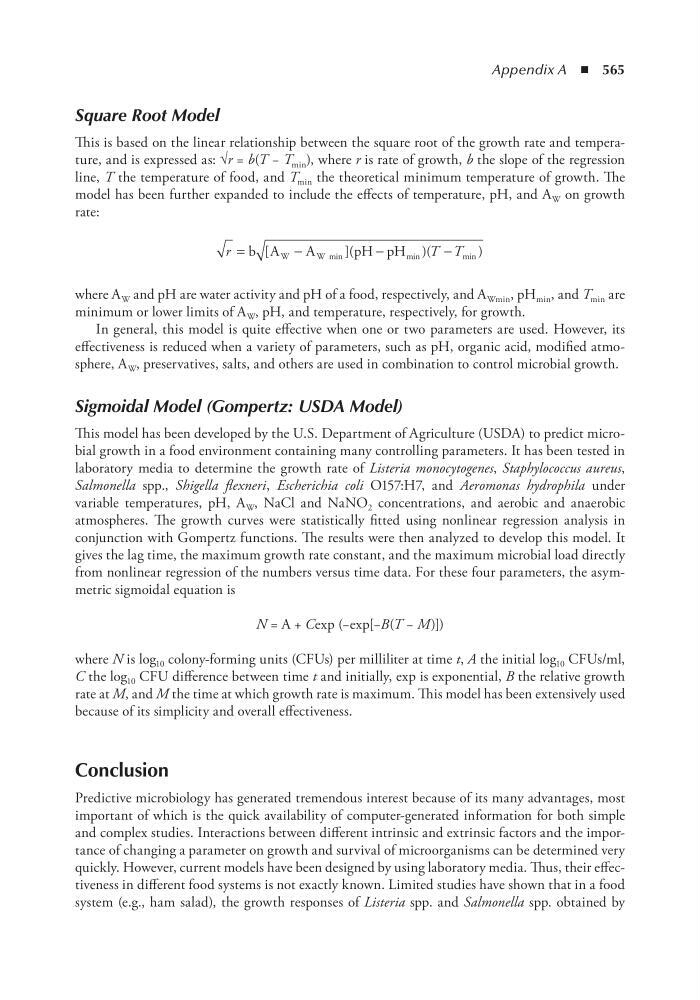
model has been further expanded to include the effects of temperature, pH, and A W on growth
rate:
r =
−
−
−
b A
A
pH pH
W
W
[
] (
) (
)
min
m in
min
T T
where A W and pH are water activity and pH of a food, respectively, and A Wmin , pH min , and T min are
minimum or lower limits of A W , pH, and temperature, respectively, for growth.
In general, this model is quite effective when one or two parameters are used. However, its
effectiveness is reduced when a variety of parameters, such as pH, organic acid, modified atmosphere, A W , preservatives, salts, and others are used in combination to control microbial growth.
Sigmoidal Model (Gompertz: USDA Model)
This model has been developed by the U.S. Department of Agriculture (USDA) to predict microbial growth in a food environment containing many controlling parameters. It has been tested in
laboratory media to determine the growth rate of Listeria monocytogenes, Staphylococcus aureus,
Salmonella spp., Shigella flexneri, Escherichia coli O157:H7, and Aeromonas hydrophila under
variable temperatures, pH, A W , NaCl and NaNO 2 concentrations, and aerobic and anaerobic
atmospheres. The growth curves were statistically fitted using nonlinear regression analysis in
conjunction with Gompertz functions. The results were then analyzed to develop this model. It
gives the lag time, the maximum growth rate constant, and the maximum microbial load directly
from nonlinear regression of the numbers versus time data. For these four parameters, the asymmetric sigmoidal equation is
N = A + Cexp (−exp[−B(T − M)])
where N is log 10 colony-forming units (CFUs) per milliliter at time t, A the initial log 10 CFUs/ml,
C the log 10 CFU difference between time t and initially, exp is exponential, B the relative growth
rate at M, and M the time at which growth rate is maximum. This model has been extensively used
because of its simplicity and overall effectiveness.
Conclusion
Predictive microbiology has generated tremendous interest because of its many advantages, most
important of which is the quick availability of computer-generated information for both simple
and complex studies. Interactions between different intrinsic and extrinsic factors and the importance of changing a parameter on growth and survival of microorganisms can be determined very
quickly. However, current models have been designed by using laboratory media. Thus, their effectiveness in different food systems is not exactly known. Limited studies have shown that in a food
system (e.g., ham salad), the growth responses of Listeria spp. and Salmonella spp. obtained by
Square Root Model
This is based on the linear relationship between the square root of the growth rate and temperature, and is expressed as: √r = b(T − T min ), where r is rate of growth, b the slope of the regression
line, T the temperature of food, and T min the theoretical minimum temperature of growth. The
model has been further expanded to include the effects of temperature, pH, and A W on growth
rate:
r =
−
−
−
b A
A
pH pH
W
W
[
] (
) (
)
min
m in
min
T T
where A W and pH are water activity and pH of a food, respectively, and A Wmin , pH min , and T min are
minimum or lower limits of A W , pH, and temperature, respectively, for growth.
In general, this model is quite effective when one or two parameters are used. However, its
effectiveness is reduced when a variety of parameters, such as pH, organic acid, modified atmosphere, A W , preservatives, salts, and others are used in combination to control microbial growth.
Sigmoidal Model (Gompertz: USDA Model)
This model has been developed by the U.S. Department of Agriculture (USDA) to predict microbial growth in a food environment containing many controlling parameters. It has been tested in
laboratory media to determine the growth rate of Listeria monocytogenes, Staphylococcus aureus,
Salmonella spp., Shigella flexneri, Escherichia coli O157:H7, and Aeromonas hydrophila under
variable temperatures, pH, A W , NaCl and NaNO 2 concentrations, and aerobic and anaerobic
atmospheres. The growth curves were statistically fitted using nonlinear regression analysis in
conjunction with Gompertz functions. The results were then analyzed to develop this model. It
gives the lag time, the maximum growth rate constant, and the maximum microbial load directly
from nonlinear regression of the numbers versus time data. For these four parameters, the asymmetric sigmoidal equation is
N = A + Cexp (−exp[−B(T − M)])
where N is log 10 colony-forming units (CFUs) per milliliter at time t, A the initial log 10 CFUs/ml,
C the log 10 CFU difference between time t and initially, exp is exponential, B the relative growth
rate at M, and M the time at which growth rate is maximum. This model has been extensively used
because of its simplicity and overall effectiveness.
Conclusion
Predictive microbiology has generated tremendous interest because of its many advantages, most
important of which is the quick availability of computer-generated information for both simple
and complex studies. Interactions between different intrinsic and extrinsic factors and the importance of changing a parameter on growth and survival of microorganisms can be determined very
quickly. However, current models have been designed by using laboratory media. Thus, their effectiveness in different food systems is not exactly known. Limited studies have shown that in a food
system (e.g., ham salad), the growth responses of Listeria spp. and Salmonella spp. obtained by