

12 ◾ Fundamental Food Microbiology
Classification of Microorganisms
Living cellular organisms, on the basis of phylogenetic and evolutionary relationships, were
grouped originally in five kingdoms, in which bacteria belonged to prokaryotes (before nucleus),
and the eukaryotic (with nucleus) molds and yeasts were grouped under fungi. 1 In the 1970s, the
prokaryotic domain was changed to Eubacteria (with murein or peptidoglycan on cell wall) and
Archaebacteria (without murein on cell wall). In the 1990s, this was changed to Bacteria and
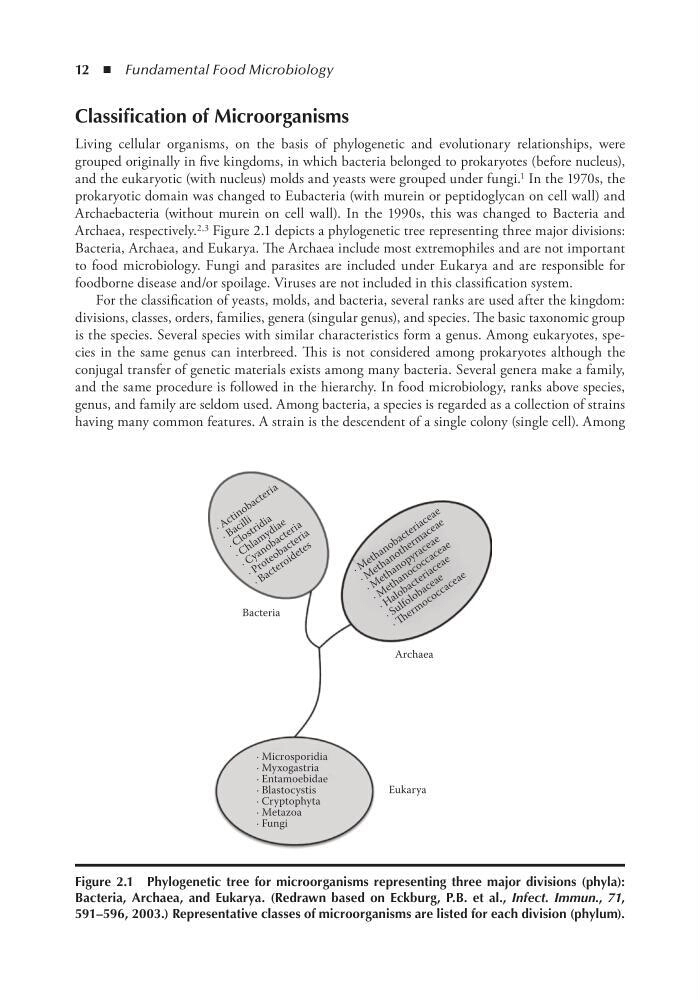
Archaea, respectively. 2,3 Figure 2.1 depicts a phylogenetic tree representing three major divisions:
Bacteria, Archaea, and Eukarya. The Archaea include most extremophiles and are not important
to food microbiology. Fungi and parasites are included under Eukarya and are responsible for
foodborne disease and/or spoilage. Viruses are not included in this classification system.
For the classification of yeasts, molds, and bacteria, several ranks are used after the kingdom:
divisions, classes, orders, families, genera (singular genus), and species. The basic taxonomic group
is the species. Several species with similar characteristics form a genus. Among eukaryotes, species in the same genus can interbreed. This is not considered among prokaryotes although the
conjugal transfer of genetic materials exists among many bacteria. Several genera make a family,
and the same procedure is followed in the hierarchy. In food microbiology, ranks above species,
genus, and family are seldom used. Among bacteria, a species is regarded as a collection of strains
having many common features. A strain is the descendent of a single colony (single cell). Among
Archaea
Bacteria
Eukarya
· Microsporidia
· Myxogastria
· Entamoebidae
· Blastocystis
· Cryptophyta
· Metazoa
· Fungi
· A c t i n o b a c t e r i a
· B a c i l l i
· C l o s t r i d i a
· C h l a m y d i a e
· C y a n o b a c t e r i a
· P r o t e o b a c t e r i a
· B a c t e r o i d e t e s
· M
e t h a n o b a c t e r i a c e a e
· M
e t h a n o t h e r m a c e a e
· M
e t h a n o p y r a c e a e
· M
e t h a n o c o c c a c e a e
· H a l o b a c t e r i a c e a e
· S u l f o l o b a c e a e
·
e r m o c o c c a c e a e
Figure 2.1 Phylogenetic tree for microorganisms representing three major divisions (phyla):
Bacteria, Archaea, and eukarya. (Redrawn based on eckburg, P.B. et al., Infect. Immun., 71,
591–596, 2003.) Representative classes of microorganisms are listed for each division (phylum).
Classification of Microorganisms
Living cellular organisms, on the basis of phylogenetic and evolutionary relationships, were
grouped originally in five kingdoms, in which bacteria belonged to prokaryotes (before nucleus),
and the eukaryotic (with nucleus) molds and yeasts were grouped under fungi. 1 In the 1970s, the
prokaryotic domain was changed to Eubacteria (with murein or peptidoglycan on cell wall) and
Archaebacteria (without murein on cell wall). In the 1990s, this was changed to Bacteria and
Archaea, respectively. 2,3 Figure 2.1 depicts a phylogenetic tree representing three major divisions:
Bacteria, Archaea, and Eukarya. The Archaea include most extremophiles and are not important
to food microbiology. Fungi and parasites are included under Eukarya and are responsible for
foodborne disease and/or spoilage. Viruses are not included in this classification system.
For the classification of yeasts, molds, and bacteria, several ranks are used after the kingdom:
divisions, classes, orders, families, genera (singular genus), and species. The basic taxonomic group
is the species. Several species with similar characteristics form a genus. Among eukaryotes, species in the same genus can interbreed. This is not considered among prokaryotes although the
conjugal transfer of genetic materials exists among many bacteria. Several genera make a family,
and the same procedure is followed in the hierarchy. In food microbiology, ranks above species,
genus, and family are seldom used. Among bacteria, a species is regarded as a collection of strains
having many common features. A strain is the descendent of a single colony (single cell). Among
Archaea
Bacteria
Eukarya
· Microsporidia
· Myxogastria
· Entamoebidae
· Blastocystis
· Cryptophyta
· Metazoa
· Fungi
· A c t i n o b a c t e r i a
· B a c i l l i
· C l o s t r i d i a
· C h l a m y d i a e
· C y a n o b a c t e r i a
· P r o t e o b a c t e r i a
· B a c t e r o i d e t e s
· M
e t h a n o b a c t e r i a c e a e
· M
e t h a n o t h e r m a c e a e
· M
e t h a n o p y r a c e a e
· M
e t h a n o c o c c a c e a e
· H a l o b a c t e r i a c e a e
· S u l f o l o b a c e a e
·
e r m o c o c c a c e a e
Figure 2.1 Phylogenetic tree for microorganisms representing three major divisions (phyla):
Bacteria, Archaea, and eukarya. (Redrawn based on eckburg, P.B. et al., Infect. Immun., 71,
591–596, 2003.) Representative classes of microorganisms are listed for each division (phylum).