

554 ◾ Fundamental Food Microbiology
hours. Interestingly, many of the modern-day biosensor-based methods are developed utilizing
one of the above four principles or their combinations. However, antibody-based immunosensor
methods are very common and offer the most versatility and convenience.
Pathogen detection using biosensors from food samples are challenging because of the complex nature of food, which consists of fats, proteins, carbohydrates, minerals, and preservatives
with different acidities, salts, and colorings. Application of nanobiotechnology to detect pathogens
from such a complex system presents numerous challenges. This is further complicated by the fact
that in a food the populations of target microorganisms are normally very low compared to the
indigenous flora. Therefore, exceptionally rational strategies need to be employed to detect such
low numbers of pathogens directly from food. Varieties of biosensor-based methods have been and
continue to be developed: electrochemical (impedance and amperometric), optical (light scattering, fiber optic, and SPR), thermometric (thermister and pyroelectric), and mass-based (piezoelectric and surface acoustic) methods. Among these, optical sensors appear to be very popular
because of their sensitivity, available instrumentation, and relative ease of data interpretation.
Fiber-Optic Biosensors 32–35
A fiber-optic biosensor is a sensitive optical method that has been used for detection of foodborne
as well as microbial and chemical biowarfare agents. A polystyrene or glass waveguide in the form
of a fiber or glass slide is used for such application. This method utilizes the total internal reflection
(TIR) property of light when it travels through the waveguide and generates a boundary of evanescent waves on the surface of the waveguide. Fluorescent molecules present in the evanescent field
are excited and emit light that returns through the fiber in high-order modes and is detected by a
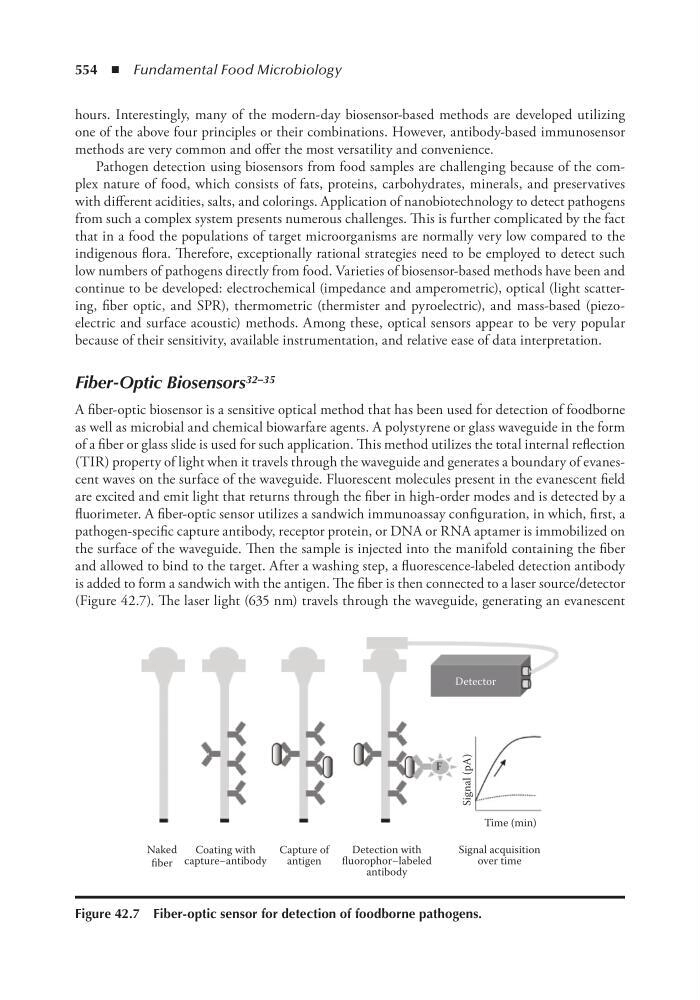
fluorimeter. A fiber-optic sensor utilizes a sandwich immunoassay configuration, in which, first, a
pathogen-specific capture antibody, receptor protein, or DNA or RNA aptamer is immobilized on
the surface of the waveguide. Then the sample is injected into the manifold containing the fiber
and allowed to bind to the target. After a washing step, a fluorescence-labeled detection antibody
is added to form a sandwich with the antigen. The fiber is then connected to a laser source/detector
(Figure 42.7). The laser light (635 nm) travels through the waveguide, generating an evanescent
Naked
fiber
Detector
Coating with
capture−antibody
Capture of
antigen
Detection with
fluorophor−labeled
antibody
Signal acquisition
over time
Time (min)
Signal (pA)
F
Figure 42.7 Fiber-optic sensor for detection of foodborne pathogens.
hours. Interestingly, many of the modern-day biosensor-based methods are developed utilizing
one of the above four principles or their combinations. However, antibody-based immunosensor
methods are very common and offer the most versatility and convenience.
Pathogen detection using biosensors from food samples are challenging because of the complex nature of food, which consists of fats, proteins, carbohydrates, minerals, and preservatives
with different acidities, salts, and colorings. Application of nanobiotechnology to detect pathogens
from such a complex system presents numerous challenges. This is further complicated by the fact
that in a food the populations of target microorganisms are normally very low compared to the
indigenous flora. Therefore, exceptionally rational strategies need to be employed to detect such
low numbers of pathogens directly from food. Varieties of biosensor-based methods have been and
continue to be developed: electrochemical (impedance and amperometric), optical (light scattering, fiber optic, and SPR), thermometric (thermister and pyroelectric), and mass-based (piezoelectric and surface acoustic) methods. Among these, optical sensors appear to be very popular
because of their sensitivity, available instrumentation, and relative ease of data interpretation.
Fiber-Optic Biosensors 32–35
A fiber-optic biosensor is a sensitive optical method that has been used for detection of foodborne
as well as microbial and chemical biowarfare agents. A polystyrene or glass waveguide in the form
of a fiber or glass slide is used for such application. This method utilizes the total internal reflection
(TIR) property of light when it travels through the waveguide and generates a boundary of evanescent waves on the surface of the waveguide. Fluorescent molecules present in the evanescent field
are excited and emit light that returns through the fiber in high-order modes and is detected by a
fluorimeter. A fiber-optic sensor utilizes a sandwich immunoassay configuration, in which, first, a
pathogen-specific capture antibody, receptor protein, or DNA or RNA aptamer is immobilized on
the surface of the waveguide. Then the sample is injected into the manifold containing the fiber
and allowed to bind to the target. After a washing step, a fluorescence-labeled detection antibody
is added to form a sandwich with the antigen. The fiber is then connected to a laser source/detector
(Figure 42.7). The laser light (635 nm) travels through the waveguide, generating an evanescent
Naked
fiber
Detector
Coating with
capture−antibody
Capture of
antigen
Detection with
fluorophor−labeled
antibody
Signal acquisition
over time
Time (min)
Signal (pA)
F
Figure 42.7 Fiber-optic sensor for detection of foodborne pathogens.