

540 ◾ Fundamental Food Microbiology
agents then help to differentiate these species or groups from one another by their specific colony
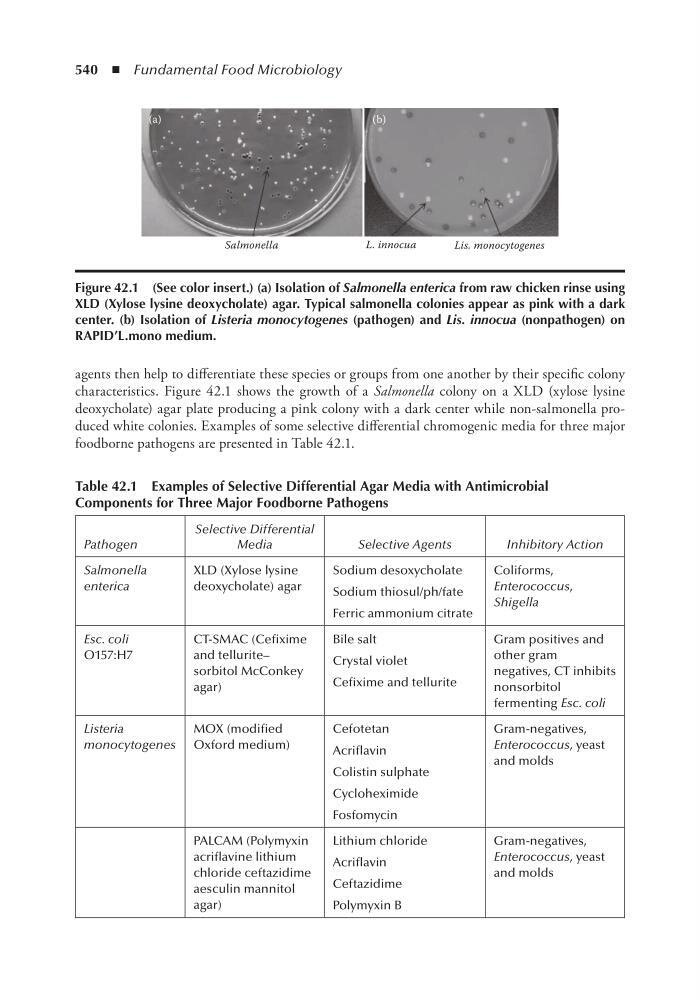
characteristics. Figure 42.1 shows the growth of a Salmonella colony on a XLD (xylose lysine
deoxycholate) agar plate producing a pink colony with a dark center while non-salmonella produced white colonies. Examples of some selective differential chromogenic media for three major
foodborne pathogens are presented in Table 42.1.
(a)
(b)
Salmonella
L. innocua
Lis. monocytogenes
Figure 42.1 (See color insert.) (a) isolation of Salmonella enterica from raw chicken rinse using
XLD (Xylose lysine deoxycholate) agar. typical salmonella colonies appear as pink with a dark
center. (b) isolation of Listeria monocytogenes (pathogen) and Lis. innocua (nonpathogen) on
RAPiD’L.mono medium.
table 42.1 examples of Selective Differential Agar Media with Antimicrobial
Components for three Major Foodborne Pathogens
Pathogen
Selective Differential
Media
Selective Agents
Inhibitory Action
Salmonella
enterica
XLD (Xylose lysine
deoxycholate) agar
Sodium desoxycholate
Sodium thiosul/ph/fate
Ferric ammonium citrate
Coliforms,
Enterococcus,
Shigella
Esc. coli
O157:H7
CT-SMAC (Cefixime
and tellurite–
sorbitol McConkey
agar)
Bile salt
Crystal violet
Cefixime and tellurite
Gram positives and
other gram
negatives, CT inhibits
nonsorbitol
fermenting Esc. coli
Listeria
monocytogenes
MOX (modified
Oxford medium)
Cefotetan
Acriflavin
Colistin sulphate
Cycloheximide
Fosfomycin
Gram-negatives,
Enterococcus, yeast
and molds
PALCAM (Polymyxin
acriflavine lithium
chloride ceftazidime
aesculin mannitol
agar)
Lithium chloride
Acriflavin
Ceftazidime
Polymyxin B
Gram-negatives,
Enterococcus, yeast
and molds
agents then help to differentiate these species or groups from one another by their specific colony
characteristics. Figure 42.1 shows the growth of a Salmonella colony on a XLD (xylose lysine
deoxycholate) agar plate producing a pink colony with a dark center while non-salmonella produced white colonies. Examples of some selective differential chromogenic media for three major
foodborne pathogens are presented in Table 42.1.
(a)
(b)
Salmonella
L. innocua
Lis. monocytogenes
Figure 42.1 (See color insert.) (a) isolation of Salmonella enterica from raw chicken rinse using
XLD (Xylose lysine deoxycholate) agar. typical salmonella colonies appear as pink with a dark
center. (b) isolation of Listeria monocytogenes (pathogen) and Lis. innocua (nonpathogen) on
RAPiD’L.mono medium.
table 42.1 examples of Selective Differential Agar Media with Antimicrobial
Components for three Major Foodborne Pathogens
Pathogen
Selective Differential
Media
Selective Agents
Inhibitory Action
Salmonella
enterica
XLD (Xylose lysine
deoxycholate) agar
Sodium desoxycholate
Sodium thiosul/ph/fate
Ferric ammonium citrate
Coliforms,
Enterococcus,
Shigella
Esc. coli
O157:H7
CT-SMAC (Cefixime
and tellurite–
sorbitol McConkey
agar)
Bile salt
Crystal violet
Cefixime and tellurite
Gram positives and
other gram
negatives, CT inhibits
nonsorbitol
fermenting Esc. coli
Listeria
monocytogenes
MOX (modified
Oxford medium)
Cefotetan
Acriflavin
Colistin sulphate
Cycloheximide
Fosfomycin
Gram-negatives,
Enterococcus, yeast
and molds
PALCAM (Polymyxin
acriflavine lithium
chloride ceftazidime
aesculin mannitol
agar)
Lithium chloride
Acriflavin
Ceftazidime
Polymyxin B
Gram-negatives,
Enterococcus, yeast
and molds