

528 ◾ Fundamental Food Microbiology
each of these agents or methods is used “gently” (at a lower level) as opposed to “harshly,” they
normally do not adversely affect the acceptance and nutritional qualities of foods but do retain
their desirable safety and stability. The mechanisms by which the combination of factors, or the
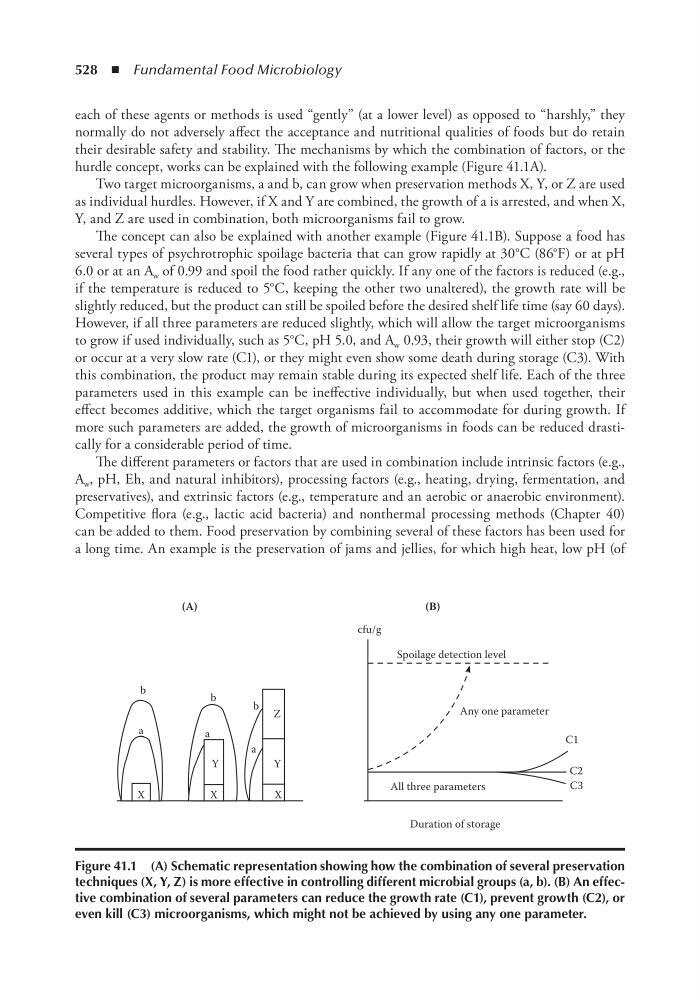
hurdle concept, works can be explained with the following example (Figure 41.1A).
Two target microorganisms, a and b, can grow when preservation methods X, Y, or Z are used
as individual hurdles. However, if X and Y are combined, the growth of a is arrested, and when X,
Y, and Z are used in combination, both microorganisms fail to grow.
The concept can also be explained with another example (Figure 41.1B). Suppose a food has
several types of psychrotrophic spoilage bacteria that can grow rapidly at 30°C (86°F) or at pH
6.0 or at an A w of 0.99 and spoil the food rather quickly. If any one of the factors is reduced (e.g.,
if the temperature is reduced to 5°C, keeping the other two unaltered), the growth rate will be
slightly reduced, but the product can still be spoiled before the desired shelf life time (say 60 days).
However, if all three parameters are reduced slightly, which will allow the target microorganisms
to grow if used individually, such as 5°C, pH 5.0, and A w 0.93, their growth will either stop (C2)
or occur at a very slow rate (C1), or they might even show some death during storage (C3). With
this combination, the product may remain stable during its expected shelf life. Each of the three
parameters used in this example can be ineffective individually, but when used together, their
effect becomes additive, which the target organisms fail to accommodate for during growth. If
more such parameters are added, the growth of microorganisms in foods can be reduced drastically for a considerable period of time.
The different parameters or factors that are used in combination include intrinsic factors (e.g.,
A w , pH, Eh, and natural inhibitors), processing factors (e.g., heating, drying, fermentation, and
preservatives), and extrinsic factors (e.g., temperature and an aerobic or anaerobic environment).
Competitive flora (e.g., lactic acid bacteria) and nonthermal processing methods (Chapter 40)
can be added to them. Food preservation by combining several of these factors has been used for
a long time. An example is the preservation of jams and jellies, for which high heat, low pH (of
(A)
(B)
cfu/g
Spoilage detection level
Duration of storage
Any one parameter
All three parameters
C1
C2
C3
Z
Y
Y
X
X
X
a
a
a
b
b
b
Figure 41.1 (A) Schematic representation showing how the combination of several preservation
techniques (X, Y, Z) is more effective in controlling different microbial groups (a, b). (B) An effective combination of several parameters can reduce the growth rate (C1), prevent growth (C2), or
even kill (C3) microorganisms, which might not be achieved by using any one parameter.
each of these agents or methods is used “gently” (at a lower level) as opposed to “harshly,” they
normally do not adversely affect the acceptance and nutritional qualities of foods but do retain
their desirable safety and stability. The mechanisms by which the combination of factors, or the
hurdle concept, works can be explained with the following example (Figure 41.1A).
Two target microorganisms, a and b, can grow when preservation methods X, Y, or Z are used
as individual hurdles. However, if X and Y are combined, the growth of a is arrested, and when X,
Y, and Z are used in combination, both microorganisms fail to grow.
The concept can also be explained with another example (Figure 41.1B). Suppose a food has
several types of psychrotrophic spoilage bacteria that can grow rapidly at 30°C (86°F) or at pH
6.0 or at an A w of 0.99 and spoil the food rather quickly. If any one of the factors is reduced (e.g.,
if the temperature is reduced to 5°C, keeping the other two unaltered), the growth rate will be
slightly reduced, but the product can still be spoiled before the desired shelf life time (say 60 days).
However, if all three parameters are reduced slightly, which will allow the target microorganisms
to grow if used individually, such as 5°C, pH 5.0, and A w 0.93, their growth will either stop (C2)
or occur at a very slow rate (C1), or they might even show some death during storage (C3). With
this combination, the product may remain stable during its expected shelf life. Each of the three
parameters used in this example can be ineffective individually, but when used together, their
effect becomes additive, which the target organisms fail to accommodate for during growth. If
more such parameters are added, the growth of microorganisms in foods can be reduced drastically for a considerable period of time.
The different parameters or factors that are used in combination include intrinsic factors (e.g.,
A w , pH, Eh, and natural inhibitors), processing factors (e.g., heating, drying, fermentation, and
preservatives), and extrinsic factors (e.g., temperature and an aerobic or anaerobic environment).
Competitive flora (e.g., lactic acid bacteria) and nonthermal processing methods (Chapter 40)
can be added to them. Food preservation by combining several of these factors has been used for
a long time. An example is the preservation of jams and jellies, for which high heat, low pH (of
(A)
(B)
cfu/g
Spoilage detection level
Duration of storage
Any one parameter
All three parameters
C1
C2
C3
Z
Y
Y
X
X
X
a
a
a
b
b
b
Figure 41.1 (A) Schematic representation showing how the combination of several preservation
techniques (X, Y, Z) is more effective in controlling different microbial groups (a, b). (B) An effective combination of several parameters can reduce the growth rate (C1), prevent growth (C2), or
even kill (C3) microorganisms, which might not be achieved by using any one parameter.