

Control by Novel Processing Technologies ◾ 519
actions) augment these molecular changes. Among the molecules, most changes occur in the secondary and tertiary structures of proteins as well as association of proteins with other molecules.
In microbial cells, many vital structural and functional components are adversely affected, causing
viability loss as well as reversible or sublethal injury. Although damage to the cell membrane is
viewed as the major cause of cell death, damages in cell wall, DNA, and RNA; inactivation as well
as activation of some enzymes; and lysis of cells have been reported. These changes are enhanced
by increasing the pressure, pressurization temperature, and pressurization time. Bacterial spores at
a very high pressure (≥700 MPa) are probably inactivated by the inactivation of enzymes associated
with the germination process. At a lower pressure range (~200–300 MPa), spores are induced to
germination by a mechanism similar to heat-shock germination. Once germinated, the outgrowing
spores are susceptible to pressurization like the vegetative cells.
Hydrostatic pressure processing of food requires a very short time, less energy, and less space,
and is safer than thermal processing. It does not act on covalent bonds of molecules; thus, vitamins, color pigments, and other small molecules are not adversely affected. Although it is basically
a batch process, because of the short time requirements, it can be made continuous by installing
E
C
A
B
F
G
D
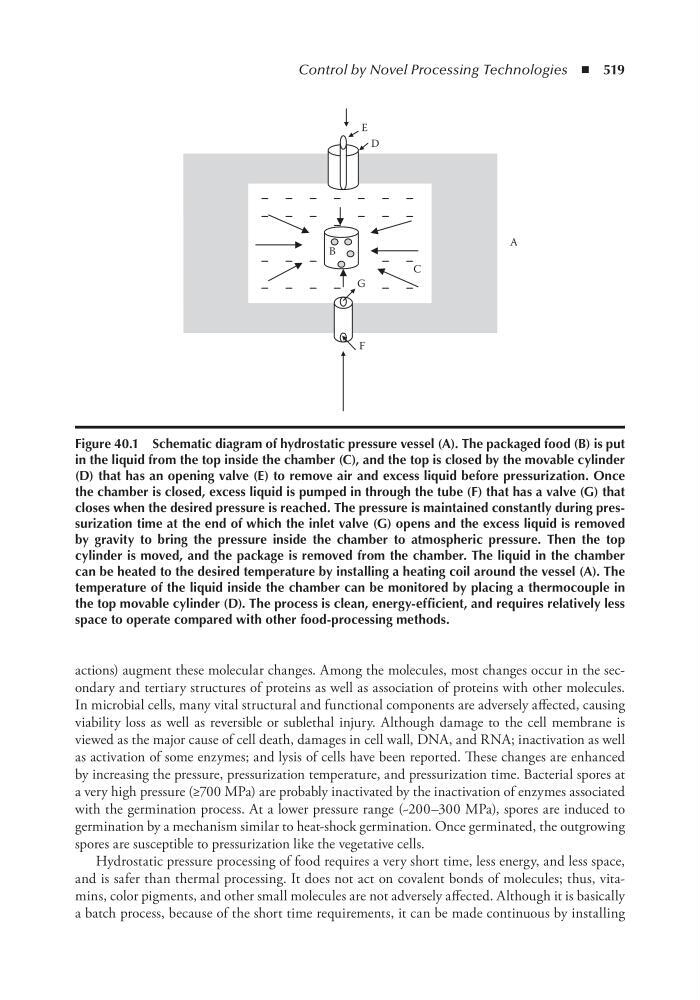
Figure 40.1 Schematic diagram of hydrostatic pressure vessel (A). the packaged food (B) is put
in the liquid from the top inside the chamber (C), and the top is closed by the movable cylinder
(D) that has an opening valve (e) to remove air and excess liquid before pressurization. once
the chamber is closed, excess liquid is pumped in through the tube (F) that has a valve (G) that
closes when the desired pressure is reached. the pressure is maintained constantly during pressurization time at the end of which the inlet valve (G) opens and the excess liquid is removed
by gravity to bring the pressure inside the chamber to atmospheric pressure. then the top
cylinder is moved, and the package is removed from the chamber. the liquid in the chamber
can be heated to the desired temperature by installing a heating coil around the vessel (A). the
temperature of the liquid inside the chamber can be monitored by placing a thermocouple in
the top movable cylinder (D). the process is clean, energy-efficient, and requires relatively less
space to operate compared with other food-processing methods.
actions) augment these molecular changes. Among the molecules, most changes occur in the secondary and tertiary structures of proteins as well as association of proteins with other molecules.
In microbial cells, many vital structural and functional components are adversely affected, causing
viability loss as well as reversible or sublethal injury. Although damage to the cell membrane is
viewed as the major cause of cell death, damages in cell wall, DNA, and RNA; inactivation as well
as activation of some enzymes; and lysis of cells have been reported. These changes are enhanced
by increasing the pressure, pressurization temperature, and pressurization time. Bacterial spores at
a very high pressure (≥700 MPa) are probably inactivated by the inactivation of enzymes associated
with the germination process. At a lower pressure range (~200–300 MPa), spores are induced to
germination by a mechanism similar to heat-shock germination. Once germinated, the outgrowing
spores are susceptible to pressurization like the vegetative cells.
Hydrostatic pressure processing of food requires a very short time, less energy, and less space,
and is safer than thermal processing. It does not act on covalent bonds of molecules; thus, vitamins, color pigments, and other small molecules are not adversely affected. Although it is basically
a batch process, because of the short time requirements, it can be made continuous by installing
E
C
A
B
F
G
D
Figure 40.1 Schematic diagram of hydrostatic pressure vessel (A). the packaged food (B) is put
in the liquid from the top inside the chamber (C), and the top is closed by the movable cylinder
(D) that has an opening valve (e) to remove air and excess liquid before pressurization. once
the chamber is closed, excess liquid is pumped in through the tube (F) that has a valve (G) that
closes when the desired pressure is reached. the pressure is maintained constantly during pressurization time at the end of which the inlet valve (G) opens and the excess liquid is removed
by gravity to bring the pressure inside the chamber to atmospheric pressure. then the top
cylinder is moved, and the package is removed from the chamber. the liquid in the chamber
can be heated to the desired temperature by installing a heating coil around the vessel (A). the
temperature of the liquid inside the chamber can be monitored by placing a thermocouple in
the top movable cylinder (D). the process is clean, energy-efficient, and requires relatively less
space to operate compared with other food-processing methods.