

484 ◾ Fundamental Food Microbiology
many convenient and ready-to-eat foods that are preserved by altering the environment. As the
demand for such food is expected to grow in the future, the use of an altered atmosphere to preserve these foods will increase. 1–6
Four terminologies are used to alter the atmosphere in foods in order to preserve and increase
their acceptance quality. To avoid confusion, these terms are defined here:
1. Controlled atmosphere packaging (CAP). In this method, the atmosphere in a storage facility is altered and the levels of the gases are continually monitored and adjusted as required.
This is expensive and used for long-term storage of fruits and vegetables to maintain their
freshness.
2. Modified atmosphere packaging (MAP). This method, unlike CAP, does not require a high
degree of control of the gaseous environment during the entire storage period. In this
method, a food is enclosed in a high gas-barrier packaging material; the air is removed from
the package, which is then flushed with a particular gas or combination of gases; and the
package is hermetically sealed.
3. Active packaging (AP). The active components in the packaging system interact with the
content or the environment to extend the shelf life and quality of the product. This includes
moisture control, O 2 generators, CO 2 controllers, O 2 -permeable films, O 2 scavengers, flavor
enhancement, or odor removal, etc.
4. Vacuum packaging (VP). This method involves the removal of air from the package and then
sealing the package hermetically.
MAP and VP have been described as two separate methods by some but as one method (e.g.,
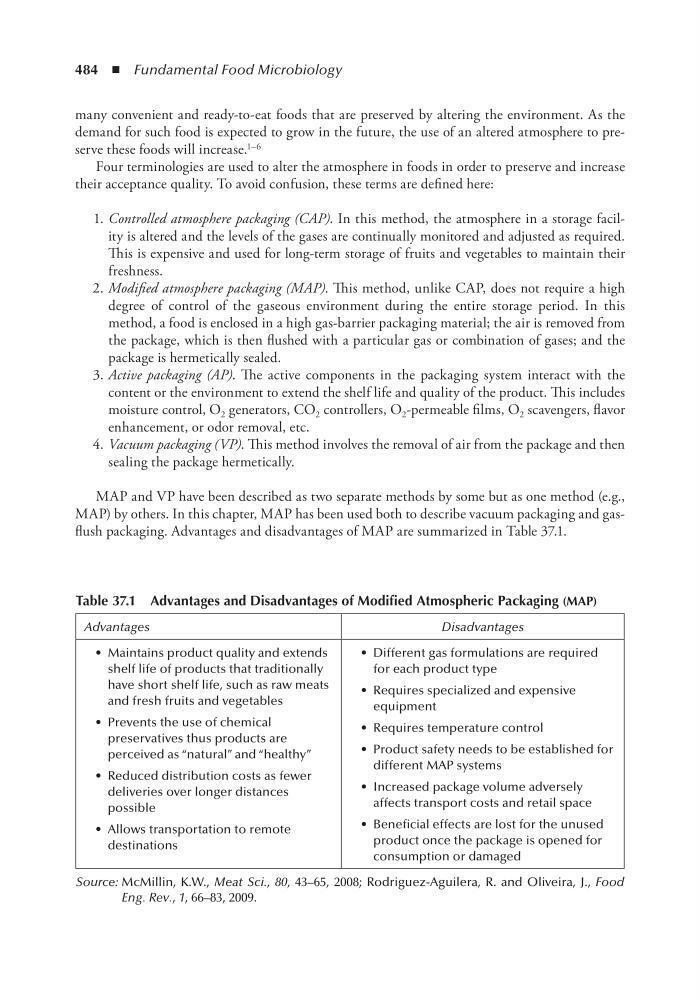
MAP) by others. In this chapter, MAP has been used both to describe vacuum packaging and gasflush packaging. Advantages and disadvantages of MAP are summarized in Table 37.1.
table 37.1 Advantages and Disadvantages of Modified Atmospheric Packaging (MAP)
Advantages
Disadvantages
• Maintains product quality and extends
shelf life of products that traditionally
have short shelf life, such as raw meats
and fresh fruits and vegetables
• Prevents the use of chemical
preservatives thus products are
perceived as ‘‘natural’’ and ‘‘healthy’’
• Reduced distribution costs as fewer
deliveries over longer distances
possible
• Allows transportation to remote
destinations
• Different gas formulations are required
for each product type
• Requires specialized and expensive
equipment
• Requires temperature control
• Product safety needs to be established for
different MAP systems
• Increased package volume adversely
affects transport costs and retail space
• Beneficial effects are lost for the unused
product once the package is opened for
consumption or damaged
Source: McMillin, K.W., Meat Sci., 80, 43–65, 2008; Rodriguez-Aguilera, R. and Oliveira, J., Food
Eng. Rev., 1, 66–83, 2009.
many convenient and ready-to-eat foods that are preserved by altering the environment. As the
demand for such food is expected to grow in the future, the use of an altered atmosphere to preserve these foods will increase. 1–6
Four terminologies are used to alter the atmosphere in foods in order to preserve and increase
their acceptance quality. To avoid confusion, these terms are defined here:
1. Controlled atmosphere packaging (CAP). In this method, the atmosphere in a storage facility is altered and the levels of the gases are continually monitored and adjusted as required.
This is expensive and used for long-term storage of fruits and vegetables to maintain their
freshness.
2. Modified atmosphere packaging (MAP). This method, unlike CAP, does not require a high
degree of control of the gaseous environment during the entire storage period. In this
method, a food is enclosed in a high gas-barrier packaging material; the air is removed from
the package, which is then flushed with a particular gas or combination of gases; and the
package is hermetically sealed.
3. Active packaging (AP). The active components in the packaging system interact with the
content or the environment to extend the shelf life and quality of the product. This includes
moisture control, O 2 generators, CO 2 controllers, O 2 -permeable films, O 2 scavengers, flavor
enhancement, or odor removal, etc.
4. Vacuum packaging (VP). This method involves the removal of air from the package and then
sealing the package hermetically.
MAP and VP have been described as two separate methods by some but as one method (e.g.,
MAP) by others. In this chapter, MAP has been used both to describe vacuum packaging and gasflush packaging. Advantages and disadvantages of MAP are summarized in Table 37.1.
table 37.1 Advantages and Disadvantages of Modified Atmospheric Packaging (MAP)
Advantages
Disadvantages
• Maintains product quality and extends
shelf life of products that traditionally
have short shelf life, such as raw meats
and fresh fruits and vegetables
• Prevents the use of chemical
preservatives thus products are
perceived as ‘‘natural’’ and ‘‘healthy’’
• Reduced distribution costs as fewer
deliveries over longer distances
possible
• Allows transportation to remote
destinations
• Different gas formulations are required
for each product type
• Requires specialized and expensive
equipment
• Requires temperature control
• Product safety needs to be established for
different MAP systems
• Increased package volume adversely
affects transport costs and retail space
• Beneficial effects are lost for the unused
product once the package is opened for
consumption or damaged
Source: McMillin, K.W., Meat Sci., 80, 43–65, 2008; Rodriguez-Aguilera, R. and Oliveira, J., Food
Eng. Rev., 1, 66–83, 2009.