

476 ◾ Fundamental Food Microbiology
objectives
The major antimicrobial objective of using weak organic acids is to reduce the pH of food to
control microbial growth. As the pH drops below 5.0, some bacteria become injured and die.
However, the death rate in low pH is not predictable as in the case of heat. Thus, it could not be
used with the objective of destroying a predictable percentage of a microbial population in the
normal pH range of foods. 1,2
Mechanisms of Antimicrobial Action
The antimicrobial action of a weak organic acid is produced by the combined actions of the
undissociated molecules and the dissociated ions. 2,3 Microorganisms that are important in food
tend to maintain an internal cytoplasmic pH of approximately 6.5–7.0 in acidophiles and 7.5–8.0
in neutrophiles. The internal pH (pHi) is tightly regulated and drops by approximately 0.1 unit
for each 1.0 unit change in the environmental pH (pHo). For nutrient transport and energy synthesis, the microorganisms also maintain a transmembrane pH gradient (ca. 0.5–1.0 unit with
alkaline pHi) and a proton gradient (ca. 200 mV); together, they form the proton motive force
(PMF).
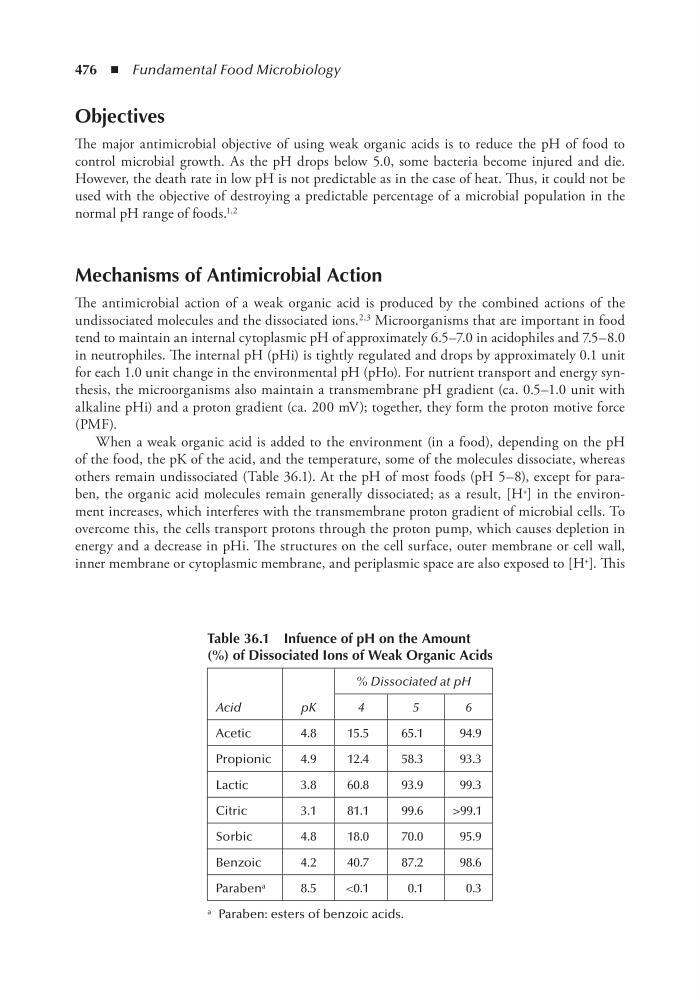
When a weak organic acid is added to the environment (in a food), depending on the pH
of the food, the pK of the acid, and the temperature, some of the molecules dissociate, whereas
others remain undissociated (Table 36.1). At the pH of most foods (pH 5–8), except for paraben, the organic acid molecules remain generally dissociated; as a result, [H + ] in the environment increases, which interferes with the transmembrane proton gradient of microbial cells. To
overcome this, the cells transport protons through the proton pump, which causes depletion in
energy and a decrease in pHi. The structures on the cell surface, outer membrane or cell wall,
inner membrane or cytoplasmic membrane, and periplasmic space are also exposed to [H + ]. This
table 36.1 infuence of pH on the Amount
(%) of Dissociated ions of Weak organic Acids
Acid
pK
% Dissociated at pH
4
5
6
Acetic
4.8
15.5
65.1
94.9
Propionic
4.9
12.4
58.3
93.3
Lactic
3.8
60.8
93.9
99.3
Citric
3.1
81.1
99.6
>99.1
Sorbic
4.8
18.0
70.0
95.9
Benzoic
4.2
40.7
87.2
98.6
Paraben a
8.5
<0.1
0.1
0.3
a Paraben: esters of benzoic acids.
objectives
The major antimicrobial objective of using weak organic acids is to reduce the pH of food to
control microbial growth. As the pH drops below 5.0, some bacteria become injured and die.
However, the death rate in low pH is not predictable as in the case of heat. Thus, it could not be
used with the objective of destroying a predictable percentage of a microbial population in the
normal pH range of foods. 1,2
Mechanisms of Antimicrobial Action
The antimicrobial action of a weak organic acid is produced by the combined actions of the
undissociated molecules and the dissociated ions. 2,3 Microorganisms that are important in food
tend to maintain an internal cytoplasmic pH of approximately 6.5–7.0 in acidophiles and 7.5–8.0
in neutrophiles. The internal pH (pHi) is tightly regulated and drops by approximately 0.1 unit
for each 1.0 unit change in the environmental pH (pHo). For nutrient transport and energy synthesis, the microorganisms also maintain a transmembrane pH gradient (ca. 0.5–1.0 unit with
alkaline pHi) and a proton gradient (ca. 200 mV); together, they form the proton motive force
(PMF).
When a weak organic acid is added to the environment (in a food), depending on the pH
of the food, the pK of the acid, and the temperature, some of the molecules dissociate, whereas
others remain undissociated (Table 36.1). At the pH of most foods (pH 5–8), except for paraben, the organic acid molecules remain generally dissociated; as a result, [H + ] in the environment increases, which interferes with the transmembrane proton gradient of microbial cells. To
overcome this, the cells transport protons through the proton pump, which causes depletion in
energy and a decrease in pHi. The structures on the cell surface, outer membrane or cell wall,
inner membrane or cytoplasmic membrane, and periplasmic space are also exposed to [H + ]. This
table 36.1 infuence of pH on the Amount
(%) of Dissociated ions of Weak organic Acids
Acid
pK
% Dissociated at pH
4
5
6
Acetic
4.8
15.5
65.1
94.9
Propionic
4.9
12.4
58.3
93.3
Lactic
3.8
60.8
93.9
99.3
Citric
3.1
81.1
99.6
>99.1
Sorbic
4.8
18.0
70.0
95.9
Benzoic
4.2
40.7
87.2
98.6
Paraben a
8.5
<0.1
0.1
0.3
a Paraben: esters of benzoic acids.