

472 ◾ Fundamental Food Microbiology
Depending on the temperature and time of exposure, some microbial cells can die during drying; whereas other cells can be sublethally injured. Also, during storage, depending on the storage
conditions, microbial cells can die rapidly at the initial stage and then at a slow rate. Spores generally survive and remain viable during storage in a dried food.
Freeze Drying
The acceptance quality of food is least affected by freeze-drying as compared with both natural
and mechanical drying. However, freeze-drying is a relatively costly process. It can be used for
both solid and liquid foods. The process initially involves freezing the food, preferably rapidly at a
low temperature, and then exposing the frozen food to a relatively high vacuum environment. The
water molecules are removed from the food by sublimation (from solid state to vapor state) without
affecting its shape or size. The method has been used to produce freeze-dried vegetables, fruits,
fruit juices, coffee, tea, and meat and fish products, some as specialty products. 8 Freeze-drying is a
popular method of food preservation for space foods for astronauts, especially the side dishes, such
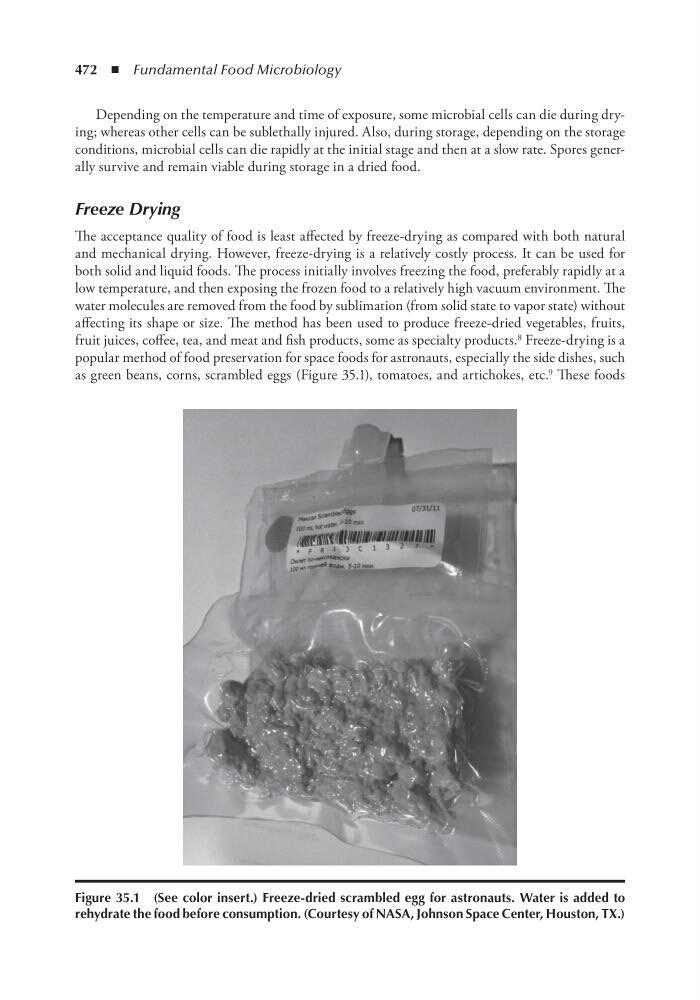
as green beans, corns, scrambled eggs (Figure 35.1), tomatoes, and artichokes, etc. 9 These foods
Figure 35.1 (See color insert.) Freeze-dried scrambled egg for astronauts. Water is added to
rehydrate the food before consumption. (Courtesy of nASA, Johnson Space Center, Houston, tX.)
Depending on the temperature and time of exposure, some microbial cells can die during drying; whereas other cells can be sublethally injured. Also, during storage, depending on the storage
conditions, microbial cells can die rapidly at the initial stage and then at a slow rate. Spores generally survive and remain viable during storage in a dried food.
Freeze Drying
The acceptance quality of food is least affected by freeze-drying as compared with both natural
and mechanical drying. However, freeze-drying is a relatively costly process. It can be used for
both solid and liquid foods. The process initially involves freezing the food, preferably rapidly at a
low temperature, and then exposing the frozen food to a relatively high vacuum environment. The
water molecules are removed from the food by sublimation (from solid state to vapor state) without
affecting its shape or size. The method has been used to produce freeze-dried vegetables, fruits,
fruit juices, coffee, tea, and meat and fish products, some as specialty products. 8 Freeze-drying is a
popular method of food preservation for space foods for astronauts, especially the side dishes, such
as green beans, corns, scrambled eggs (Figure 35.1), tomatoes, and artichokes, etc. 9 These foods
Figure 35.1 (See color insert.) Freeze-dried scrambled egg for astronauts. Water is added to
rehydrate the food before consumption. (Courtesy of nASA, Johnson Space Center, Houston, tX.)