

New and Emerging Foodborne Pathogens ◾ 419
Nipah Virus 19,20
The first Nipah virus (NiV) outbreak was reported in Malaysia in 1998–1999, which affected
276 people with a 39% fatality rate, and the infection was transmitted through sick pigs. The
NiV was amplified at large numbers in the respiratory tracts and facilitated the spread of infection of farm workers. NiV is a RNA virus and is a member of genus Henipavirus within the family of Paramyxoviridae. It was originally isolated from a patient from the Sungai Nipah Village
in Malaysia, and fruit bats serve as a natural reservoir. Interaction of fruit bats with swine and
humans led to increased numbers of outbreaks in Malaysia. Bats transmit viruses through saliva
or urine to the fruits, and pig farms located near the bat habitat acquire the organisms and aid in
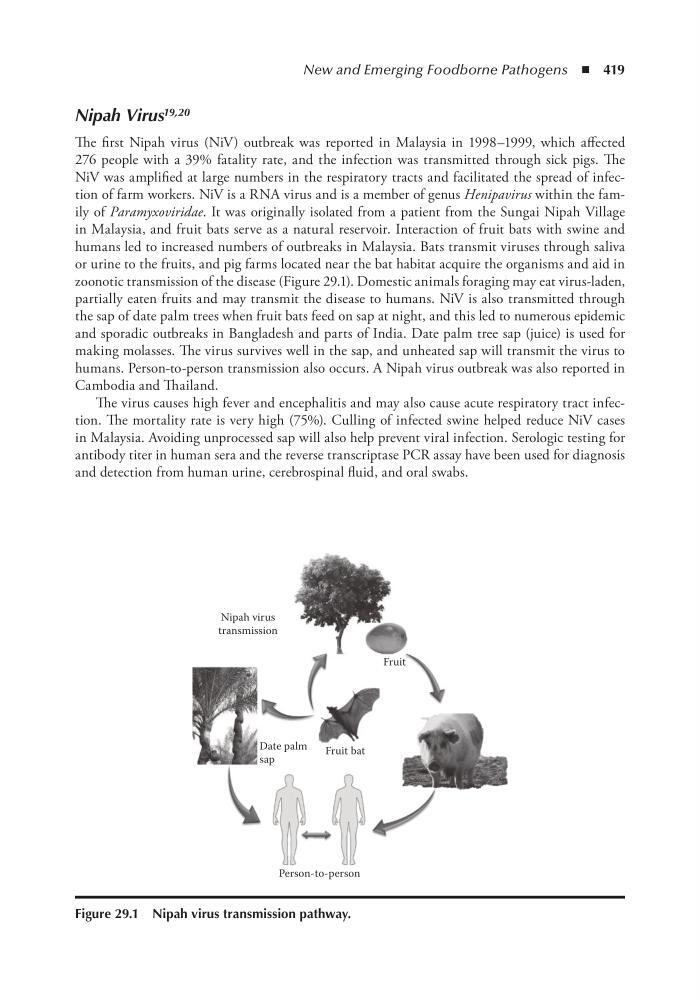
zoonotic transmission of the disease (Figure 29.1). Domestic animals foraging may eat virus-laden,
partially eaten fruits and may transmit the disease to humans. NiV is also transmitted through
the sap of date palm trees when fruit bats feed on sap at night, and this led to numerous epidemic
and sporadic outbreaks in Bangladesh and parts of India. Date palm tree sap (juice) is used for
making molasses. The virus survives well in the sap, and unheated sap will transmit the virus to
humans. Person-to-person transmission also occurs. A Nipah virus outbreak was also reported in
Cambodia and Thailand.
The virus causes high fever and encephalitis and may also cause acute respiratory tract infection. The mortality rate is very high (75%). Culling of infected swine helped reduce NiV cases
in Malaysia. Avoiding unprocessed sap will also help prevent viral infection. Serologic testing for
antibody titer in human sera and the reverse transcriptase PCR assay have been used for diagnosis
and detection from human urine, cerebrospinal fluid, and oral swabs.
Nipah virus
transmission
Fruit
Fruit bat
Date palm
sap
Person-to-person
Figure 29.1 nipah virus transmission pathway.
Nipah Virus 19,20
The first Nipah virus (NiV) outbreak was reported in Malaysia in 1998–1999, which affected
276 people with a 39% fatality rate, and the infection was transmitted through sick pigs. The
NiV was amplified at large numbers in the respiratory tracts and facilitated the spread of infection of farm workers. NiV is a RNA virus and is a member of genus Henipavirus within the family of Paramyxoviridae. It was originally isolated from a patient from the Sungai Nipah Village
in Malaysia, and fruit bats serve as a natural reservoir. Interaction of fruit bats with swine and
humans led to increased numbers of outbreaks in Malaysia. Bats transmit viruses through saliva
or urine to the fruits, and pig farms located near the bat habitat acquire the organisms and aid in
zoonotic transmission of the disease (Figure 29.1). Domestic animals foraging may eat virus-laden,
partially eaten fruits and may transmit the disease to humans. NiV is also transmitted through
the sap of date palm trees when fruit bats feed on sap at night, and this led to numerous epidemic
and sporadic outbreaks in Bangladesh and parts of India. Date palm tree sap (juice) is used for
making molasses. The virus survives well in the sap, and unheated sap will transmit the virus to
humans. Person-to-person transmission also occurs. A Nipah virus outbreak was also reported in
Cambodia and Thailand.
The virus causes high fever and encephalitis and may also cause acute respiratory tract infection. The mortality rate is very high (75%). Culling of infected swine helped reduce NiV cases
in Malaysia. Avoiding unprocessed sap will also help prevent viral infection. Serologic testing for
antibody titer in human sera and the reverse transcriptase PCR assay have been used for diagnosis
and detection from human urine, cerebrospinal fluid, and oral swabs.
Nipah virus
transmission
Fruit
Fruit bat
Date palm
sap
Person-to-person
Figure 29.1 nipah virus transmission pathway.