

Bacterial Pathogens, Mycotoxins, Viruses, Parasites, and Fish Toxins ◾ 403
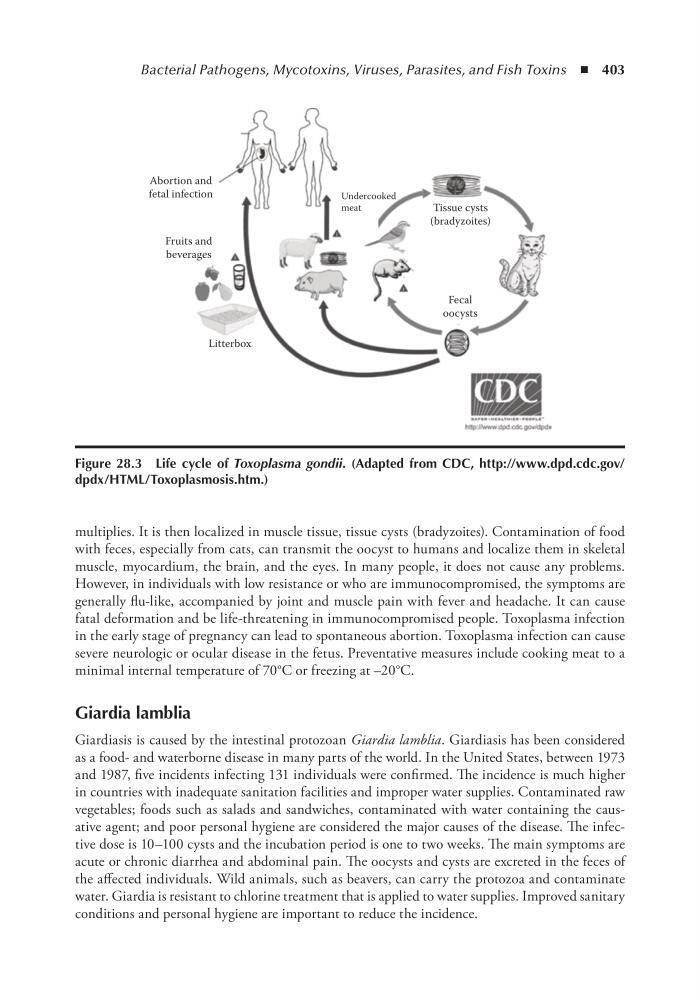
multiplies. It is then localized in muscle tissue, tissue cysts (bradyzoites). Contamination of food
with feces, especially from cats, can transmit the oocyst to humans and localize them in skeletal
muscle, myocardium, the brain, and the eyes. In many people, it does not cause any problems.
However, in individuals with low resistance or who are immunocompromised, the symptoms are
generally flu-like, accompanied by joint and muscle pain with fever and headache. It can cause
fatal deformation and be life-threatening in immunocompromised people. Toxoplasma infection
in the early stage of pregnancy can lead to spontaneous abortion. Toxoplasma infection can cause
severe neurologic or ocular disease in the fetus. Preventative measures include cooking meat to a
minimal internal temperature of 70°C or freezing at –20°C.
Giardia lamblia
Giardiasis is caused by the intestinal protozoan Giardia lamblia. Giardiasis has been considered
as a food- and waterborne disease in many parts of the world. In the United States, between 1973
and 1987, five incidents infecting 131 individuals were confirmed. The incidence is much higher
in countries with inadequate sanitation facilities and improper water supplies. Contaminated raw
vegetables; foods such as salads and sandwiches, contaminated with water containing the causative agent; and poor personal hygiene are considered the major causes of the disease. The infective dose is 10–100 cysts and the incubation period is one to two weeks. The main symptoms are
acute or chronic diarrhea and abdominal pain. The oocysts and cysts are excreted in the feces of
the affected individuals. Wild animals, such as beavers, can carry the protozoa and contaminate
water. Giardia is resistant to chlorine treatment that is applied to water supplies. Improved sanitary
conditions and personal hygiene are important to reduce the incidence.
Undercooked
meat
Tissue cysts
(bradyzoites)
Abortion and
fetal infection
Fruits and
beverages
Litterbox
Fecal
oocysts
Figure 28.3 Life cycle of Toxoplasma gondii. (Adapted from CDC, http://www.dpd.cdc.gov/
dpdx/HtML/toxoplasmosis.htm.)
multiplies. It is then localized in muscle tissue, tissue cysts (bradyzoites). Contamination of food
with feces, especially from cats, can transmit the oocyst to humans and localize them in skeletal
muscle, myocardium, the brain, and the eyes. In many people, it does not cause any problems.
However, in individuals with low resistance or who are immunocompromised, the symptoms are
generally flu-like, accompanied by joint and muscle pain with fever and headache. It can cause
fatal deformation and be life-threatening in immunocompromised people. Toxoplasma infection
in the early stage of pregnancy can lead to spontaneous abortion. Toxoplasma infection can cause
severe neurologic or ocular disease in the fetus. Preventative measures include cooking meat to a
minimal internal temperature of 70°C or freezing at –20°C.
Giardia lamblia
Giardiasis is caused by the intestinal protozoan Giardia lamblia. Giardiasis has been considered
as a food- and waterborne disease in many parts of the world. In the United States, between 1973
and 1987, five incidents infecting 131 individuals were confirmed. The incidence is much higher
in countries with inadequate sanitation facilities and improper water supplies. Contaminated raw
vegetables; foods such as salads and sandwiches, contaminated with water containing the causative agent; and poor personal hygiene are considered the major causes of the disease. The infective dose is 10–100 cysts and the incubation period is one to two weeks. The main symptoms are
acute or chronic diarrhea and abdominal pain. The oocysts and cysts are excreted in the feces of
the affected individuals. Wild animals, such as beavers, can carry the protozoa and contaminate
water. Giardia is resistant to chlorine treatment that is applied to water supplies. Improved sanitary
conditions and personal hygiene are important to reduce the incidence.
Undercooked
meat
Tissue cysts
(bradyzoites)
Abortion and
fetal infection
Fruits and
beverages
Litterbox
Fecal
oocysts
Figure 28.3 Life cycle of Toxoplasma gondii. (Adapted from CDC, http://www.dpd.cdc.gov/
dpdx/HtML/toxoplasmosis.htm.)