

Foodborne Bacterial Infections ◾ 359
foods. They are sensitive to many environmental parameters, including oxygen (in air), NaCl
(above 2.5%), low pH (below pH 5.0), temperature (below 30°C), heat (pasteurization), and drying. However, they survive well under refrigeration and for months in the frozen state.
Habitat
Cam. jejuni is an enteric organism. It has been isolated in high frequency from the feces of animals
and birds. Human carriers were also found to shed the organisms in feces. Fecal materials from
poultry were found to contain ≥10 6 cells/g in some instances. Water, sewage, vegetables, and foods
of animal origin are easily contaminated with Cam. jejuni excreted through feces.
Pathogenic Factors and Toxins 33
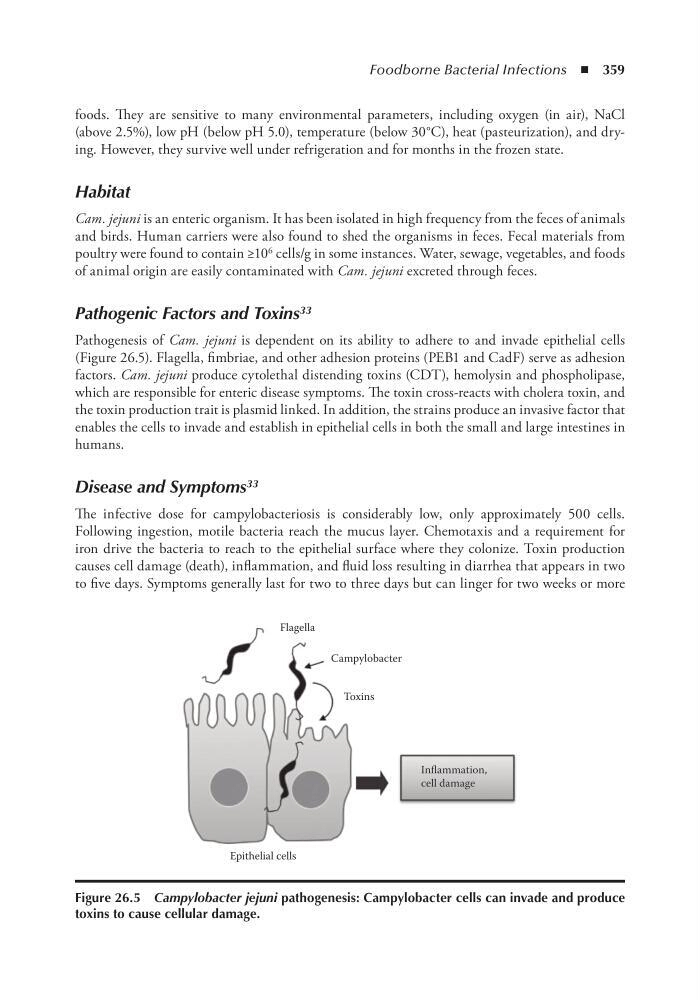
Pathogenesis of Cam. jejuni is dependent on its ability to adhere to and invade epithelial cells
(Figure 26.5). Flagella, fimbriae, and other adhesion proteins (PEB1 and CadF) serve as adhesion
factors. Cam. jejuni produce cytolethal distending toxins (CDT), hemolysin and phospholipase,
which are responsible for enteric disease symptoms. The toxin cross-reacts with cholera toxin, and
the toxin production trait is plasmid linked. In addition, the strains produce an invasive factor that
enables the cells to invade and establish in epithelial cells in both the small and large intestines in
humans.
Disease and Symptoms 33
The infective dose for campylobacteriosis is considerably low, only approximately 500 cells.
Following ingestion, motile bacteria reach the mucus layer. Chemotaxis and a requirement for
iron drive the bacteria to reach to the epithelial surface where they colonize. Toxin production
causes cell damage (death), inflammation, and fluid loss resulting in diarrhea that appears in two
to five days. Symptoms generally last for two to three days but can linger for two weeks or more
Flagella
Campylobacter
Toxins
Inflammation,
cell damage
Epithelial cells
Figure 26.5 Campylobacter jejuni pathogenesis: Campylobacter cells can invade and produce
toxins to cause cellular damage.
foods. They are sensitive to many environmental parameters, including oxygen (in air), NaCl
(above 2.5%), low pH (below pH 5.0), temperature (below 30°C), heat (pasteurization), and drying. However, they survive well under refrigeration and for months in the frozen state.
Habitat
Cam. jejuni is an enteric organism. It has been isolated in high frequency from the feces of animals
and birds. Human carriers were also found to shed the organisms in feces. Fecal materials from
poultry were found to contain ≥10 6 cells/g in some instances. Water, sewage, vegetables, and foods
of animal origin are easily contaminated with Cam. jejuni excreted through feces.
Pathogenic Factors and Toxins 33
Pathogenesis of Cam. jejuni is dependent on its ability to adhere to and invade epithelial cells
(Figure 26.5). Flagella, fimbriae, and other adhesion proteins (PEB1 and CadF) serve as adhesion
factors. Cam. jejuni produce cytolethal distending toxins (CDT), hemolysin and phospholipase,
which are responsible for enteric disease symptoms. The toxin cross-reacts with cholera toxin, and
the toxin production trait is plasmid linked. In addition, the strains produce an invasive factor that
enables the cells to invade and establish in epithelial cells in both the small and large intestines in
humans.
Disease and Symptoms 33
The infective dose for campylobacteriosis is considerably low, only approximately 500 cells.
Following ingestion, motile bacteria reach the mucus layer. Chemotaxis and a requirement for
iron drive the bacteria to reach to the epithelial surface where they colonize. Toxin production
causes cell damage (death), inflammation, and fluid loss resulting in diarrhea that appears in two
to five days. Symptoms generally last for two to three days but can linger for two weeks or more
Flagella
Campylobacter
Toxins
Inflammation,
cell damage
Epithelial cells
Figure 26.5 Campylobacter jejuni pathogenesis: Campylobacter cells can invade and produce
toxins to cause cellular damage.