

Foodborne Bacterial Infections ◾ 357
Disease and Symptoms
The infective dose is very low, approximately 10 cells in adults. Bacteria, after ingestion with contaminated food or beverages, pass through the stomach and small intestine and reach the large
intestine. The disease is restricted to the intestinal mucosa and invades the epithelial cells of the
colon. Shigellae are also taken up by M cells in the Peyer’s patch, which also facilitate invasion.
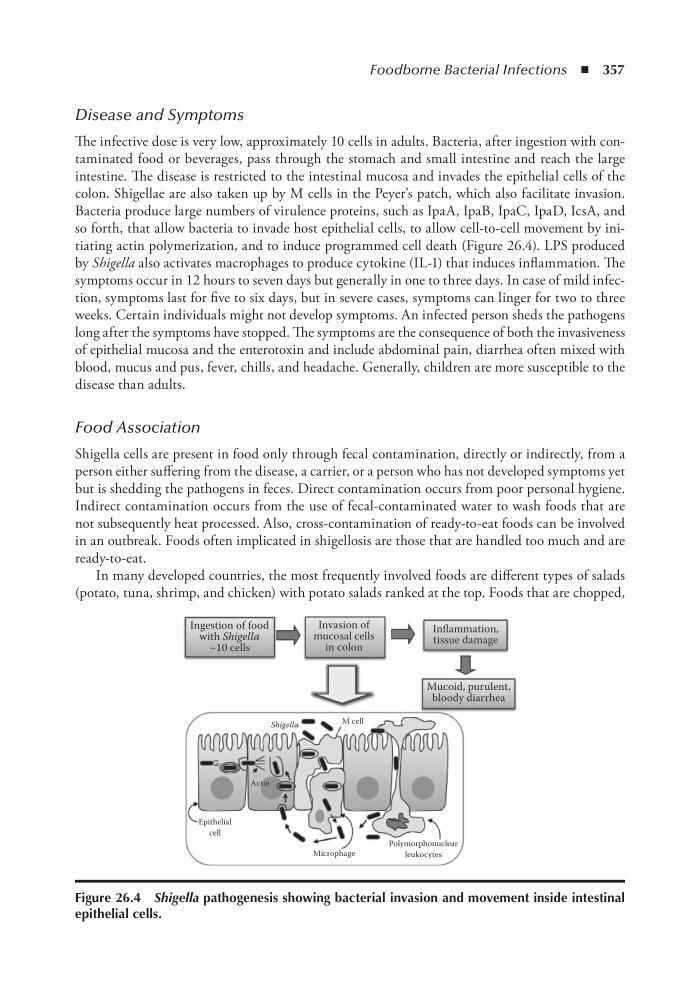
Bacteria produce large numbers of virulence proteins, such as IpaA, IpaB, IpaC, IpaD, IcsA, and
so forth, that allow bacteria to invade host epithelial cells, to allow cell-to-cell movement by initiating actin polymerization, and to induce programmed cell death (Figure 26.4). LPS produced
by Shigella also activates macrophages to produce cytokine (IL-1) that induces inflammation. The
symptoms occur in 12 hours to seven days but generally in one to three days. In case of mild infection, symptoms last for five to six days, but in severe cases, symptoms can linger for two to three
weeks. Certain individuals might not develop symptoms. An infected person sheds the pathogens
long after the symptoms have stopped. The symptoms are the consequence of both the invasiveness
of epithelial mucosa and the enterotoxin and include abdominal pain, diarrhea often mixed with
blood, mucus and pus, fever, chills, and headache. Generally, children are more susceptible to the
disease than adults.
Food Association
Shigella cells are present in food only through fecal contamination, directly or indirectly, from a
person either suffering from the disease, a carrier, or a person who has not developed symptoms yet
but is shedding the pathogens in feces. Direct contamination occurs from poor personal hygiene.
Indirect contamination occurs from the use of fecal-contaminated water to wash foods that are
not subsequently heat processed. Also, cross-contamination of ready-to-eat foods can be involved
in an outbreak. Foods often implicated in shigellosis are those that are handled too much and are
ready-to-eat.
In many developed countries, the most frequently involved foods are different types of salads
(potato, tuna, shrimp, and chicken) with potato salads ranked at the top. Foods that are chopped,
Ingestion of food
with Shigella
~10 cells
Shigella
M cell
Actin
Epithelial
cell
Microphage
Polymorphonuclear
leukocytes
Mucoid, purulent,
bloody diarrhea
Invasion of
mucosal cells
in colon
Inflammation,
tissue damage
Figure 26.4 Shigella pathogenesis showing bacterial invasion and movement inside intestinal
epithelial cells.
Disease and Symptoms
The infective dose is very low, approximately 10 cells in adults. Bacteria, after ingestion with contaminated food or beverages, pass through the stomach and small intestine and reach the large
intestine. The disease is restricted to the intestinal mucosa and invades the epithelial cells of the
colon. Shigellae are also taken up by M cells in the Peyer’s patch, which also facilitate invasion.
Bacteria produce large numbers of virulence proteins, such as IpaA, IpaB, IpaC, IpaD, IcsA, and
so forth, that allow bacteria to invade host epithelial cells, to allow cell-to-cell movement by initiating actin polymerization, and to induce programmed cell death (Figure 26.4). LPS produced
by Shigella also activates macrophages to produce cytokine (IL-1) that induces inflammation. The
symptoms occur in 12 hours to seven days but generally in one to three days. In case of mild infection, symptoms last for five to six days, but in severe cases, symptoms can linger for two to three
weeks. Certain individuals might not develop symptoms. An infected person sheds the pathogens
long after the symptoms have stopped. The symptoms are the consequence of both the invasiveness
of epithelial mucosa and the enterotoxin and include abdominal pain, diarrhea often mixed with
blood, mucus and pus, fever, chills, and headache. Generally, children are more susceptible to the
disease than adults.
Food Association
Shigella cells are present in food only through fecal contamination, directly or indirectly, from a
person either suffering from the disease, a carrier, or a person who has not developed symptoms yet
but is shedding the pathogens in feces. Direct contamination occurs from poor personal hygiene.
Indirect contamination occurs from the use of fecal-contaminated water to wash foods that are
not subsequently heat processed. Also, cross-contamination of ready-to-eat foods can be involved
in an outbreak. Foods often implicated in shigellosis are those that are handled too much and are
ready-to-eat.
In many developed countries, the most frequently involved foods are different types of salads
(potato, tuna, shrimp, and chicken) with potato salads ranked at the top. Foods that are chopped,
Ingestion of food
with Shigella
~10 cells
Shigella
M cell
Actin
Epithelial
cell
Microphage
Polymorphonuclear
leukocytes
Mucoid, purulent,
bloody diarrhea
Invasion of
mucosal cells
in colon
Inflammation,
tissue damage
Figure 26.4 Shigella pathogenesis showing bacterial invasion and movement inside intestinal
epithelial cells.