

Foodborne Bacterial Infections ◾ 345
from 2000 cases per year in 1986 to about 1000 cases per year in 1991. Now, an estimated 1600
cases with 255 deaths are reported per year with a fatality rate of 16%. The infectious dose for
this pathogen varies between individuals, with the immunosuppressed being most susceptible.
Because this pathogen is highly infectious, there is no study done with volunteer feeding trials to
establish an infectious dose. On the basis of the epidemiological data, it is estimated to be in the
range of 100–1000 cells in an immunocompromised host, and because of its high fatality rate, the
U.S. government has established a zero-tolerance policy for this pathogen in ready-to-eat products.
In Canada and some European countries, the acceptance level is 100 cells per 25 g ready-to-eat
product. In healthy individuals, the disease is less severe and is manifested as febrile gastroenteritis, and a dose of 10 8 –10 10 cells is required to cause such disease.
Classification
The genus Listeria contains six species, including Lis. monocytogenes, Lis. ivanovii, Lis. seeligeri, Lis.
innocua, Lis. welshimeri, and Lis. grayi. Three new species have been added to the genus Listeria
since 2010: Lis. marthii, Lis. rocourtiae and Lis. weihenstephanensis. Lis. monocytogenes is considered
to be pathogenic to humans and animals, and Lis. ivanovii is pathogenic only to animals, primarily the ruminants (cattle and sheep); however, it caused disease in humans in recent outbreaks.
The remainder species in the genus are considered nonpathogenic. Lis. monocytogenes is comprised
of 13 serogroups: 1/2a, 1/2b, 1/2c, 3a, 3b, 3c, 4a, 4b, 4c, 4d, 4e, 4ab, and 7. While 1/2a and 1/2b
were the predominant serogroups isolated in foodborne human listeriosis in Europe, 4b was predominant in Canada and the United States. Lis. monocytogenes again is grouped into three distinct
lineages (I, II, III) based on their genetic fingerprint patterns and pathogenic potential. Lineage
I contains primarily epidemic clones and is responsible for most outbreaks; lineage II contains
clones that are responsible for sporadic human disease, and lineage III contains clones that rarely
cause human disease but may be responsible for animal listeriosis. Lineage III is again subdivided
into IIIA and IIIB; IIIA is rhamnose-positive and IIIB is rhamnose-negative. Thirteen serogroups
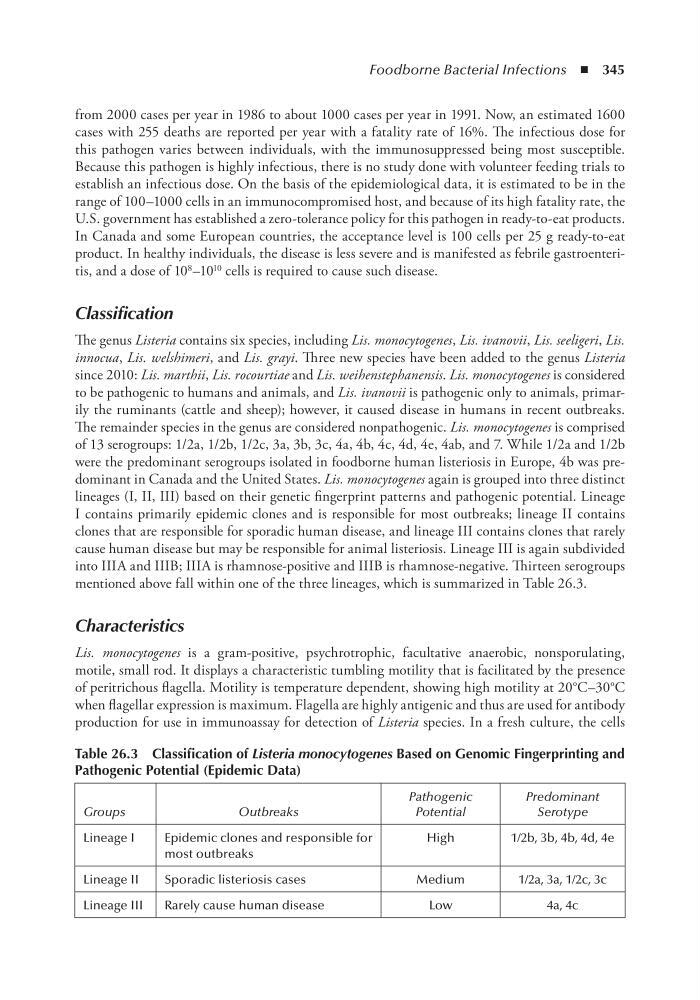
mentioned above fall within one of the three lineages, which is summarized in Table 26.3.
Characteristics
Lis. monocytogenes is a gram-positive, psychrotrophic, facultative anaerobic, nonsporulating,
motile, small rod. It displays a characteristic tumbling motility that is facilitated by the presence
of peritrichous flagella. Motility is temperature dependent, showing high motility at 20°C–30°C
when flagellar expression is maximum. Flagella are highly antigenic and thus are used for antibody
production for use in immunoassay for detection of Listeria species. In a fresh culture, the cells
table 26.3 Classification of Listeria monocytogenes Based on Genomic Fingerprinting and
Pathogenic Potential (epidemic Data)
Groups
Outbreaks
Pathogenic
Potential
Predominant
Serotype
Lineage I
Epidemic clones and responsible for
most outbreaks
High
1/2b, 3b, 4b, 4d, 4e
Lineage II
Sporadic listeriosis cases
Medium
1/2a, 3a, 1/2c, 3c
Lineage III
Rarely cause human disease
Low
4a, 4c
from 2000 cases per year in 1986 to about 1000 cases per year in 1991. Now, an estimated 1600
cases with 255 deaths are reported per year with a fatality rate of 16%. The infectious dose for
this pathogen varies between individuals, with the immunosuppressed being most susceptible.
Because this pathogen is highly infectious, there is no study done with volunteer feeding trials to
establish an infectious dose. On the basis of the epidemiological data, it is estimated to be in the
range of 100–1000 cells in an immunocompromised host, and because of its high fatality rate, the
U.S. government has established a zero-tolerance policy for this pathogen in ready-to-eat products.
In Canada and some European countries, the acceptance level is 100 cells per 25 g ready-to-eat
product. In healthy individuals, the disease is less severe and is manifested as febrile gastroenteritis, and a dose of 10 8 –10 10 cells is required to cause such disease.
Classification
The genus Listeria contains six species, including Lis. monocytogenes, Lis. ivanovii, Lis. seeligeri, Lis.
innocua, Lis. welshimeri, and Lis. grayi. Three new species have been added to the genus Listeria
since 2010: Lis. marthii, Lis. rocourtiae and Lis. weihenstephanensis. Lis. monocytogenes is considered
to be pathogenic to humans and animals, and Lis. ivanovii is pathogenic only to animals, primarily the ruminants (cattle and sheep); however, it caused disease in humans in recent outbreaks.
The remainder species in the genus are considered nonpathogenic. Lis. monocytogenes is comprised
of 13 serogroups: 1/2a, 1/2b, 1/2c, 3a, 3b, 3c, 4a, 4b, 4c, 4d, 4e, 4ab, and 7. While 1/2a and 1/2b
were the predominant serogroups isolated in foodborne human listeriosis in Europe, 4b was predominant in Canada and the United States. Lis. monocytogenes again is grouped into three distinct
lineages (I, II, III) based on their genetic fingerprint patterns and pathogenic potential. Lineage
I contains primarily epidemic clones and is responsible for most outbreaks; lineage II contains
clones that are responsible for sporadic human disease, and lineage III contains clones that rarely
cause human disease but may be responsible for animal listeriosis. Lineage III is again subdivided
into IIIA and IIIB; IIIA is rhamnose-positive and IIIB is rhamnose-negative. Thirteen serogroups
mentioned above fall within one of the three lineages, which is summarized in Table 26.3.
Characteristics
Lis. monocytogenes is a gram-positive, psychrotrophic, facultative anaerobic, nonsporulating,
motile, small rod. It displays a characteristic tumbling motility that is facilitated by the presence
of peritrichous flagella. Motility is temperature dependent, showing high motility at 20°C–30°C
when flagellar expression is maximum. Flagella are highly antigenic and thus are used for antibody
production for use in immunoassay for detection of Listeria species. In a fresh culture, the cells
table 26.3 Classification of Listeria monocytogenes Based on Genomic Fingerprinting and
Pathogenic Potential (epidemic Data)
Groups
Outbreaks
Pathogenic
Potential
Predominant
Serotype
Lineage I
Epidemic clones and responsible for
most outbreaks
High
1/2b, 3b, 4b, 4d, 4e
Lineage II
Sporadic listeriosis cases
Medium
1/2a, 3a, 1/2c, 3c
Lineage III
Rarely cause human disease
Low
4a, 4c