

330 ◾ Fundamental Food Microbiology
can be contaminated with spores from soil; fish from water and sediments, and various other
foods can be contaminated from many of the above sources. While types A and B spores are more
prevalent in soil, sewage, and fecal matters of animals, type E spores are generally found in marine
environments. Type A spores are predominant in the western United States, and type B spores are
found predominantly in the eastern United States and different parts of the world.
Toxins and Toxin Production
The botulinum neurontoxin (BoNT) is a 150 kDa protein toxin produced by Clo. botulinum. It is
an A-B type toxin consisting of two subunits: A subunit is 50 kDa, and B is 100 kDa. The toxin is
produced as a large derivative toxin, which is inactive. Bacterial or stomach protease converts the
inactive toxin to its active form. BoNT produced by nonproteolytic strains are activated by host protease (trypsin) in the digestive tract, whereas BoNT from proteolytic strain is activated by bacterial
protease. In general, toxins associated with food intoxication in humans (types A, B, E, and F) are
extremely potent, and only a small amount of toxin is required to produce the symptoms and death.
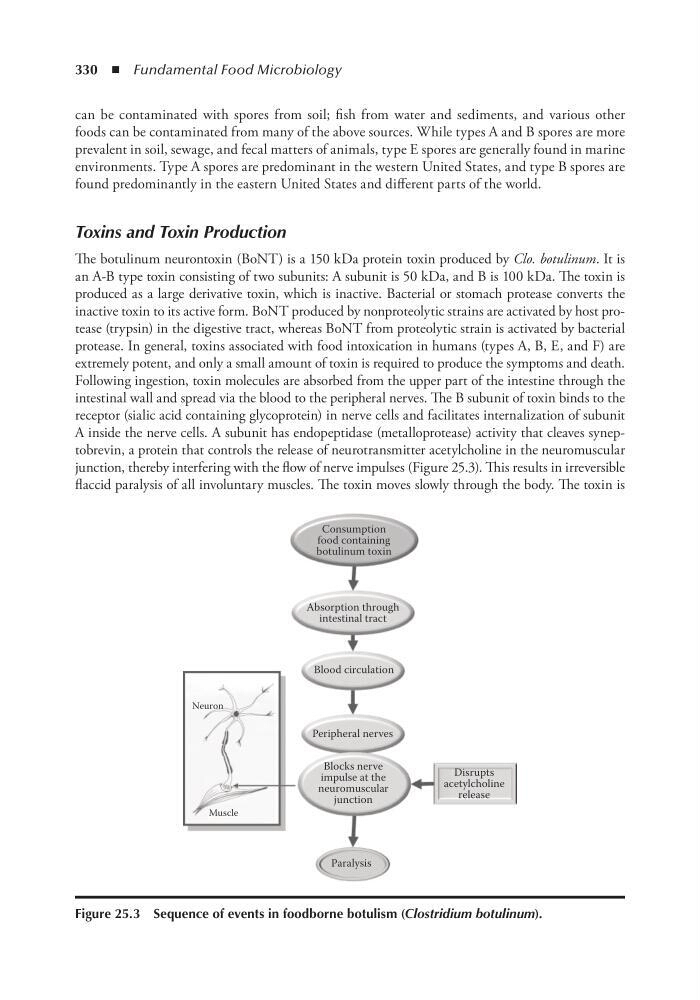
Following ingestion, toxin molecules are absorbed from the upper part of the intestine through the
intestinal wall and spread via the blood to the peripheral nerves. The B subunit of toxin binds to the
receptor (sialic acid containing glycoprotein) in nerve cells and facilitates internalization of subunit
A inside the nerve cells. A subunit has endopeptidase (metalloprotease) activity that cleaves syneptobrevin, a protein that controls the release of neurotransmitter acetylcholine in the neuromuscular
junction, thereby interfering with the flow of nerve impulses (Figure 25.3). This results in irreversible
flaccid paralysis of all involuntary muscles. The toxin moves slowly through the body. The toxin is
Consumption
food containing
botulinum toxin
Absorption through
intestinal tract
Blood circulation
Peripheral nerves
Blocks nerve
impulse at the
neuromuscular
junction
Paralysis
Disrupts
acetylcholine
release
Muscle
Neuron
Figure 25.3 Sequence of events in foodborne botulism (Clostridium botulinum).
can be contaminated with spores from soil; fish from water and sediments, and various other
foods can be contaminated from many of the above sources. While types A and B spores are more
prevalent in soil, sewage, and fecal matters of animals, type E spores are generally found in marine
environments. Type A spores are predominant in the western United States, and type B spores are
found predominantly in the eastern United States and different parts of the world.
Toxins and Toxin Production
The botulinum neurontoxin (BoNT) is a 150 kDa protein toxin produced by Clo. botulinum. It is
an A-B type toxin consisting of two subunits: A subunit is 50 kDa, and B is 100 kDa. The toxin is
produced as a large derivative toxin, which is inactive. Bacterial or stomach protease converts the
inactive toxin to its active form. BoNT produced by nonproteolytic strains are activated by host protease (trypsin) in the digestive tract, whereas BoNT from proteolytic strain is activated by bacterial
protease. In general, toxins associated with food intoxication in humans (types A, B, E, and F) are
extremely potent, and only a small amount of toxin is required to produce the symptoms and death.
Following ingestion, toxin molecules are absorbed from the upper part of the intestine through the
intestinal wall and spread via the blood to the peripheral nerves. The B subunit of toxin binds to the
receptor (sialic acid containing glycoprotein) in nerve cells and facilitates internalization of subunit
A inside the nerve cells. A subunit has endopeptidase (metalloprotease) activity that cleaves syneptobrevin, a protein that controls the release of neurotransmitter acetylcholine in the neuromuscular
junction, thereby interfering with the flow of nerve impulses (Figure 25.3). This results in irreversible
flaccid paralysis of all involuntary muscles. The toxin moves slowly through the body. The toxin is
Consumption
food containing
botulinum toxin
Absorption through
intestinal tract
Blood circulation
Peripheral nerves
Blocks nerve
impulse at the
neuromuscular
junction
Paralysis
Disrupts
acetylcholine
release
Muscle
Neuron
Figure 25.3 Sequence of events in foodborne botulism (Clostridium botulinum).