

324 ◾ Fundamental Food Microbiology
poisoning outbreaks has declined. CDC reports indicate that during 1972 to 1976, it was associated with 21.4% of the foodborne disease outbreaks affecting 29.7% of total cases; in contrast,
between 1983 and 1987, there were 5.2% staphylococcal foodborne outbreaks affecting 5.8%
of the cases with no deaths. This decline is probably a reflection of the better use of refrigerated
temperatures to store food and improved sanitary practices that can control contamination and
growth of Sta. aureus. Even then, the number of outbreaks and number of cases of staphylococcal
gastroenteritis is much higher than several other microbial foodborne disease outbreaks. In 2011,
the CDC reported that Sta. aureus is responsible for about 240 cases with six deaths annually in the
United States. 2 The European Food Safety Authority (EFSA) reported that in 2009 there were 293
outbreaks caused by Staphylococcus spp. and bacterial toxins (produced by Bacillus, Clostridium,
and Staphylococcus), which were the fourth most common causative agent in foodborne outbreaks.
Characteristics of Staphylococcus aureus 1,3
Organisms
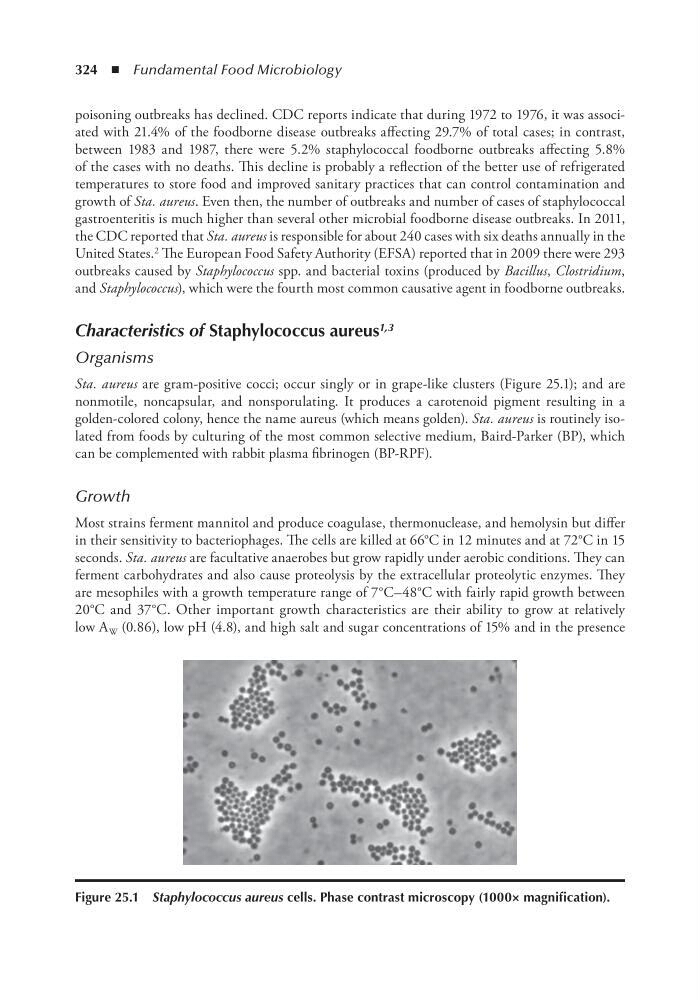
Sta. aureus are gram-positive cocci; occur singly or in grape-like clusters (Figure 25.1); and are
nonmotile, noncapsular, and nonsporulating. It produces a carotenoid pigment resulting in a
golden-colored colony, hence the name aureus (which means golden). Sta. aureus is routinely isolated from foods by culturing of the most common selective medium, Baird-Parker (BP), which
can be complemented with rabbit plasma fibrinogen (BP-RPF).
Growth
Most strains ferment mannitol and produce coagulase, thermonuclease, and hemolysin but differ
in their sensitivity to bacteriophages. The cells are killed at 66°C in 12 minutes and at 72°C in 15
seconds. Sta. aureus are facultative anaerobes but grow rapidly under aerobic conditions. They can
ferment carbohydrates and also cause proteolysis by the extracellular proteolytic enzymes. They
are mesophiles with a growth temperature range of 7°C–48°C with fairly rapid growth between
20°C and 37°C. Other important growth characteristics are their ability to grow at relatively
low A W (0.86), low pH (4.8), and high salt and sugar concentrations of 15% and in the presence
Figure 25.1 Staphylococcus aureus cells. Phase contrast microscopy (1000× magnification).
poisoning outbreaks has declined. CDC reports indicate that during 1972 to 1976, it was associated with 21.4% of the foodborne disease outbreaks affecting 29.7% of total cases; in contrast,
between 1983 and 1987, there were 5.2% staphylococcal foodborne outbreaks affecting 5.8%
of the cases with no deaths. This decline is probably a reflection of the better use of refrigerated
temperatures to store food and improved sanitary practices that can control contamination and
growth of Sta. aureus. Even then, the number of outbreaks and number of cases of staphylococcal
gastroenteritis is much higher than several other microbial foodborne disease outbreaks. In 2011,
the CDC reported that Sta. aureus is responsible for about 240 cases with six deaths annually in the
United States. 2 The European Food Safety Authority (EFSA) reported that in 2009 there were 293
outbreaks caused by Staphylococcus spp. and bacterial toxins (produced by Bacillus, Clostridium,
and Staphylococcus), which were the fourth most common causative agent in foodborne outbreaks.
Characteristics of Staphylococcus aureus 1,3
Organisms
Sta. aureus are gram-positive cocci; occur singly or in grape-like clusters (Figure 25.1); and are
nonmotile, noncapsular, and nonsporulating. It produces a carotenoid pigment resulting in a
golden-colored colony, hence the name aureus (which means golden). Sta. aureus is routinely isolated from foods by culturing of the most common selective medium, Baird-Parker (BP), which
can be complemented with rabbit plasma fibrinogen (BP-RPF).
Growth
Most strains ferment mannitol and produce coagulase, thermonuclease, and hemolysin but differ
in their sensitivity to bacteriophages. The cells are killed at 66°C in 12 minutes and at 72°C in 15
seconds. Sta. aureus are facultative anaerobes but grow rapidly under aerobic conditions. They can
ferment carbohydrates and also cause proteolysis by the extracellular proteolytic enzymes. They
are mesophiles with a growth temperature range of 7°C–48°C with fairly rapid growth between
20°C and 37°C. Other important growth characteristics are their ability to grow at relatively
low A W (0.86), low pH (4.8), and high salt and sugar concentrations of 15% and in the presence
Figure 25.1 Staphylococcus aureus cells. Phase contrast microscopy (1000× magnification).