

310 ◾ Fundamental Food Microbiology
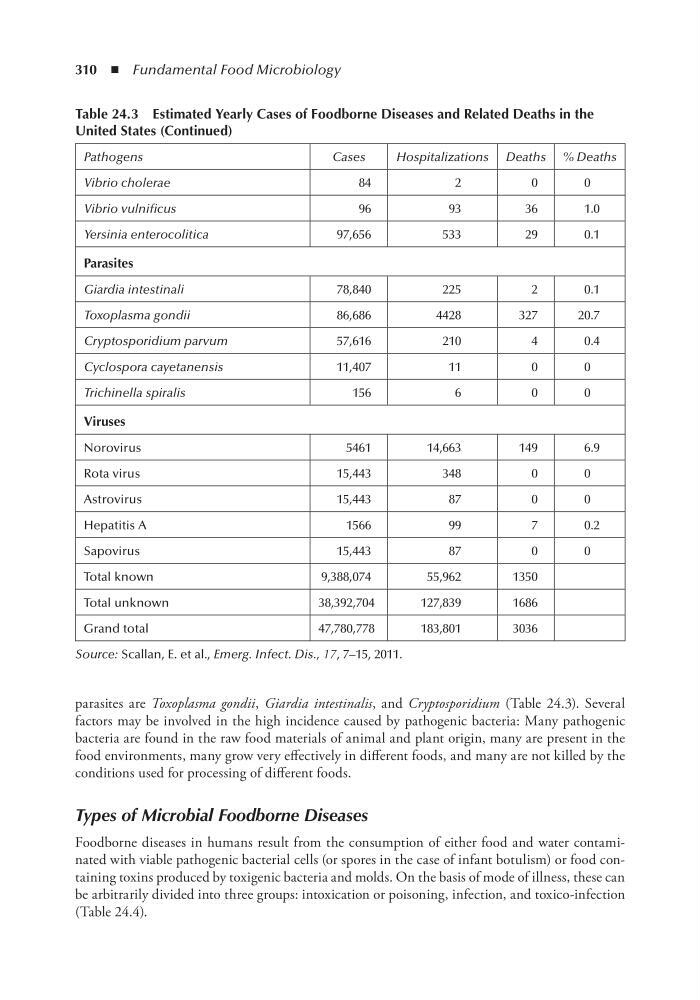
parasites are Toxoplasma gondii, Giardia intestinalis, and Cryptosporidium (Table 24.3). Several
factors may be involved in the high incidence caused by pathogenic bacteria: Many pathogenic
bacteria are found in the raw food materials of animal and plant origin, many are present in the
food environments, many grow very effectively in different foods, and many are not killed by the
conditions used for processing of different foods.
Types of Microbial Foodborne Diseases
Foodborne diseases in humans result from the consumption of either food and water contaminated with viable pathogenic bacterial cells (or spores in the case of infant botulism) or food containing toxins produced by toxigenic bacteria and molds. On the basis of mode of illness, these can
be arbitrarily divided into three groups: intoxication or poisoning, infection, and toxico-infection
(Table 24.4).
table 24.3 estimated Yearly Cases of Foodborne Diseases and Related Deaths in the
United States (Continued)
Pathogens
Cases
Hospitalizations Deaths % Deaths
Vibrio cholerae
84
2
0
0
Vibrio vulnificus
96
93
36
1.0
Yersinia enterocolitica
97,656
533
29
0.1
Parasites
Giardia intestinali
78,840
225
2
0.1
Toxoplasma gondii
86,686
4428
327
20.7
Cryptosporidium parvum
57,616
210
4
0.4
Cyclospora cayetanensis
11,407
11
0
0
Trichinella spiralis
156
6
0
0
Viruses
Norovirus
5461
14,663
149
6.9
Rota virus
15,443
348
0
0
Astrovirus
15,443
87
0
0
Hepatitis A
1566
99
7
0.2
Sapovirus
15,443
87
0
0
Total known
9,388,074
55,962
1350
Total unknown
38,392,704
127,839
1686
Grand total
47,780,778
183,801
3036
Source: Scallan, E. et al., Emerg. Infect. Dis., 17, 7–15, 2011.
parasites are Toxoplasma gondii, Giardia intestinalis, and Cryptosporidium (Table 24.3). Several
factors may be involved in the high incidence caused by pathogenic bacteria: Many pathogenic
bacteria are found in the raw food materials of animal and plant origin, many are present in the
food environments, many grow very effectively in different foods, and many are not killed by the
conditions used for processing of different foods.
Types of Microbial Foodborne Diseases
Foodborne diseases in humans result from the consumption of either food and water contaminated with viable pathogenic bacterial cells (or spores in the case of infant botulism) or food containing toxins produced by toxigenic bacteria and molds. On the basis of mode of illness, these can
be arbitrarily divided into three groups: intoxication or poisoning, infection, and toxico-infection
(Table 24.4).
table 24.3 estimated Yearly Cases of Foodborne Diseases and Related Deaths in the
United States (Continued)
Pathogens
Cases
Hospitalizations Deaths % Deaths
Vibrio cholerae
84
2
0
0
Vibrio vulnificus
96
93
36
1.0
Yersinia enterocolitica
97,656
533
29
0.1
Parasites
Giardia intestinali
78,840
225
2
0.1
Toxoplasma gondii
86,686
4428
327
20.7
Cryptosporidium parvum
57,616
210
4
0.4
Cyclospora cayetanensis
11,407
11
0
0
Trichinella spiralis
156
6
0
0
Viruses
Norovirus
5461
14,663
149
6.9
Rota virus
15,443
348
0
0
Astrovirus
15,443
87
0
0
Hepatitis A
1566
99
7
0.2
Sapovirus
15,443
87
0
0
Total known
9,388,074
55,962
1350
Total unknown
38,392,704
127,839
1686
Grand total
47,780,778
183,801
3036
Source: Scallan, E. et al., Emerg. Infect. Dis., 17, 7–15, 2011.