

New Food Spoilage Bacteria in Refrigerated Foods ◾ 277
cells were Gram-positive. The rod-shaped bacterium was suspected to be a Clostridium species but
could not be cultured in agar and broth media recommended for Clostridium spp. Later, it was
purified by heating the purge (from the package of 12-week-old spoiled meat containing spores)
at 80°C (176°F) for 10 min and culturing the material at 15°C in a broth under anaerobic conditions. Biochemical studies revealed it to be a new species, and it was designated Clo. laramie NK1
(ATCC 51254). The cells are extremely sensitive to oxygen and grow optimally under a good
anaerobic environment at 12°C–15°C (53.6°F–59°F) with a growth temperature range of –2°C to
22°C. The species can sporulate and germinate at 2°C (35.6°F).
Inoculation of raw beef with these spores followed by vacuum packaging and refrigeration
storage caused the samples to develop similar characteristics, and the purge had the Clostridium
cells. A limited in-plant sampling was done from the slaughtering area to the conveyor systems
(a)
(c)
(b)
(d)
(e)
(f )
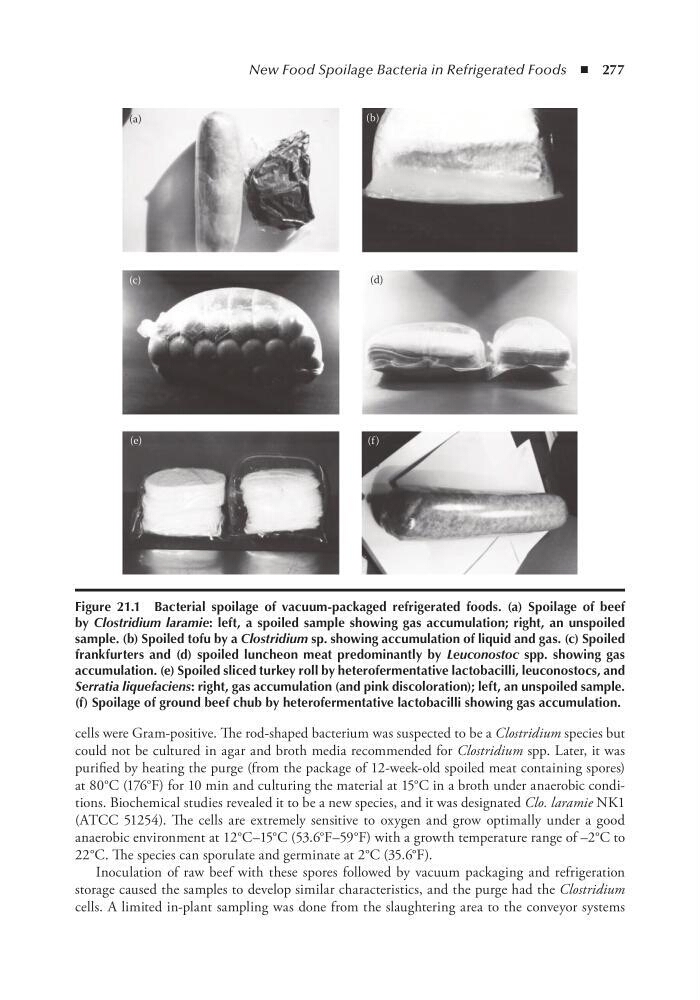
Figure 21.1 Bacterial spoilage of vacuum-packaged refrigerated foods. (a) Spoilage of beef
by Clostridium laramie: left, a spoiled sample showing gas accumulation; right, an unspoiled
sample. (b) Spoiled tofu by a Clostridium sp. showing accumulation of liquid and gas. (c) Spoiled
frankfurters and (d) spoiled luncheon meat predominantly by Leuconostoc spp. showing gas
accumulation. (e) Spoiled sliced turkey roll by heterofermentative lactobacilli, leuconostocs, and
Serratia liquefaciens: right, gas accumulation (and pink discoloration); left, an unspoiled sample.
(f) Spoilage of ground beef chub by heterofermentative lactobacilli showing gas accumulation.
cells were Gram-positive. The rod-shaped bacterium was suspected to be a Clostridium species but
could not be cultured in agar and broth media recommended for Clostridium spp. Later, it was
purified by heating the purge (from the package of 12-week-old spoiled meat containing spores)
at 80°C (176°F) for 10 min and culturing the material at 15°C in a broth under anaerobic conditions. Biochemical studies revealed it to be a new species, and it was designated Clo. laramie NK1
(ATCC 51254). The cells are extremely sensitive to oxygen and grow optimally under a good
anaerobic environment at 12°C–15°C (53.6°F–59°F) with a growth temperature range of –2°C to
22°C. The species can sporulate and germinate at 2°C (35.6°F).
Inoculation of raw beef with these spores followed by vacuum packaging and refrigeration
storage caused the samples to develop similar characteristics, and the purge had the Clostridium
cells. A limited in-plant sampling was done from the slaughtering area to the conveyor systems
(a)
(c)
(b)
(d)
(e)
(f )
Figure 21.1 Bacterial spoilage of vacuum-packaged refrigerated foods. (a) Spoilage of beef
by Clostridium laramie: left, a spoiled sample showing gas accumulation; right, an unspoiled
sample. (b) Spoiled tofu by a Clostridium sp. showing accumulation of liquid and gas. (c) Spoiled
frankfurters and (d) spoiled luncheon meat predominantly by Leuconostoc spp. showing gas
accumulation. (e) Spoiled sliced turkey roll by heterofermentative lactobacilli, leuconostocs, and
Serratia liquefaciens: right, gas accumulation (and pink discoloration); left, an unspoiled sample.
(f) Spoilage of ground beef chub by heterofermentative lactobacilli showing gas accumulation.