

Spoilage of Specific Food Groups ◾ 269
Thus, these products are called commercially sterile (instead of sterile, which means free of any living organism) foods. The spores that survive the heat treatment designed to destroy Clo. botulinum
spores are thermophilic spores and can germinate at 43°C and above. However, once germinated,
some can outgrow at temperatures as low as 30°C. The other food group, designated as a low-pH
or high-acid food with a pH below 4.6, is heat treated to kill all vegetative cells and some spores.
Although low pH inhibits germination of spores and subsequent growth of Clo. botulinum, spores
of some aciduric thermophilic spoilage bacteria can germinate and grow when the products are
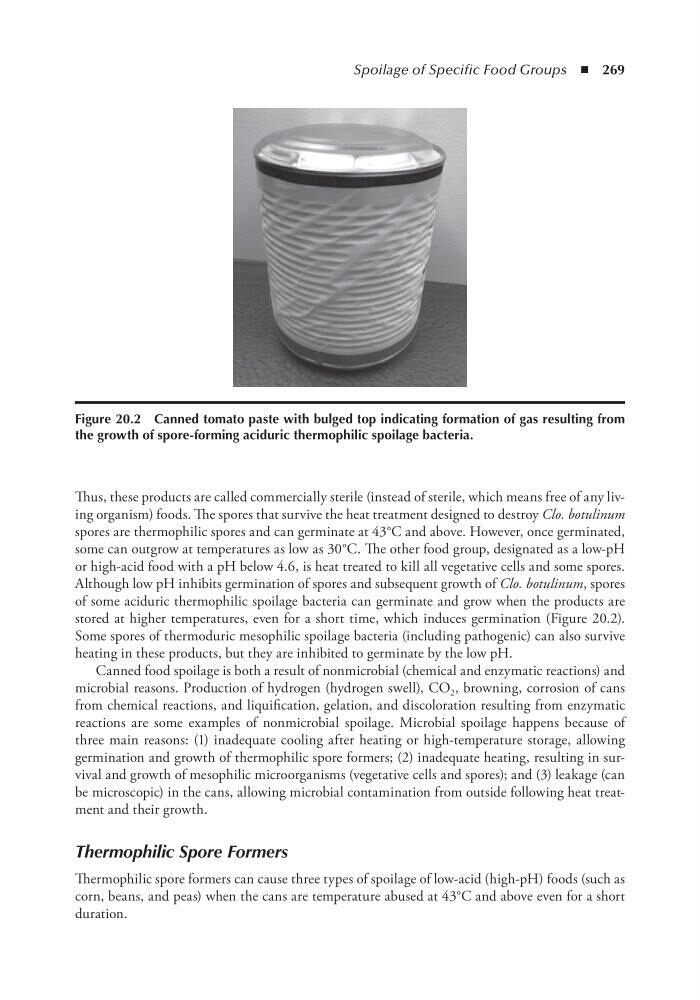
stored at higher temperatures, even for a short time, which induces germination (Figure 20.2).
Some spores of thermoduric mesophilic spoilage bacteria (including pathogenic) can also survive
heating in these products, but they are inhibited to germinate by the low pH.
Canned food spoilage is both a result of nonmicrobial (chemical and enzymatic reactions) and
microbial reasons. Production of hydrogen (hydrogen swell), CO 2 , browning, corrosion of cans
from chemical reactions, and liquification, gelation, and discoloration resulting from enzymatic
reactions are some examples of nonmicrobial spoilage. Microbial spoilage happens because of
three main reasons: (1) inadequate cooling after heating or high-temperature storage, allowing
germination and growth of thermophilic spore formers; (2) inadequate heating, resulting in survival and growth of mesophilic microorganisms (vegetative cells and spores); and (3) leakage (can
be microscopic) in the cans, allowing microbial contamination from outside following heat treatment and their growth.
Thermophilic Spore Formers
Thermophilic spore formers can cause three types of spoilage of low-acid (high-pH) foods (such as
corn, beans, and peas) when the cans are temperature abused at 43°C and above even for a short
duration.
Figure 20.2 Canned tomato paste with bulged top indicating formation of gas resulting from
the growth of spore-forming aciduric thermophilic spoilage bacteria.
Thus, these products are called commercially sterile (instead of sterile, which means free of any living organism) foods. The spores that survive the heat treatment designed to destroy Clo. botulinum
spores are thermophilic spores and can germinate at 43°C and above. However, once germinated,
some can outgrow at temperatures as low as 30°C. The other food group, designated as a low-pH
or high-acid food with a pH below 4.6, is heat treated to kill all vegetative cells and some spores.
Although low pH inhibits germination of spores and subsequent growth of Clo. botulinum, spores
of some aciduric thermophilic spoilage bacteria can germinate and grow when the products are
stored at higher temperatures, even for a short time, which induces germination (Figure 20.2).
Some spores of thermoduric mesophilic spoilage bacteria (including pathogenic) can also survive
heating in these products, but they are inhibited to germinate by the low pH.
Canned food spoilage is both a result of nonmicrobial (chemical and enzymatic reactions) and
microbial reasons. Production of hydrogen (hydrogen swell), CO 2 , browning, corrosion of cans
from chemical reactions, and liquification, gelation, and discoloration resulting from enzymatic
reactions are some examples of nonmicrobial spoilage. Microbial spoilage happens because of
three main reasons: (1) inadequate cooling after heating or high-temperature storage, allowing
germination and growth of thermophilic spore formers; (2) inadequate heating, resulting in survival and growth of mesophilic microorganisms (vegetative cells and spores); and (3) leakage (can
be microscopic) in the cans, allowing microbial contamination from outside following heat treatment and their growth.
Thermophilic Spore Formers
Thermophilic spore formers can cause three types of spoilage of low-acid (high-pH) foods (such as
corn, beans, and peas) when the cans are temperature abused at 43°C and above even for a short
duration.
Figure 20.2 Canned tomato paste with bulged top indicating formation of gas resulting from
the growth of spore-forming aciduric thermophilic spoilage bacteria.