

Spoilage of Specific Food Groups ◾ 263
low in proteins (ca. 1%–2%), and, except for tomatoes, have high pH. Microorganisms grow more
rapidly in damaged or cut vegetables. The presence of air, high humidity, and higher temperatures
during storage increases the chances of spoilage. The most common spoilage is caused by different types of molds, some of those from genera Penicillium, Phytopthora, Alternaria, Botrytis, and
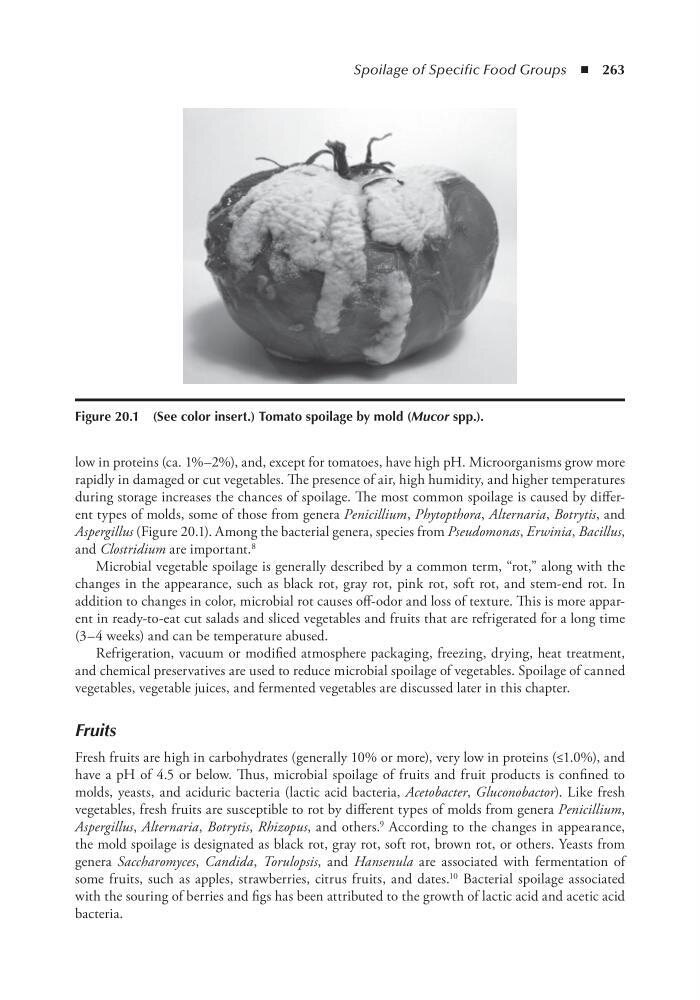
Aspergillus (Figure 20.1). Among the bacterial genera, species from Pseudomonas, Erwinia, Bacillus,
and Clostridium are important. 8
Microbial vegetable spoilage is generally described by a common term, “rot,” along with the
changes in the appearance, such as black rot, gray rot, pink rot, soft rot, and stem-end rot. In
addition to changes in color, microbial rot causes off-odor and loss of texture. This is more apparent in ready-to-eat cut salads and sliced vegetables and fruits that are refrigerated for a long time
(3– 4 weeks) and can be temperature abused.
Refrigeration, vacuum or modified atmosphere packaging, freezing, drying, heat treatment,
and chemical preservatives are used to reduce microbial spoilage of vegetables. Spoilage of canned
vegetables, vegetable juices, and fermented vegetables are discussed later in this chapter.
Fruits
Fresh fruits are high in carbohydrates (generally 10% or more), very low in proteins (≤1.0%), and
have a pH of 4.5 or below. Thus, microbial spoilage of fruits and fruit products is confined to
molds, yeasts, and aciduric bacteria (lactic acid bacteria, Acetobacter, Gluconobactor). Like fresh
vegetables, fresh fruits are susceptible to rot by different types of molds from genera Penicillium,
Aspergillus, Alternaria, Botrytis, Rhizopus, and others. 9 According to the changes in appearance,
the mold spoilage is designated as black rot, gray rot, soft rot, brown rot, or others. Yeasts from
genera Saccharomyces, Candida, Torulopsis, and Hansenula are associated with fermentation of
some fruits, such as apples, strawberries, citrus fruits, and dates. 10 Bacterial spoilage associated
with the souring of berries and figs has been attributed to the growth of lactic acid and acetic acid
bacteria.
Figure 20.1 (See color insert.) tomato spoilage by mold (Mucor spp.).
low in proteins (ca. 1%–2%), and, except for tomatoes, have high pH. Microorganisms grow more
rapidly in damaged or cut vegetables. The presence of air, high humidity, and higher temperatures
during storage increases the chances of spoilage. The most common spoilage is caused by different types of molds, some of those from genera Penicillium, Phytopthora, Alternaria, Botrytis, and
Aspergillus (Figure 20.1). Among the bacterial genera, species from Pseudomonas, Erwinia, Bacillus,
and Clostridium are important. 8
Microbial vegetable spoilage is generally described by a common term, “rot,” along with the
changes in the appearance, such as black rot, gray rot, pink rot, soft rot, and stem-end rot. In
addition to changes in color, microbial rot causes off-odor and loss of texture. This is more apparent in ready-to-eat cut salads and sliced vegetables and fruits that are refrigerated for a long time
(3– 4 weeks) and can be temperature abused.
Refrigeration, vacuum or modified atmosphere packaging, freezing, drying, heat treatment,
and chemical preservatives are used to reduce microbial spoilage of vegetables. Spoilage of canned
vegetables, vegetable juices, and fermented vegetables are discussed later in this chapter.
Fruits
Fresh fruits are high in carbohydrates (generally 10% or more), very low in proteins (≤1.0%), and
have a pH of 4.5 or below. Thus, microbial spoilage of fruits and fruit products is confined to
molds, yeasts, and aciduric bacteria (lactic acid bacteria, Acetobacter, Gluconobactor). Like fresh
vegetables, fresh fruits are susceptible to rot by different types of molds from genera Penicillium,
Aspergillus, Alternaria, Botrytis, Rhizopus, and others. 9 According to the changes in appearance,
the mold spoilage is designated as black rot, gray rot, soft rot, brown rot, or others. Yeasts from
genera Saccharomyces, Candida, Torulopsis, and Hansenula are associated with fermentation of
some fruits, such as apples, strawberries, citrus fruits, and dates. 10 Bacterial spoilage associated
with the souring of berries and figs has been attributed to the growth of lactic acid and acetic acid
bacteria.
Figure 20.1 (See color insert.) tomato spoilage by mold (Mucor spp.).