

Important Factors in Microbial Food Spoilage ◾ 247
fermented foods are not considered spoiled. Spoilage of these foods can occur because of growth
of undesirable bacteria, such as slime formation and off-flavor in cottage cheese by Alcaligenes and
Pseudomonas spp. In such products, selective methods should be used to determine the populations of undesirable bacteria or yeasts. 2,3,5
Predominant Microorganisms
The microbiological profile of a food is quite different from that of a pure culture growing in a
laboratory medium. An unspoiled, nonsterile food generally contains many types of microorganisms, such as bacteria, yeasts, and molds (also viruses) from different genera, maybe more than one
species from the same genus and even more than one strain from the same species. The population
level of each type can vary greatly (Chapter 20). However, when the same food is spoiled, it is
found to contain predominantly one or two types, and they may not even be present initially in
the highest numbers in the unspoiled or fresh product. Among the different species initially present and capable of growing in a particular food, only those with the shortest generation time under
the storage conditions attain the numbers rapidly and cause spoilage. In a study, a beef sample
(pH 6.0) was found to initially contain approximately 10 3 bacterial cells/g with relative levels of
Pseudomonas spp. of 1%, Acinetobacter and Moraxella 11%, Brochothrix thermosphacta 13%, and
others (Micrococcus, Staphylococcus, Enterobacteriaceae, lactic acid bacteria, etc.) 75%. Following
aerobic storage at 2°C for 12 days, the population reached 6 × 10 7 cells/g with the relative levels
of Pseudomonas spp. at 99% and all others at 1%. Many of the bacterial species present initially
could grow at the storage condition of the meat, but Pseudomonas spp. had the shortest generation
time. As a result, initially even they constituted only 1% of the total population; after 12 days, they
became predominant (99%). If the same meat sample were stored at 2°C anaerobically (such as in
a vacuum package) until the population had reached 10 7 /g, the predominant bacteria would have
Spoilage detection load (hypothetical)
8
6
12°C
12°C
4
2
0 0
2
4
Weeks in storage
6
8
cfu/mL,g,cm 2
≤4°C
≤4°C
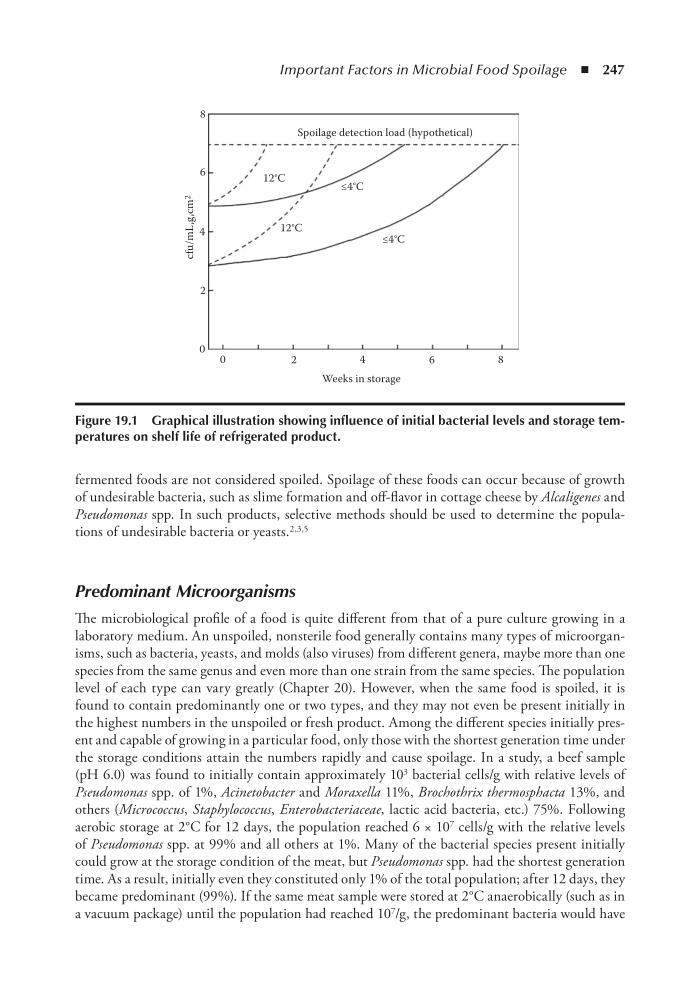
Figure 19.1 Graphical illustration showing influence of initial bacterial levels and storage temperatures on shelf life of refrigerated product.
fermented foods are not considered spoiled. Spoilage of these foods can occur because of growth
of undesirable bacteria, such as slime formation and off-flavor in cottage cheese by Alcaligenes and
Pseudomonas spp. In such products, selective methods should be used to determine the populations of undesirable bacteria or yeasts. 2,3,5
Predominant Microorganisms
The microbiological profile of a food is quite different from that of a pure culture growing in a
laboratory medium. An unspoiled, nonsterile food generally contains many types of microorganisms, such as bacteria, yeasts, and molds (also viruses) from different genera, maybe more than one
species from the same genus and even more than one strain from the same species. The population
level of each type can vary greatly (Chapter 20). However, when the same food is spoiled, it is
found to contain predominantly one or two types, and they may not even be present initially in
the highest numbers in the unspoiled or fresh product. Among the different species initially present and capable of growing in a particular food, only those with the shortest generation time under
the storage conditions attain the numbers rapidly and cause spoilage. In a study, a beef sample
(pH 6.0) was found to initially contain approximately 10 3 bacterial cells/g with relative levels of
Pseudomonas spp. of 1%, Acinetobacter and Moraxella 11%, Brochothrix thermosphacta 13%, and
others (Micrococcus, Staphylococcus, Enterobacteriaceae, lactic acid bacteria, etc.) 75%. Following
aerobic storage at 2°C for 12 days, the population reached 6 × 10 7 cells/g with the relative levels
of Pseudomonas spp. at 99% and all others at 1%. Many of the bacterial species present initially
could grow at the storage condition of the meat, but Pseudomonas spp. had the shortest generation
time. As a result, initially even they constituted only 1% of the total population; after 12 days, they
became predominant (99%). If the same meat sample were stored at 2°C anaerobically (such as in
a vacuum package) until the population had reached 10 7 /g, the predominant bacteria would have
Spoilage detection load (hypothetical)
8
6
12°C
12°C
4
2
0 0
2
4
Weeks in storage
6
8
cfu/mL,g,cm 2
≤4°C
≤4°C
Figure 19.1 Graphical illustration showing influence of initial bacterial levels and storage temperatures on shelf life of refrigerated product.