

Food Ingredients and Enzymes of Microbial Origin ◾ 235
product by an enzyme through a single-step reaction. Thus, production of different metabolites by
live cells from the same substrate can be avoided. In addition, a reaction step can be controlled and
enhanced more easily by using purified enzymes. Finally, by using recombinant DNA technology,
the efficiency of enzymes can be improved and, by immobilizing, they can be recycled. The main
disadvantage of using enzymes is that if a substrate is converted to a product through many steps
(such as glucose to lactic acid), microbial cells must be used for their efficient and economical
production.
Enzymes Used
Among the five classes of enzymes, three are predominantly used in food processing: hydrolases
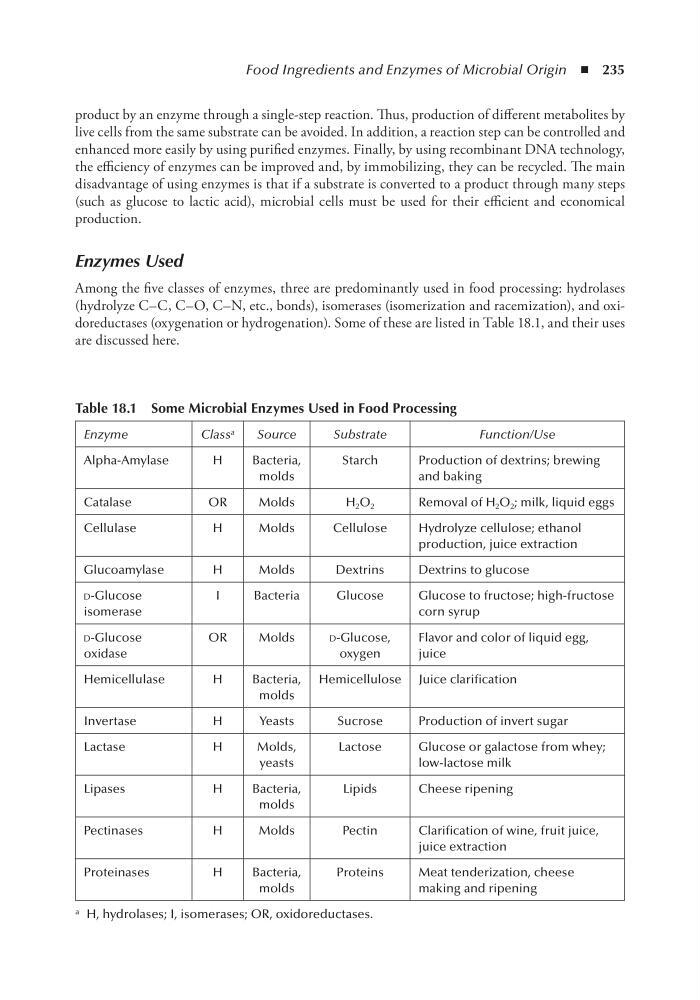
(hydrolyze C–C, C–O, C–N, etc., bonds), isomerases (isomerization and racemization), and oxidoreductases (oxygenation or hydrogenation). Some of these are listed in Table 18.1, and their uses
are discussed here.
table 18.1 Some Microbial enzymes Used in Food Processing
Enzyme
Class a
Source
Substrate
Function/Use
Alpha-Amylase
H
Bacteria,
molds
Starch
Production of dextrins; brewing
and baking
Catalase
OR
Molds
H 2 O 2
Removal of H 2 O 2 ; milk, liquid eggs
Cellulase
H
Molds
Cellulose
Hydrolyze cellulose; ethanol
production, juice extraction
Glucoamylase
H
Molds
Dextrins
Dextrins to glucose
d-Glucose
isomerase
I
Bacteria
Glucose
Glucose to fructose; high-fructose
corn syrup
d-Glucose
oxidase
OR
Molds
d-Glucose,
oxygen
Flavor and color of liquid egg,
juice
Hemicellulase
H
Bacteria,
molds
Hemicellulose Juice clarification
Invertase
H
Yeasts
Sucrose
Production of invert sugar
Lactase
H
Molds,
yeasts
Lactose
Glucose or galactose from whey;
low-lactose milk
Lipases
H
Bacteria,
molds
Lipids
Cheese ripening
Pectinases
H
Molds
Pectin
Clarification of wine, fruit juice,
juice extraction
Proteinases
H
Bacteria,
molds
Proteins
Meat tenderization, cheese
making and ripening
a H, hydrolases; I, isomerases; OR, oxidoreductases.
product by an enzyme through a single-step reaction. Thus, production of different metabolites by
live cells from the same substrate can be avoided. In addition, a reaction step can be controlled and
enhanced more easily by using purified enzymes. Finally, by using recombinant DNA technology,
the efficiency of enzymes can be improved and, by immobilizing, they can be recycled. The main
disadvantage of using enzymes is that if a substrate is converted to a product through many steps
(such as glucose to lactic acid), microbial cells must be used for their efficient and economical
production.
Enzymes Used
Among the five classes of enzymes, three are predominantly used in food processing: hydrolases
(hydrolyze C–C, C–O, C–N, etc., bonds), isomerases (isomerization and racemization), and oxidoreductases (oxygenation or hydrogenation). Some of these are listed in Table 18.1, and their uses
are discussed here.
table 18.1 Some Microbial enzymes Used in Food Processing
Enzyme
Class a
Source
Substrate
Function/Use
Alpha-Amylase
H
Bacteria,
molds
Starch
Production of dextrins; brewing
and baking
Catalase
OR
Molds
H 2 O 2
Removal of H 2 O 2 ; milk, liquid eggs
Cellulase
H
Molds
Cellulose
Hydrolyze cellulose; ethanol
production, juice extraction
Glucoamylase
H
Molds
Dextrins
Dextrins to glucose
d-Glucose
isomerase
I
Bacteria
Glucose
Glucose to fructose; high-fructose
corn syrup
d-Glucose
oxidase
OR
Molds
d-Glucose,
oxygen
Flavor and color of liquid egg,
juice
Hemicellulase
H
Bacteria,
molds
Hemicellulose Juice clarification
Invertase
H
Yeasts
Sucrose
Production of invert sugar
Lactase
H
Molds,
yeasts
Lactose
Glucose or galactose from whey;
low-lactose milk
Lipases
H
Bacteria,
molds
Lipids
Cheese ripening
Pectinases
H
Molds
Pectin
Clarification of wine, fruit juice,
juice extraction
Proteinases
H
Bacteria,
molds
Proteins
Meat tenderization, cheese
making and ripening
a H, hydrolases; I, isomerases; OR, oxidoreductases.