

Food Biopreservatives of Microbial Origin, Bacteriocin, and Nanotechnology ◾ 219
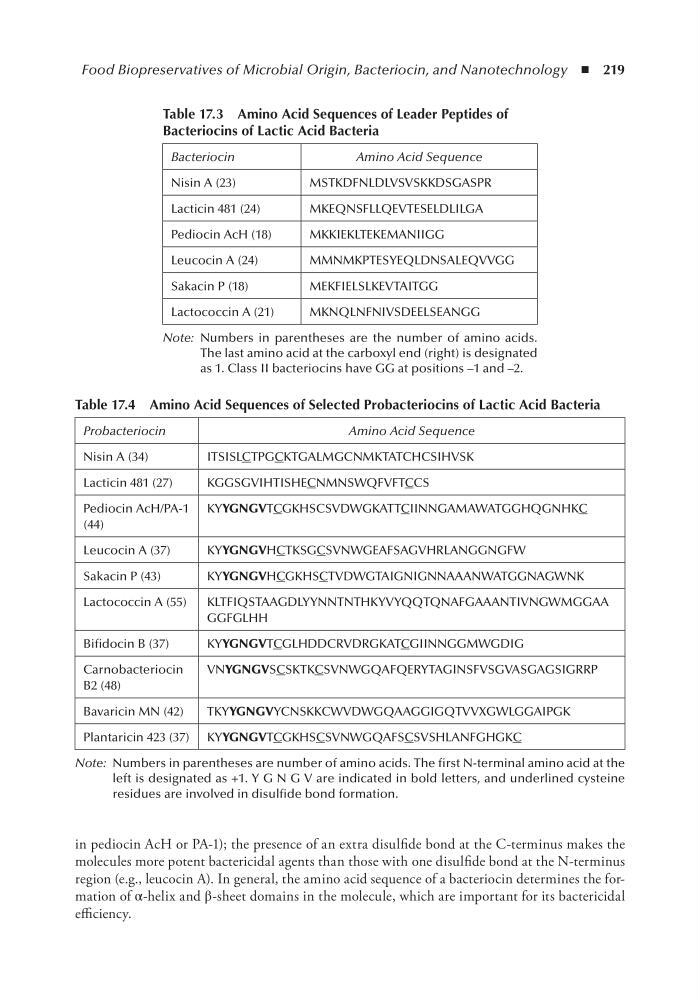
in pediocin AcH or PA-1); the presence of an extra disulfide bond at the C-terminus makes the
molecules more potent bactericidal agents than those with one disulfide bond at the N-terminus
region (e.g., leucocin A). In general, the amino acid sequence of a bacteriocin determines the formation of α-helix and β-sheet domains in the molecule, which are important for its bactericidal
efficiency.
table 17.3 Amino Acid Sequences of Leader Peptides of
Bacteriocins of Lactic Acid Bacteria
Bacteriocin
Amino Acid Sequence
Nisin A (23)
MSTKDFNLDLVSVSKKDSGASPR
Lacticin 481 (24)
MKEQNSFLLQEVTESELDLILGA
Pediocin AcH (18)
MKKIEKLTEKEMANIIGG
Leucocin A (24)
MMNMKPTESYEQLDNSALEQVVGG
Sakacin P (18)
MEKFIELSLKEVTAITGG
Lactococcin A (21)
MKNQLNFNIVSDEELSEANGG
Note: Numbers in parentheses are the number of amino acids.
The last amino acid at the carboxyl end (right) is designated
as 1. Class II bacteriocins have GG at positions –1 and –2.
table 17.4 Amino Acid Sequences of Selected Probacteriocins of Lactic Acid Bacteria
Probacteriocin
Amino Acid Sequence
Nisin A (34)
ITSISLCTPGCKTGALMGCNMKTATCHCSIHVSK
Lacticin 481 (27)
KGGSGVIHTISHECNMNSWQFVFTCCS
Pediocin AcH/PA-1
(44)
KYYGNGVTCGKHSCSVDWGKATTCIINNGAMAWATGGHQGNHKC
Leucocin A (37)
KYYGNGVHCTKSGCSVNWGEAFSAGVHRLANGGNGFW
Sakacin P (43)
KYYGNGVHCGKHSCTVDWGTAIGNIGNNAAANWATGGNAGWNK
Lactococcin A (55)
KLTFIQSTAAGDLYYNNTNTHKYVYQQTQNAFGAAANTIVNGWMGGAA
GGFGLHH
Bifidocin B (37)
KYYGNGVTCGLHDDCRVDRGKATCGIINNGGMWGDIG
Carnobacteriocin
B2 (48)
VNYGNGVSCSKTKCSVNWGQAFQERYTAGINSFVSGVASGAGSIGRRP
Bavaricin MN (42)
TKYYGNGVYCNSKKCWVDWGQAAGGIGQTVVXGWLGGAIPGK
Plantaricin 423 (37) KYYGNGVTCGKHSCSVNWGQAFSCSVSHLANFGHGKC
Note: Numbers in parentheses are number of amino acids. The first N-terminal amino acid at the
left is designated as +1. Y G N G V are indicated in bold letters, and underlined cysteine
residues are involved in disulfide bond formation.
in pediocin AcH or PA-1); the presence of an extra disulfide bond at the C-terminus makes the
molecules more potent bactericidal agents than those with one disulfide bond at the N-terminus
region (e.g., leucocin A). In general, the amino acid sequence of a bacteriocin determines the formation of α-helix and β-sheet domains in the molecule, which are important for its bactericidal
efficiency.
table 17.3 Amino Acid Sequences of Leader Peptides of
Bacteriocins of Lactic Acid Bacteria
Bacteriocin
Amino Acid Sequence
Nisin A (23)
MSTKDFNLDLVSVSKKDSGASPR
Lacticin 481 (24)
MKEQNSFLLQEVTESELDLILGA
Pediocin AcH (18)
MKKIEKLTEKEMANIIGG
Leucocin A (24)
MMNMKPTESYEQLDNSALEQVVGG
Sakacin P (18)
MEKFIELSLKEVTAITGG
Lactococcin A (21)
MKNQLNFNIVSDEELSEANGG
Note: Numbers in parentheses are the number of amino acids.
The last amino acid at the carboxyl end (right) is designated
as 1. Class II bacteriocins have GG at positions –1 and –2.
table 17.4 Amino Acid Sequences of Selected Probacteriocins of Lactic Acid Bacteria
Probacteriocin
Amino Acid Sequence
Nisin A (34)
ITSISLCTPGCKTGALMGCNMKTATCHCSIHVSK
Lacticin 481 (27)
KGGSGVIHTISHECNMNSWQFVFTCCS
Pediocin AcH/PA-1
(44)
KYYGNGVTCGKHSCSVDWGKATTCIINNGAMAWATGGHQGNHKC
Leucocin A (37)
KYYGNGVHCTKSGCSVNWGEAFSAGVHRLANGGNGFW
Sakacin P (43)
KYYGNGVHCGKHSCTVDWGTAIGNIGNNAAANWATGGNAGWNK
Lactococcin A (55)
KLTFIQSTAAGDLYYNNTNTHKYVYQQTQNAFGAAANTIVNGWMGGAA
GGFGLHH
Bifidocin B (37)
KYYGNGVTCGLHDDCRVDRGKATCGIINNGGMWGDIG
Carnobacteriocin
B2 (48)
VNYGNGVSCSKTKCSVNWGQAFQERYTAGINSFVSGVASGAGSIGRRP
Bavaricin MN (42)
TKYYGNGVYCNSKKCWVDWGQAAGGIGQTVVXGWLGGAIPGK
Plantaricin 423 (37) KYYGNGVTCGKHSCSVNWGQAFSCSVSHLANFGHGKC
Note: Numbers in parentheses are number of amino acids. The first N-terminal amino acid at the
left is designated as +1. Y G N G V are indicated in bold letters, and underlined cysteine
residues are involved in disulfide bond formation.