

Food Biopreservatives of Microbial Origin, Bacteriocin, and Nanotechnology ◾ 217
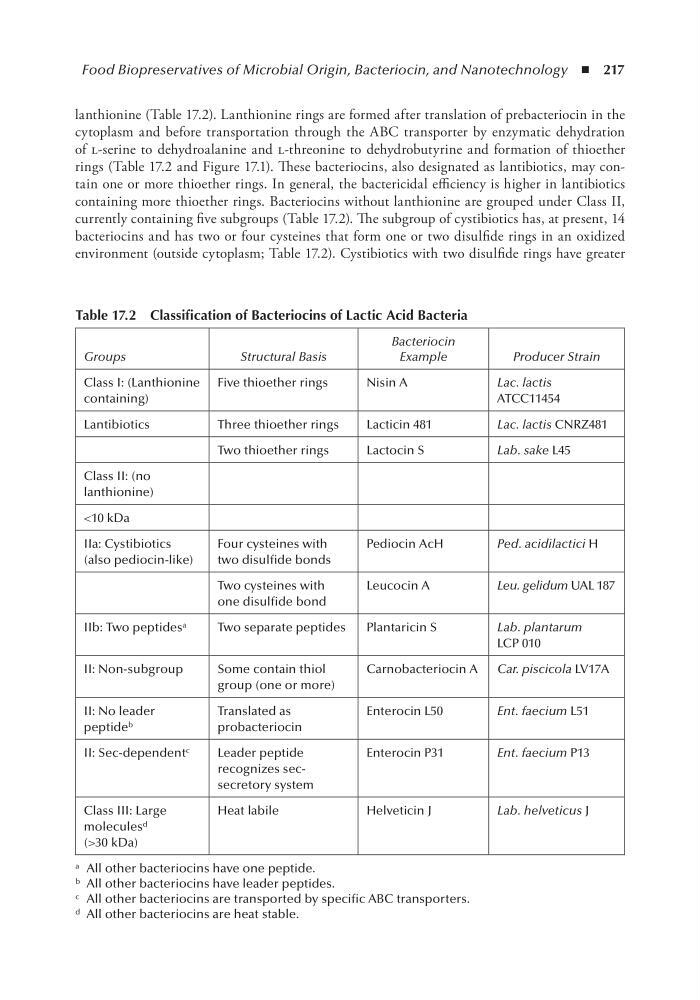
lanthionine (Table 17.2). Lanthionine rings are formed after translation of prebacteriocin in the
cytoplasm and before transportation through the ABC transporter by enzymatic dehydration
of l-serine to dehydroalanine and l-threonine to dehydrobutyrine and formation of thioether
rings (Table 17.2 and Figure 17.1). These bacteriocins, also designated as lantibiotics, may contain one or more thioether rings. In general, the bactericidal efficiency is higher in lantibiotics
containing more thioether rings. Bacteriocins without lanthionine are grouped under Class II,
currently containing five subgroups (Table 17.2). The subgroup of cystibiotics has, at present, 14
bacteriocins and has two or four cysteines that form one or two disulfide rings in an oxidized
environment (outside cytoplasm; Table 17.2). Cystibiotics with two disulfide rings have greater
table 17.2 Classification of Bacteriocins of Lactic Acid Bacteria
Groups
Structural Basis
Bacteriocin
Example
Producer Strain
Class I: (Lanthionine
containing)
Five thioether rings
Nisin A
Lac. lactis
ATCC11454
Lantibiotics
Three thioether rings
Lacticin 481
Lac. lactis CNRZ481
Two thioether rings
Lactocin S
Lab. sake L45
Class II: (no
lanthionine)
<10 kDa
IIa: Cystibiotics
(also pediocin-like)
Four cysteines with
two disulfide bonds
Pediocin AcH
Ped. acidilactici H
Two cysteines with
one disulfide bond
Leucocin A
Leu. gelidum UAL 187
IIb: Two peptides a
Two separate peptides
Plantaricin S
Lab. plantarum
LCP 010
II: Non-subgroup
Some contain thiol
group (one or more)
Carnobacteriocin A
Car. piscicola LV17A
II: No leader
peptide b
Translated as
probacteriocin
Enterocin L50
Ent. faecium L51
II: Sec-dependent c
Leader peptide
recognizes secsecretory system
Enterocin P31
Ent. faecium P13
Class III: Large
molecules d
(>30 kDa)
Heat labile
Helveticin J
Lab. helveticus J
a All other bacteriocins have one peptide.
b All other bacteriocins have leader peptides.
c All other bacteriocins are transported by specific ABC transporters.
d All other bacteriocins are heat stable.
lanthionine (Table 17.2). Lanthionine rings are formed after translation of prebacteriocin in the
cytoplasm and before transportation through the ABC transporter by enzymatic dehydration
of l-serine to dehydroalanine and l-threonine to dehydrobutyrine and formation of thioether
rings (Table 17.2 and Figure 17.1). These bacteriocins, also designated as lantibiotics, may contain one or more thioether rings. In general, the bactericidal efficiency is higher in lantibiotics
containing more thioether rings. Bacteriocins without lanthionine are grouped under Class II,
currently containing five subgroups (Table 17.2). The subgroup of cystibiotics has, at present, 14
bacteriocins and has two or four cysteines that form one or two disulfide rings in an oxidized
environment (outside cytoplasm; Table 17.2). Cystibiotics with two disulfide rings have greater
table 17.2 Classification of Bacteriocins of Lactic Acid Bacteria
Groups
Structural Basis
Bacteriocin
Example
Producer Strain
Class I: (Lanthionine
containing)
Five thioether rings
Nisin A
Lac. lactis
ATCC11454
Lantibiotics
Three thioether rings
Lacticin 481
Lac. lactis CNRZ481
Two thioether rings
Lactocin S
Lab. sake L45
Class II: (no
lanthionine)
<10 kDa
IIa: Cystibiotics
(also pediocin-like)
Four cysteines with
two disulfide bonds
Pediocin AcH
Ped. acidilactici H
Two cysteines with
one disulfide bond
Leucocin A
Leu. gelidum UAL 187
IIb: Two peptides a
Two separate peptides
Plantaricin S
Lab. plantarum
LCP 010
II: Non-subgroup
Some contain thiol
group (one or more)
Carnobacteriocin A
Car. piscicola LV17A
II: No leader
peptide b
Translated as
probacteriocin
Enterocin L50
Ent. faecium L51
II: Sec-dependent c
Leader peptide
recognizes secsecretory system
Enterocin P31
Ent. faecium P13
Class III: Large
molecules d
(>30 kDa)
Heat labile
Helveticin J
Lab. helveticus J
a All other bacteriocins have one peptide.
b All other bacteriocins have leader peptides.
c All other bacteriocins are transported by specific ABC transporters.
d All other bacteriocins are heat stable.