

188 ◾ Fundamental Food Microbiology
by supplementing the meat mixture with both glucose and sucrose. Exopolysaccharide-producing
strains can improve the texture of products.
Microbial Problems
Slow acid production can be a serious problem if the starters used are not metabolically active or
have lower numbers of viable cells or as a result of other factors, such as low glucose and high salts
in the mix. Sour or no flavor can occur if the starter, especially Ped. acidilactici, grows very rapidly
and reduces the pH to below 4.5. Gas formation can occur because of growth of Leuconostoc spp.
during fermentation and during storage in vacuum packages. Leuconostoc spp. are usually present
in raw meat. Pathogens, when present in meat, can grow if acid production is slow during fermentation. Acid-resistant pathogens can also survive in the products and cause health hazards. During
long storage or curing, biogenic amines can form. Also, mycotoxin-producing molds can grow on
the product surface during curing (also see Chapter 20).
Fermented Vegetable Products
Almost all vegetables can be fermented through natural processes because they harbor many types
of lactic acid bacteria. Worldwide, many types of vegetables are fermented, mostly in small volumes.
However, some are produced commercially. Vegetable fermentation originated in the early years of
human civilization and, even now, is widely used by many cultures. Examples of some fermented
products and vegetables used currently for fermentation are sauerkraut and kimchi 9,10 (from cabbage),
olives, cucumbers, carrots, celery, beans, peas, corn, okra, tomatoes, cauliflower, peppers, onions,
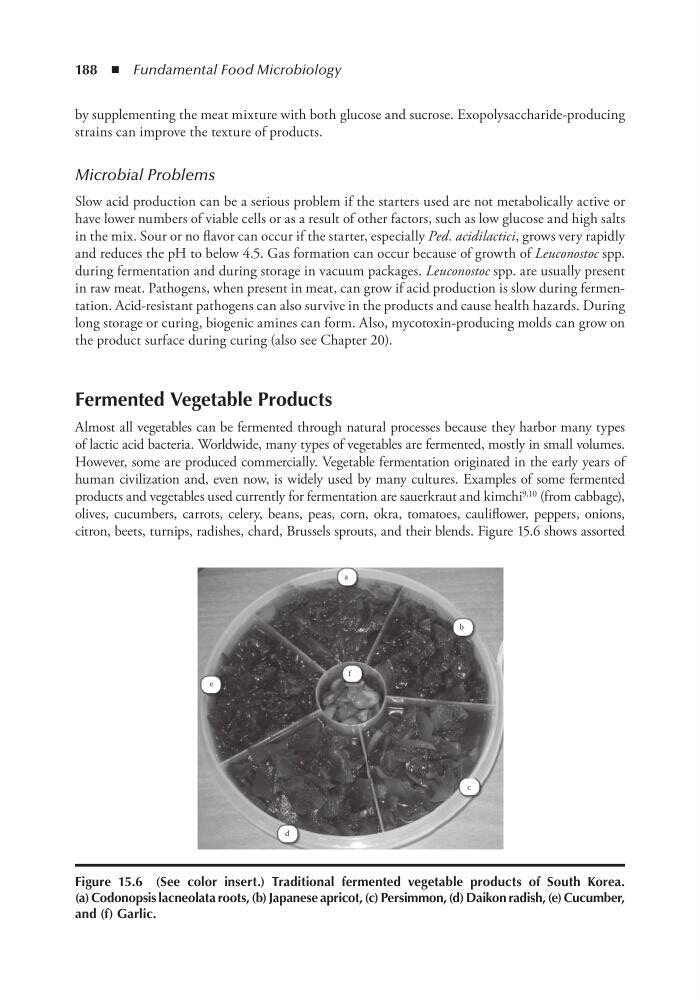
citron, beets, turnips, radishes, chard, Brussels sprouts, and their blends. Figure 15.6 shows assorted
a
f
b
c
d
e
Figure 15.6 (See color insert.) traditional fermented vegetable products of South Korea.
(a) Codonopsis lacneolata roots, (b) Japanese apricot, (c) Persimmon, (d) Daikon radish, (e) Cucumber,
and (f) Garlic.
by supplementing the meat mixture with both glucose and sucrose. Exopolysaccharide-producing
strains can improve the texture of products.
Microbial Problems
Slow acid production can be a serious problem if the starters used are not metabolically active or
have lower numbers of viable cells or as a result of other factors, such as low glucose and high salts
in the mix. Sour or no flavor can occur if the starter, especially Ped. acidilactici, grows very rapidly
and reduces the pH to below 4.5. Gas formation can occur because of growth of Leuconostoc spp.
during fermentation and during storage in vacuum packages. Leuconostoc spp. are usually present
in raw meat. Pathogens, when present in meat, can grow if acid production is slow during fermentation. Acid-resistant pathogens can also survive in the products and cause health hazards. During
long storage or curing, biogenic amines can form. Also, mycotoxin-producing molds can grow on
the product surface during curing (also see Chapter 20).
Fermented Vegetable Products
Almost all vegetables can be fermented through natural processes because they harbor many types
of lactic acid bacteria. Worldwide, many types of vegetables are fermented, mostly in small volumes.
However, some are produced commercially. Vegetable fermentation originated in the early years of
human civilization and, even now, is widely used by many cultures. Examples of some fermented
products and vegetables used currently for fermentation are sauerkraut and kimchi 9,10 (from cabbage),
olives, cucumbers, carrots, celery, beans, peas, corn, okra, tomatoes, cauliflower, peppers, onions,
citron, beets, turnips, radishes, chard, Brussels sprouts, and their blends. Figure 15.6 shows assorted
a
f
b
c
d
e
Figure 15.6 (See color insert.) traditional fermented vegetable products of South Korea.
(a) Codonopsis lacneolata roots, (b) Japanese apricot, (c) Persimmon, (d) Daikon radish, (e) Cucumber,
and (f) Garlic.