

174 ◾ Fundamental Food Microbiology
Starter (Controlled Fermentation)
Lactococcus lactis ssp. lactis or cremoris is used for acid and Leuconostoc mesenteroides ssp. cremoris
for diacetyl and CO 2 . They can be used as direct vat set frozen concentrates. (Lac. lactis ssp. lactis
biovar diacetylactis is generally not used as it may produce too much acetaldehyde, causing a green
or yogurt flavor defect.)
Growth
At 72°F (22°C), there is balanced growth of the two species and balanced production of acid,
diacetyl, and CO 2 . Above 72°F, the growth of Lactococcus species is favored with more acid and
less flavor; below 72°F, the growth of Leuconostoc species is favored with less acid and more flavor.
Biochemistry
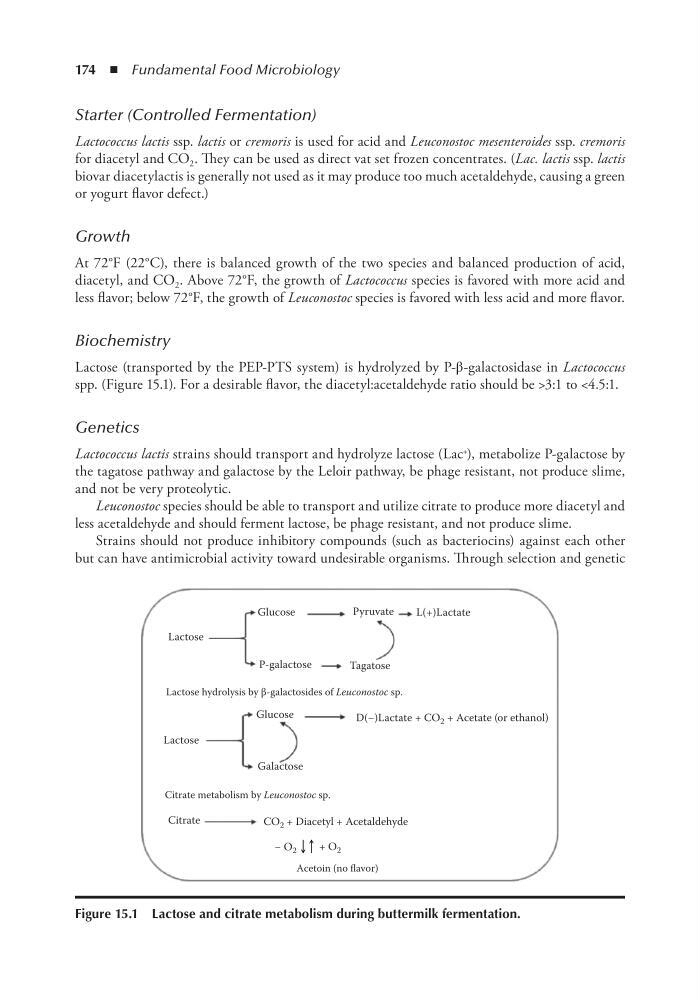
Lactose (transported by the PEP-PTS system) is hydrolyzed by P-β-galactosidase in Lactococcus
spp. (Figure 15.1). For a desirable flavor, the diacetyl:acetaldehyde ratio should be >3:1 to <4.5:1.
Genetics
Lactococcus lactis strains should transport and hydrolyze lactose (Lac + ), metabolize P-galactose by
the tagatose pathway and galactose by the Leloir pathway, be phage resistant, not produce slime,
and not be very proteolytic.
Leuconostoc species should be able to transport and utilize citrate to produce more diacetyl and
less acetaldehyde and should ferment lactose, be phage resistant, and not produce slime.
Strains should not produce inhibitory compounds (such as bacteriocins) against each other
but can have antimicrobial activity toward undesirable organisms. Through selection and genetic
Glucose
Glucose
Lactose
Lactose
Citrate
Pyruvate
L(+)Lactate
Tagatose
P-galactose
Galactose
D(−)Lactate + CO 2 + Acetate (or ethanol)
Citrate metabolism by Leuconostoc sp.
Acetoin (no flavor)
CO 2 + Diacetyl + Acetaldehyde
− O 2
+ O 2
Lactose hydrolysis by β-galactosides of Leuconostoc sp.
Figure 15.1 Lactose and citrate metabolism during buttermilk fermentation.
Starter (Controlled Fermentation)
Lactococcus lactis ssp. lactis or cremoris is used for acid and Leuconostoc mesenteroides ssp. cremoris
for diacetyl and CO 2 . They can be used as direct vat set frozen concentrates. (Lac. lactis ssp. lactis
biovar diacetylactis is generally not used as it may produce too much acetaldehyde, causing a green
or yogurt flavor defect.)
Growth
At 72°F (22°C), there is balanced growth of the two species and balanced production of acid,
diacetyl, and CO 2 . Above 72°F, the growth of Lactococcus species is favored with more acid and
less flavor; below 72°F, the growth of Leuconostoc species is favored with less acid and more flavor.
Biochemistry
Lactose (transported by the PEP-PTS system) is hydrolyzed by P-β-galactosidase in Lactococcus
spp. (Figure 15.1). For a desirable flavor, the diacetyl:acetaldehyde ratio should be >3:1 to <4.5:1.
Genetics
Lactococcus lactis strains should transport and hydrolyze lactose (Lac + ), metabolize P-galactose by
the tagatose pathway and galactose by the Leloir pathway, be phage resistant, not produce slime,
and not be very proteolytic.
Leuconostoc species should be able to transport and utilize citrate to produce more diacetyl and
less acetaldehyde and should ferment lactose, be phage resistant, and not produce slime.
Strains should not produce inhibitory compounds (such as bacteriocins) against each other
but can have antimicrobial activity toward undesirable organisms. Through selection and genetic
Glucose
Glucose
Lactose
Lactose
Citrate
Pyruvate
L(+)Lactate
Tagatose
P-galactose
Galactose
D(−)Lactate + CO 2 + Acetate (or ethanol)
Citrate metabolism by Leuconostoc sp.
Acetoin (no flavor)
CO 2 + Diacetyl + Acetaldehyde
− O 2
+ O 2
Lactose hydrolysis by β-galactosides of Leuconostoc sp.
Figure 15.1 Lactose and citrate metabolism during buttermilk fermentation.