

Starter Cultures and Bacteriophages ◾ 165
bacterial strain can have restriction enzymes that can hydrolyze and destroy the DNA of a phage.
A phage can be lytic or temperate. All phages require Ca 2+ for their adsorption on the cell surface
of lactic cultures.
Control Methods
Following the discovery of bacteriophage-related starter failure in food fermentation, steps were
developed to reduce phage contamination with starter cultures. 6–8 These include proper sanitation to reduce phage buildup in the processing facilities, both during bulk starter preparation and
product fermentation, use of phage-insensitive media, rotation of strains, and use of mixed strains
to reduce the buildup of a particular phage to a level that causes starter failure. Subsequently,
phage-resistant starter strains were developed. Initially, by growing a sensitive bacterial strain in
the presence of a specific lytic phage, cells that were not killed by the phage were isolated and
supplied to processors. Recent studies have indicated that by genetic techniques, a bacterial strain
can be made insensitive to one or more phages. These include modifying the genetic makeup of a
starter strain to inhibit phage adsorption, destroying phage DNA by restriction enzyme systems
of cells, abortive infection, and the novel restriction-modification system called CRISPR/Cas system before lysis. 8 A CRISPR/Cas (clustered regularly interspaced short palindromic repeats/cas
enzyme) system of a host provides a novel mechanism for interference with phage DNA in the
host to provide resistance against phage. By combining these traits through genetic manipulation,
Prophage
Phage DNA
Phage attachment
to bacteria
Phage DNA
injection
Lytic cycle
Induction to
lytic pathway
Lysogenic
cycle
Latent
period
Phage
maturation
Lysis
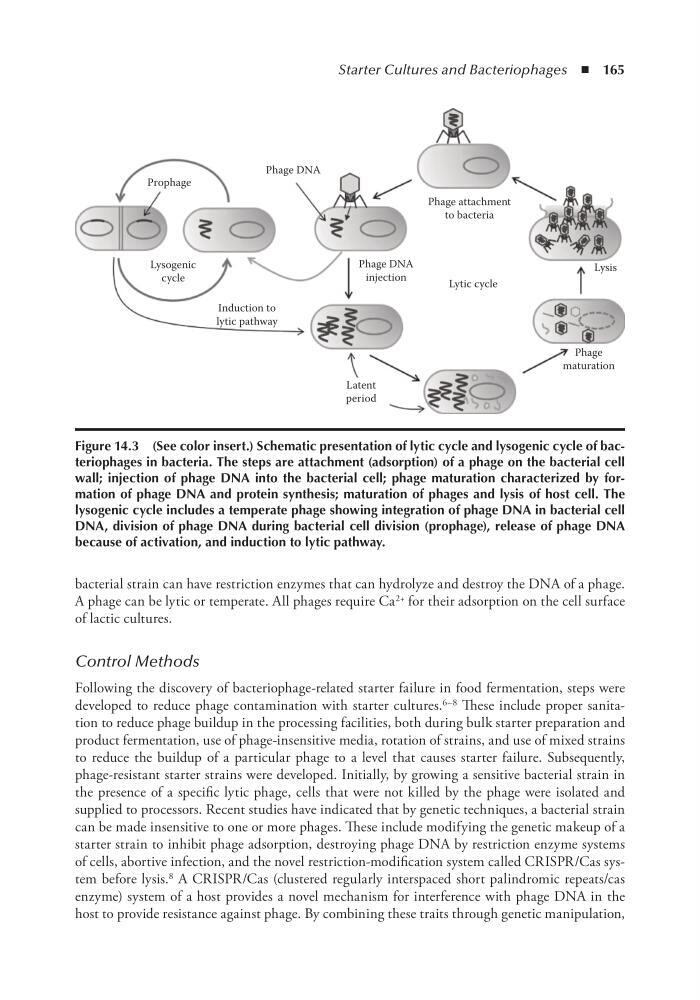
Figure 14.3 (See color insert.) Schematic presentation of lytic cycle and lysogenic cycle of bacteriophages in bacteria. the steps are attachment (adsorption) of a phage on the bacterial cell
wall; injection of phage DnA into the bacterial cell; phage maturation characterized by formation of phage DnA and protein synthesis; maturation of phages and lysis of host cell. the
lysogenic cycle includes a temperate phage showing integration of phage DnA in bacterial cell
DnA, division of phage DnA during bacterial cell division (prophage), release of phage DnA
because of activation, and induction to lytic pathway.
bacterial strain can have restriction enzymes that can hydrolyze and destroy the DNA of a phage.
A phage can be lytic or temperate. All phages require Ca 2+ for their adsorption on the cell surface
of lactic cultures.
Control Methods
Following the discovery of bacteriophage-related starter failure in food fermentation, steps were
developed to reduce phage contamination with starter cultures. 6–8 These include proper sanitation to reduce phage buildup in the processing facilities, both during bulk starter preparation and
product fermentation, use of phage-insensitive media, rotation of strains, and use of mixed strains
to reduce the buildup of a particular phage to a level that causes starter failure. Subsequently,
phage-resistant starter strains were developed. Initially, by growing a sensitive bacterial strain in
the presence of a specific lytic phage, cells that were not killed by the phage were isolated and
supplied to processors. Recent studies have indicated that by genetic techniques, a bacterial strain
can be made insensitive to one or more phages. These include modifying the genetic makeup of a
starter strain to inhibit phage adsorption, destroying phage DNA by restriction enzyme systems
of cells, abortive infection, and the novel restriction-modification system called CRISPR/Cas system before lysis. 8 A CRISPR/Cas (clustered regularly interspaced short palindromic repeats/cas
enzyme) system of a host provides a novel mechanism for interference with phage DNA in the
host to provide resistance against phage. By combining these traits through genetic manipulation,
Prophage
Phage DNA
Phage attachment
to bacteria
Phage DNA
injection
Lytic cycle
Induction to
lytic pathway
Lysogenic
cycle
Latent
period
Phage
maturation
Lysis
Figure 14.3 (See color insert.) Schematic presentation of lytic cycle and lysogenic cycle of bacteriophages in bacteria. the steps are attachment (adsorption) of a phage on the bacterial cell
wall; injection of phage DnA into the bacterial cell; phage maturation characterized by formation of phage DnA and protein synthesis; maturation of phages and lysis of host cell. the
lysogenic cycle includes a temperate phage showing integration of phage DnA in bacterial cell
DnA, division of phage DnA during bacterial cell division (prophage), release of phage DnA
because of activation, and induction to lytic pathway.