

142 ◾ Fundamental Food Microbiology
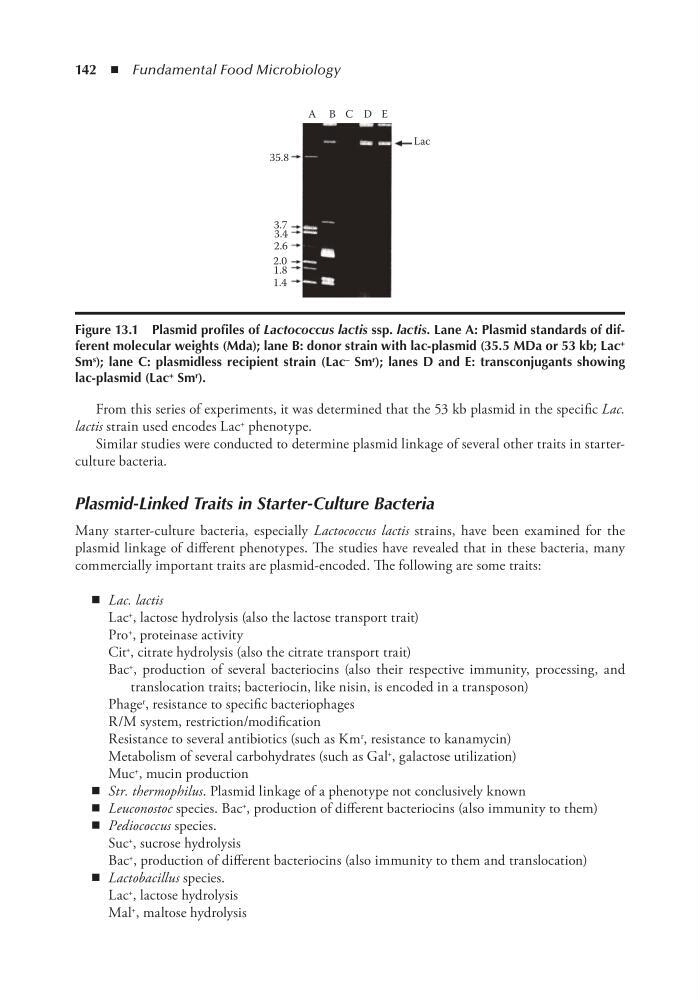
From this series of experiments, it was determined that the 53 kb plasmid in the specific Lac.
lactis strain used encodes Lac + phenotype.
Similar studies were conducted to determine plasmid linkage of several other traits in starterculture bacteria.
Plasmid-Linked Traits in Starter-Culture Bacteria
Many starter-culture bacteria, especially Lactococcus lactis strains, have been examined for the
plasmid linkage of different phenotypes. The studies have revealed that in these bacteria, many
commercially important traits are plasmid-encoded. The following are some traits:
◾ Lac. lactis
Lac + , lactose hydrolysis (also the lactose transport trait)
Pro + , proteinase activity
Cit + , citrate hydrolysis (also the citrate transport trait)
Bac + , production of several bacteriocins (also their respective immunity, processing, and
translocation traits; bacteriocin, like nisin, is encoded in a transposon)
Phage r , resistance to specific bacteriophages
R/M system, restriction/modification
Resistance to several antibiotics (such as Km r , resistance to kanamycin)
Metabolism of several carbohydrates (such as Gal + , galactose utilization)
Muc + , mucin production
◾ Str. thermophilus. Plasmid linkage of a phenotype not conclusively known
◾ Leuconostoc species. Bac + , production of different bacteriocins (also immunity to them)
◾ Pediococcus species.
Suc + , sucrose hydrolysis
Bac + , production of different bacteriocins (also immunity to them and translocation)
◾ Lactobacillus species.
Lac + , lactose hydrolysis
Mal + , maltose hydrolysis
A B C D E
Lac
35.8
3.7
3.4
2.6
2.0
1.8
1.4
Figure 13.1 Plasmid profiles of Lactococcus lactis ssp. lactis. Lane A: Plasmid standards of different molecular weights (Mda); lane B: donor strain with lac-plasmid (35.5 MDa or 53 kb; Lac +
Sm s ); lane C: plasmidless recipient strain (Lac – Sm r ); lanes D and e: transconjugants showing
lac-plasmid (Lac + Sm r ).
From this series of experiments, it was determined that the 53 kb plasmid in the specific Lac.
lactis strain used encodes Lac + phenotype.
Similar studies were conducted to determine plasmid linkage of several other traits in starterculture bacteria.
Plasmid-Linked Traits in Starter-Culture Bacteria
Many starter-culture bacteria, especially Lactococcus lactis strains, have been examined for the
plasmid linkage of different phenotypes. The studies have revealed that in these bacteria, many
commercially important traits are plasmid-encoded. The following are some traits:
◾ Lac. lactis
Lac + , lactose hydrolysis (also the lactose transport trait)
Pro + , proteinase activity
Cit + , citrate hydrolysis (also the citrate transport trait)
Bac + , production of several bacteriocins (also their respective immunity, processing, and
translocation traits; bacteriocin, like nisin, is encoded in a transposon)
Phage r , resistance to specific bacteriophages
R/M system, restriction/modification
Resistance to several antibiotics (such as Km r , resistance to kanamycin)
Metabolism of several carbohydrates (such as Gal + , galactose utilization)
Muc + , mucin production
◾ Str. thermophilus. Plasmid linkage of a phenotype not conclusively known
◾ Leuconostoc species. Bac + , production of different bacteriocins (also immunity to them)
◾ Pediococcus species.
Suc + , sucrose hydrolysis
Bac + , production of different bacteriocins (also immunity to them and translocation)
◾ Lactobacillus species.
Lac + , lactose hydrolysis
Mal + , maltose hydrolysis
A B C D E
Lac
35.8
3.7
3.4
2.6
2.0
1.8
1.4
Figure 13.1 Plasmid profiles of Lactococcus lactis ssp. lactis. Lane A: Plasmid standards of different molecular weights (Mda); lane B: donor strain with lac-plasmid (35.5 MDa or 53 kb; Lac +
Sm s ); lane C: plasmidless recipient strain (Lac – Sm r ); lanes D and e: transconjugants showing
lac-plasmid (Lac + Sm r ).