

124 ◾ Fundamental Food Microbiology
oenococcus
Oen. oeni, previously designated as Leu. oeni, has the general characteristics of Leuconostoc spp. It
is found in the winery environment. It is sometimes used to accelerate malolactic fermentation in
wine. 6 The cells transport malate in wine and metabolize it to lactic acid and CO 2 . This process
reduces the acidity of wine.
other Starter Cultures
Bifidobacterium
These are morphologically similar to some Lactobacillus spp. and were previously included in the
genus Lactobacillus. The cells are Gram-positive rods of various shapes and sizes, present as single cells or in chains of different sizes. They are non-spore-forming, nonmotile, and anaerobic
although some can tolerate O 2 in the presence of CO 2 . The species grow optimally at 37°C–41°C
with a growth temperature range of 25°C–45°C. They usually do not grow at a pH above 8.0 or
below 4.5. They ferment glucose to produce lactic and acetic acids in a 2:3 molar ratio without
producing CO 2 and also ferment lactose, galactose, and some pentoses.
They have been isolated from the feces of humans, animals, and birds and are considered beneficial for the normal health of the digestive tract. They are present in large numbers in the feces of
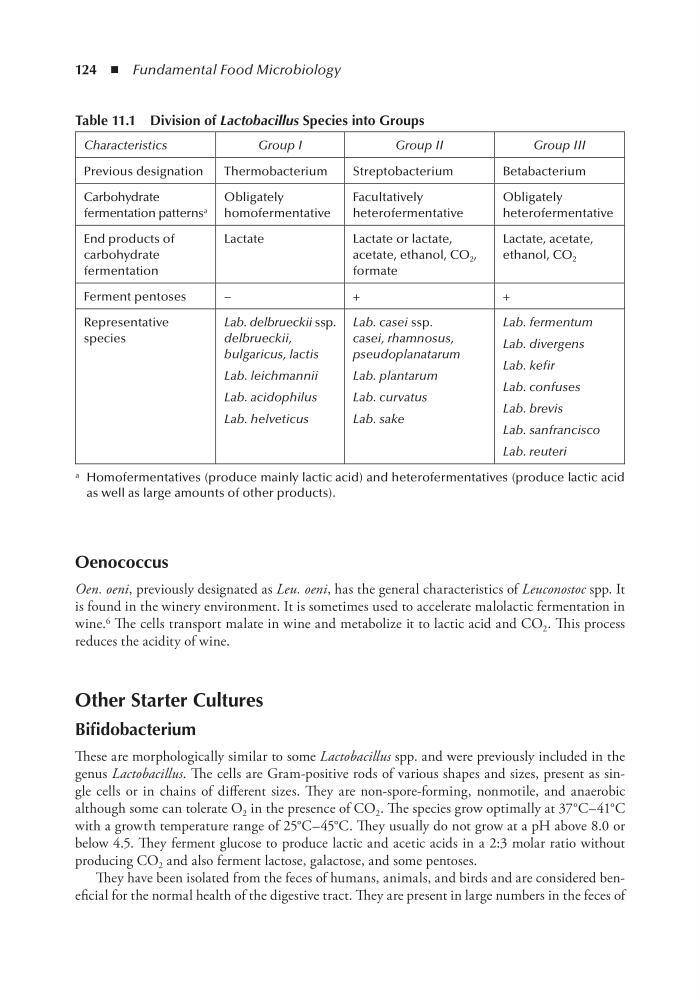
table 11.1 Division of Lactobacillus Species into Groups
Characteristics
Group I
Group II
Group III
Previous designation
Thermobacterium
Streptobacterium
Betabacterium
Carbohydrate
fermentation patterns a
Obligately
homofermentative
Facultatively
heterofermentative
Obligately
heterofermentative
End products of
carbohydrate
fermentation
Lactate
Lactate or lactate,
acetate, ethanol, CO 2 ,
formate
Lactate, acetate,
ethanol, CO 2
Ferment pentoses
−
+
+
Representative
species
Lab. delbrueckii ssp.
delbrueckii,
bulgaricus, lactis
Lab. leichmannii
Lab. acidophilus
Lab. helveticus
Lab. casei ssp.
casei, rhamnosus,
pseudoplanatarum
Lab. plantarum
Lab. curvatus
Lab. sake
Lab. fermentum
Lab. divergens
Lab. kefir
Lab. confuses
Lab. brevis
Lab. sanfrancisco
Lab. reuteri
a Homofermentatives (produce mainly lactic acid) and heterofermentatives (produce lactic acid
as well as large amounts of other products).
oenococcus
Oen. oeni, previously designated as Leu. oeni, has the general characteristics of Leuconostoc spp. It
is found in the winery environment. It is sometimes used to accelerate malolactic fermentation in
wine. 6 The cells transport malate in wine and metabolize it to lactic acid and CO 2 . This process
reduces the acidity of wine.
other Starter Cultures
Bifidobacterium
These are morphologically similar to some Lactobacillus spp. and were previously included in the
genus Lactobacillus. The cells are Gram-positive rods of various shapes and sizes, present as single cells or in chains of different sizes. They are non-spore-forming, nonmotile, and anaerobic
although some can tolerate O 2 in the presence of CO 2 . The species grow optimally at 37°C–41°C
with a growth temperature range of 25°C–45°C. They usually do not grow at a pH above 8.0 or
below 4.5. They ferment glucose to produce lactic and acetic acids in a 2:3 molar ratio without
producing CO 2 and also ferment lactose, galactose, and some pentoses.
They have been isolated from the feces of humans, animals, and birds and are considered beneficial for the normal health of the digestive tract. They are present in large numbers in the feces of
table 11.1 Division of Lactobacillus Species into Groups
Characteristics
Group I
Group II
Group III
Previous designation
Thermobacterium
Streptobacterium
Betabacterium
Carbohydrate
fermentation patterns a
Obligately
homofermentative
Facultatively
heterofermentative
Obligately
heterofermentative
End products of
carbohydrate
fermentation
Lactate
Lactate or lactate,
acetate, ethanol, CO 2 ,
formate
Lactate, acetate,
ethanol, CO 2
Ferment pentoses
−
+
+
Representative
species
Lab. delbrueckii ssp.
delbrueckii,
bulgaricus, lactis
Lab. leichmannii
Lab. acidophilus
Lab. helveticus
Lab. casei ssp.
casei, rhamnosus,
pseudoplanatarum
Lab. plantarum
Lab. curvatus
Lab. sake
Lab. fermentum
Lab. divergens
Lab. kefir
Lab. confuses
Lab. brevis
Lab. sanfrancisco
Lab. reuteri
a Homofermentatives (produce mainly lactic acid) and heterofermentatives (produce lactic acid
as well as large amounts of other products).