

110 ◾ Fundamental Food Microbiology
(TVCs) microscopically following exposure either to an inhibitor that enables cells to elongate but
prevents cell division or to a tetrazolium salt that is metabolized to formazan (a fluorescence compound) by the metabolically active cells; and enumerating CFUs in a selective agar media. Now,
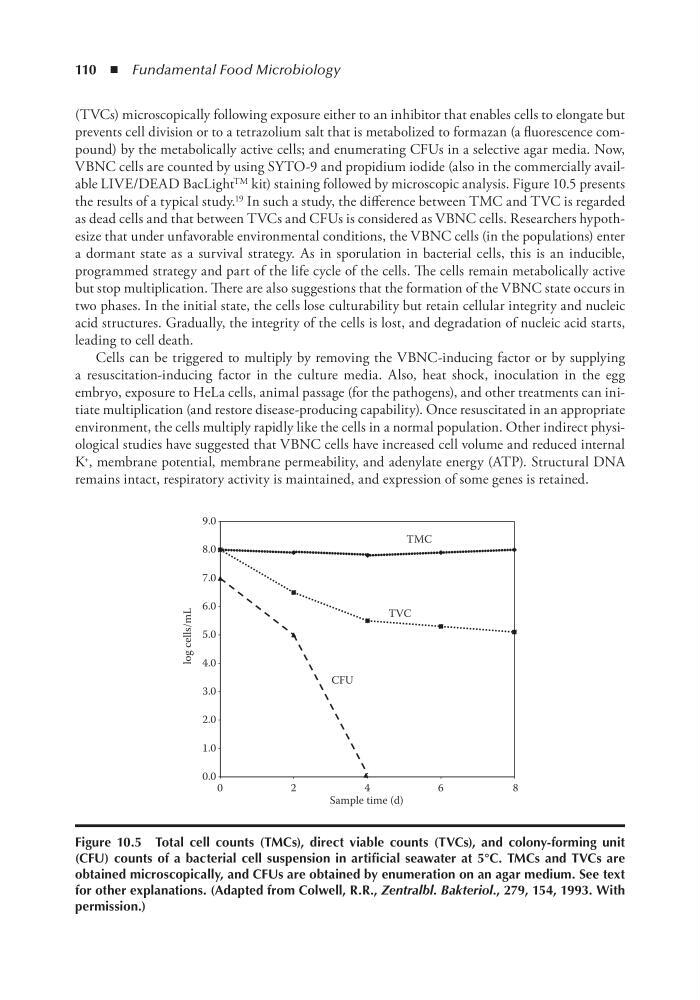
VBNC cells are counted by using SYTO-9 and propidium iodide (also in the commercially available LIVE/DEAD BacLight TM kit) staining followed by microscopic analysis. Figure 10.5 presents
the results of a typical study. 19 In such a study, the difference between TMC and TVC is regarded
as dead cells and that between TVCs and CFUs is considered as VBNC cells. Researchers hypothesize that under unfavorable environmental conditions, the VBNC cells (in the populations) enter
a dormant state as a survival strategy. As in sporulation in bacterial cells, this is an inducible,
programmed strategy and part of the life cycle of the cells. The cells remain metabolically active
but stop multiplication. There are also suggestions that the formation of the VBNC state occurs in
two phases. In the initial state, the cells lose culturability but retain cellular integrity and nucleic
acid structures. Gradually, the integrity of the cells is lost, and degradation of nucleic acid starts,
leading to cell death.
Cells can be triggered to multiply by removing the VBNC-inducing factor or by supplying
a resuscitation-inducing factor in the culture media. Also, heat shock, inoculation in the egg
embryo, exposure to HeLa cells, animal passage (for the pathogens), and other treatments can initiate multiplication (and restore disease-producing capability). Once resuscitated in an appropriate
environment, the cells multiply rapidly like the cells in a normal population. Other indirect physiological studies have suggested that VBNC cells have increased cell volume and reduced internal
K + , membrane potential, membrane permeability, and adenylate energy (ATP). Structural DNA
remains intact, respiratory activity is maintained, and expression of some genes is retained.
TVC
0.0
1.0
2.0
3.0
4.0
5.0
6.0
7.0
8.0
9.0
0
2
4
6
8
Sample time (d)
TMC
CFU
log cells/mL
Figure 10.5 total cell counts (tMCs), direct viable counts (tVCs), and colony-forming unit
(CFU) counts of a bacterial cell suspension in artificial seawater at 5°C. tMCs and tVCs are
obtained microscopically, and CFUs are obtained by enumeration on an agar medium. See text
for other explanations. (Adapted from Colwell, R.R., Zentralbl. Bakteriol., 279, 154, 1993. With
permission.)
(TVCs) microscopically following exposure either to an inhibitor that enables cells to elongate but
prevents cell division or to a tetrazolium salt that is metabolized to formazan (a fluorescence compound) by the metabolically active cells; and enumerating CFUs in a selective agar media. Now,
VBNC cells are counted by using SYTO-9 and propidium iodide (also in the commercially available LIVE/DEAD BacLight TM kit) staining followed by microscopic analysis. Figure 10.5 presents
the results of a typical study. 19 In such a study, the difference between TMC and TVC is regarded
as dead cells and that between TVCs and CFUs is considered as VBNC cells. Researchers hypothesize that under unfavorable environmental conditions, the VBNC cells (in the populations) enter
a dormant state as a survival strategy. As in sporulation in bacterial cells, this is an inducible,
programmed strategy and part of the life cycle of the cells. The cells remain metabolically active
but stop multiplication. There are also suggestions that the formation of the VBNC state occurs in
two phases. In the initial state, the cells lose culturability but retain cellular integrity and nucleic
acid structures. Gradually, the integrity of the cells is lost, and degradation of nucleic acid starts,
leading to cell death.
Cells can be triggered to multiply by removing the VBNC-inducing factor or by supplying
a resuscitation-inducing factor in the culture media. Also, heat shock, inoculation in the egg
embryo, exposure to HeLa cells, animal passage (for the pathogens), and other treatments can initiate multiplication (and restore disease-producing capability). Once resuscitated in an appropriate
environment, the cells multiply rapidly like the cells in a normal population. Other indirect physiological studies have suggested that VBNC cells have increased cell volume and reduced internal
K + , membrane potential, membrane permeability, and adenylate energy (ATP). Structural DNA
remains intact, respiratory activity is maintained, and expression of some genes is retained.
TVC
0.0
1.0
2.0
3.0
4.0
5.0
6.0
7.0
8.0
9.0
0
2
4
6
8
Sample time (d)
TMC
CFU
log cells/mL
Figure 10.5 total cell counts (tMCs), direct viable counts (tVCs), and colony-forming unit
(CFU) counts of a bacterial cell suspension in artificial seawater at 5°C. tMCs and tVCs are
obtained microscopically, and CFUs are obtained by enumeration on an agar medium. See text
for other explanations. (Adapted from Colwell, R.R., Zentralbl. Bakteriol., 279, 154, 1993. With
permission.)