

Microbial Stress Response in the Food Environment ◾ 107
Supplementation with catalase and pyruvate (to destroy H 2 O 2 produced by the cells) also enhances
repair and increases the number of repaired cells. It has been suggested that during the rapid repair
process, many cells generate H 2 O 2 but fail to hydrolyze it because of an injured peroxidase system.
Accumulated H 2 O 2 then causes cell death. A simple medium with a suitable energy source can also
enable some cells with low levels of injury to repair damage in the OM (or cell wall). Depending
on the sublethal stress, complete repair can be achieved in 1–6 hours at 25°C–37°C. For freezing
and drying injuries, the rate is very rapid; for heat injuries, the rate can be slow. Specific studies
show that the metabolic processes during repair vary with the nature of a stress and involve synthesis of ATP, RNA, DNA, and mucopeptide. Reorganization of the existing macromolecules can
also be an important event during the repair process. The cell wall (or OM) regains the ability to
prevent entrance of many chemicals to the cells; the cytoplasmic membrane (or IM) regains its
permeability barrier function as well as the enzymes; and RNA and DNA regain their original
characteristics. Finally, the cells regain their ability to multiply. Direct or indirect studies have
not been conducted to show that the repair process is associated with activation or inactivation of
genetic material.
Repair conditions for injured spores vary with the type (aerobic or anaerobic species) of spores.
The composition of media is very important; in addition to good carbon and nitrogen sources,
addition of special compounds, such as starch, a reducing compound (such as cysteine), lysozyme,
and divalent cations, may be necessary. Time, temperature, and gaseous environment also have to
be optimal for the species. Generally, a longer repair time is required by spores damaged by heat,
radiation, and chemicals than by low temperatures.
0
3
60
90
120
150
Nonselective
Selective
No repair (4°C)
Growth
Survivors
Dead
Injured
Before stress
Stress
Min at 30°C
Repair
8
6
4
2
0
log
CFUs/mL
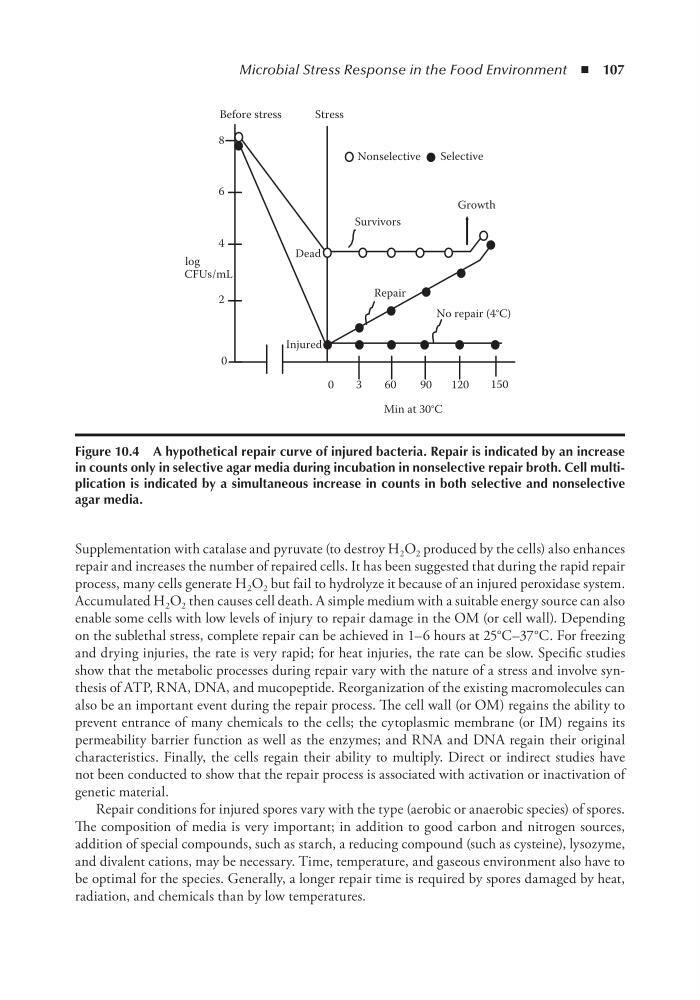
Figure 10.4 A hypothetical repair curve of injured bacteria. Repair is indicated by an increase
in counts only in selective agar media during incubation in nonselective repair broth. Cell multiplication is indicated by a simultaneous increase in counts in both selective and nonselective
agar media.
Supplementation with catalase and pyruvate (to destroy H 2 O 2 produced by the cells) also enhances
repair and increases the number of repaired cells. It has been suggested that during the rapid repair
process, many cells generate H 2 O 2 but fail to hydrolyze it because of an injured peroxidase system.
Accumulated H 2 O 2 then causes cell death. A simple medium with a suitable energy source can also
enable some cells with low levels of injury to repair damage in the OM (or cell wall). Depending
on the sublethal stress, complete repair can be achieved in 1–6 hours at 25°C–37°C. For freezing
and drying injuries, the rate is very rapid; for heat injuries, the rate can be slow. Specific studies
show that the metabolic processes during repair vary with the nature of a stress and involve synthesis of ATP, RNA, DNA, and mucopeptide. Reorganization of the existing macromolecules can
also be an important event during the repair process. The cell wall (or OM) regains the ability to
prevent entrance of many chemicals to the cells; the cytoplasmic membrane (or IM) regains its
permeability barrier function as well as the enzymes; and RNA and DNA regain their original
characteristics. Finally, the cells regain their ability to multiply. Direct or indirect studies have
not been conducted to show that the repair process is associated with activation or inactivation of
genetic material.
Repair conditions for injured spores vary with the type (aerobic or anaerobic species) of spores.
The composition of media is very important; in addition to good carbon and nitrogen sources,
addition of special compounds, such as starch, a reducing compound (such as cysteine), lysozyme,
and divalent cations, may be necessary. Time, temperature, and gaseous environment also have to
be optimal for the species. Generally, a longer repair time is required by spores damaged by heat,
radiation, and chemicals than by low temperatures.
0
3
60
90
120
150
Nonselective
Selective
No repair (4°C)
Growth
Survivors
Dead
Injured
Before stress
Stress
Min at 30°C
Repair
8
6
4
2
0
log
CFUs/mL
Figure 10.4 A hypothetical repair curve of injured bacteria. Repair is indicated by an increase
in counts only in selective agar media during incubation in nonselective repair broth. Cell multiplication is indicated by a simultaneous increase in counts in both selective and nonselective
agar media.