

Microbial Sporulation and Germination ◾ 97
Conclusion
Spore formation by certain yeasts, molds, and bacterial species is a means of survival and continuation of the life process. In yeasts and molds, sporulation occurs by asexual and sexual processes;
in bacteria, it occurs through differentiation, regulated and expressed by many genes.
Spore formation enables the dissemination of the species widely in the environment as well
as contamination of foods. Their growth in food can be undesirable when they cause spoilage
and produce toxins (except yeasts) in food and can be desirable in the processing of some foods.
Methods of destruction of spores and inhibition of germination of spores (of bacteria) by different
means are used to control their growth in food.
Some bacterial species sporulate as a means of survival strategy under conditions of physical,
chemical, or environmental stresses by genetically regulated processes. Cells of many bacterial species, when exposed to conditions suboptimal for growth or sublethal, manifest different characteristics, the control mechanisms of which are not properly understood currently. These conditions
are observed with many foodborne bacteria and have important implications in food microbiology, which are discussed in Chapter 10.
QUESTIONS
1. List the differences among mold, yeast, and bacterial spores.
2. List five genera of foodborne bacteria that form spores.
3. Draw and label the structure of a bacterial spore and discuss the functions or characteristics
of each structural component.
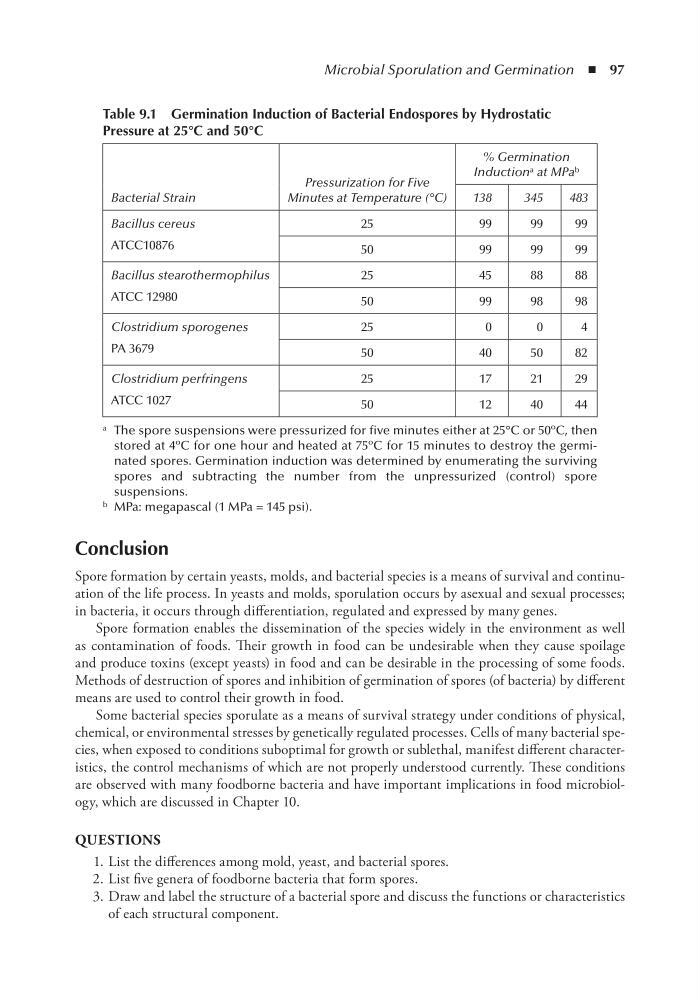
table 9.1 Germination induction of Bacterial endospores by Hydrostatic
Pressure at 25°C and 50°C
Bacterial Strain
Pressurization for Five
Minutes at Temperature (°C)
% Germination
Induction a at MPa b
138
345
483
Bacillus cereus
ATCC10876
25
99
99
99
50
99
99
99
Bacillus stearothermophilus
ATCC 12980
25
45
88
88
50
99
98
98
Clostridium sporogenes
PA 3679
25
0
0
4
50
40
50
82
Clostridium perfringens
ATCC 1027
25
17
21
29
50
12
40
44
a The spore suspensions were pressurized for five minutes either at 25°C or 50ºC, then
stored at 4ºC for one hour and heated at 75ºC for 15 minutes to destroy the germinated spores. Germination induction was determined by enumerating the surviving
spores and subtracting the number from the unpressurized (control) spore
suspensions.
b MPa: megapascal (1 MPa = 145 psi).
Conclusion
Spore formation by certain yeasts, molds, and bacterial species is a means of survival and continuation of the life process. In yeasts and molds, sporulation occurs by asexual and sexual processes;
in bacteria, it occurs through differentiation, regulated and expressed by many genes.
Spore formation enables the dissemination of the species widely in the environment as well
as contamination of foods. Their growth in food can be undesirable when they cause spoilage
and produce toxins (except yeasts) in food and can be desirable in the processing of some foods.
Methods of destruction of spores and inhibition of germination of spores (of bacteria) by different
means are used to control their growth in food.
Some bacterial species sporulate as a means of survival strategy under conditions of physical,
chemical, or environmental stresses by genetically regulated processes. Cells of many bacterial species, when exposed to conditions suboptimal for growth or sublethal, manifest different characteristics, the control mechanisms of which are not properly understood currently. These conditions
are observed with many foodborne bacteria and have important implications in food microbiology, which are discussed in Chapter 10.
QUESTIONS
1. List the differences among mold, yeast, and bacterial spores.
2. List five genera of foodborne bacteria that form spores.
3. Draw and label the structure of a bacterial spore and discuss the functions or characteristics
of each structural component.
table 9.1 Germination induction of Bacterial endospores by Hydrostatic
Pressure at 25°C and 50°C
Bacterial Strain
Pressurization for Five
Minutes at Temperature (°C)
% Germination
Induction a at MPa b
138
345
483
Bacillus cereus
ATCC10876
25
99
99
99
50
99
99
99
Bacillus stearothermophilus
ATCC 12980
25
45
88
88
50
99
98
98
Clostridium sporogenes
PA 3679
25
0
0
4
50
40
50
82
Clostridium perfringens
ATCC 1027
25
17
21
29
50
12
40
44
a The spore suspensions were pressurized for five minutes either at 25°C or 50ºC, then
stored at 4ºC for one hour and heated at 75ºC for 15 minutes to destroy the germinated spores. Germination induction was determined by enumerating the surviving
spores and subtracting the number from the unpressurized (control) spore
suspensions.
b MPa: megapascal (1 MPa = 145 psi).