

Microbial Metabolism of Food Components ◾ 87
Fermentation (Putrefaction)
Degradation of l-amino acids by anaerobic and facultative anaerobic bacteria is carried out either
with single amino acids or two amino acids in pairs. Metabolism of single amino acids is carried
out through different types of deamination (producing the C-skeletones and NH 3 ), decarboxylation (producing amines and CO 2 ), and hydrolysis (producing the C-skeletones, CO 2 , NH 3 , and
H 2 ). The C-skeletones (fatty acids, α-keto acids, and unsaturated acids) are then used to supply
energy and other metabolic products. The metabolism of amino acids in pairs involves simultaneous oxidation-reduction reactions between suitable pairs in which one acts as the hydrogen
donor (oxidized) and the other as the hydrogen acceptor (reduced). Alanine, leucine, and valine
can be oxidized, whereas glycine, proline, and arginine can be reduced by this type of reaction
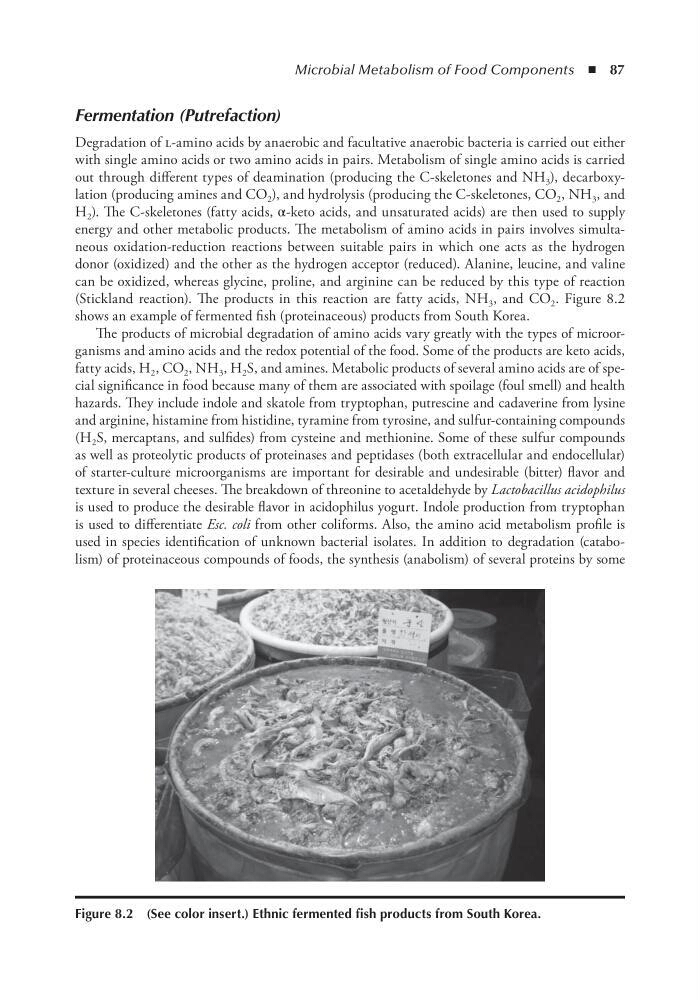
(Stickland reaction). The products in this reaction are fatty acids, NH 3 , and CO 2 . Figure 8.2
shows an example of fermented fish (proteinaceous) products from South Korea.
The products of microbial degradation of amino acids vary greatly with the types of microorganisms and amino acids and the redox potential of the food. Some of the products are keto acids,
fatty acids, H 2 , CO 2 , NH 3 , H 2 S, and amines. Metabolic products of several amino acids are of special significance in food because many of them are associated with spoilage (foul smell) and health
hazards. They include indole and skatole from tryptophan, putrescine and cadaverine from lysine
and arginine, histamine from histidine, tyramine from tyrosine, and sulfur-containing compounds
(H 2 S, mercaptans, and sulfides) from cysteine and methionine. Some of these sulfur compounds
as well as proteolytic products of proteinases and peptidases (both extracellular and endocellular)
of starter-culture microorganisms are important for desirable and undesirable (bitter) flavor and
texture in several cheeses. The breakdown of threonine to acetaldehyde by Lactobacillus acidophilus
is used to produce the desirable flavor in acidophilus yogurt. Indole production from tryptophan
is used to differentiate Esc. coli from other coliforms. Also, the amino acid metabolism profile is
used in species identification of unknown bacterial isolates. In addition to degradation (catabolism) of proteinaceous compounds of foods, the synthesis (anabolism) of several proteins by some
Figure 8.2 (See color insert.) ethnic fermented fish products from South Korea.
Fermentation (Putrefaction)
Degradation of l-amino acids by anaerobic and facultative anaerobic bacteria is carried out either
with single amino acids or two amino acids in pairs. Metabolism of single amino acids is carried
out through different types of deamination (producing the C-skeletones and NH 3 ), decarboxylation (producing amines and CO 2 ), and hydrolysis (producing the C-skeletones, CO 2 , NH 3 , and
H 2 ). The C-skeletones (fatty acids, α-keto acids, and unsaturated acids) are then used to supply
energy and other metabolic products. The metabolism of amino acids in pairs involves simultaneous oxidation-reduction reactions between suitable pairs in which one acts as the hydrogen
donor (oxidized) and the other as the hydrogen acceptor (reduced). Alanine, leucine, and valine
can be oxidized, whereas glycine, proline, and arginine can be reduced by this type of reaction
(Stickland reaction). The products in this reaction are fatty acids, NH 3 , and CO 2 . Figure 8.2
shows an example of fermented fish (proteinaceous) products from South Korea.
The products of microbial degradation of amino acids vary greatly with the types of microorganisms and amino acids and the redox potential of the food. Some of the products are keto acids,
fatty acids, H 2 , CO 2 , NH 3 , H 2 S, and amines. Metabolic products of several amino acids are of special significance in food because many of them are associated with spoilage (foul smell) and health
hazards. They include indole and skatole from tryptophan, putrescine and cadaverine from lysine
and arginine, histamine from histidine, tyramine from tyrosine, and sulfur-containing compounds
(H 2 S, mercaptans, and sulfides) from cysteine and methionine. Some of these sulfur compounds
as well as proteolytic products of proteinases and peptidases (both extracellular and endocellular)
of starter-culture microorganisms are important for desirable and undesirable (bitter) flavor and
texture in several cheeses. The breakdown of threonine to acetaldehyde by Lactobacillus acidophilus
is used to produce the desirable flavor in acidophilus yogurt. Indole production from tryptophan
is used to differentiate Esc. coli from other coliforms. Also, the amino acid metabolism profile is
used in species identification of unknown bacterial isolates. In addition to degradation (catabolism) of proteinaceous compounds of foods, the synthesis (anabolism) of several proteins by some
Figure 8.2 (See color insert.) ethnic fermented fish products from South Korea.