

82 ◾ Fundamental Food Microbiology
Degradation of Disaccharides
Disaccharides of foods, either present in food (lactose, sucrose) or produced through microbial degradation (maltose from starch), are hydrolyzed to monosaccharides inside the cell by specific enzymes:
lactose by lactase to galactose and glucose, sucrose by sucrase to glucose and fructose, and maltose by
maltase to glucose. Many microbial species cannot metabolize one or more disaccharides. 1–5
Degradation of Monosaccharides
Monosaccharides are degraded (catabolized) by aerobic, anaerobic, and facultative anaerobic microorganisms via several pathways that generate many types of intermediate and end products. The
metabolic pathways are dependent on the type and amount of monosaccharides, the type of microorganisms, and the redox potential of the system. Although all microorganisms important in foods
can metabolize glucose, they differ greatly in their ability to utilize fructose, galactose, tetroses, and
pentoses. Fermentable monosaccharides are metabolized by five major pathways, and many microbial species have more than one pathway. They are the Embden-Meyerhoff-Parnas (EMP) pathway,
the hexose monophosphate shunt (HMP) pathway, the Entner-Doudroff (ED) pathway, and two
phosphoketolase (PK) pathways (pentose phosphoketolase and hexose phosphoketolase). Pyruvic
acid produced via these pathways is subsequently metabolized by microorganisms in several different pathways through fermentation, anaerobic respiration, and aerobic respiration. 1–5
Fermentation
Monosaccharides are fermented by anaerobic and facultative microorganisms by the five major
pathways mentioned previously. 1–3 In addition, several other pathways are used, especially for the
metabolism of pyruvate, by some specific microbial species and groups. In general, the terminal
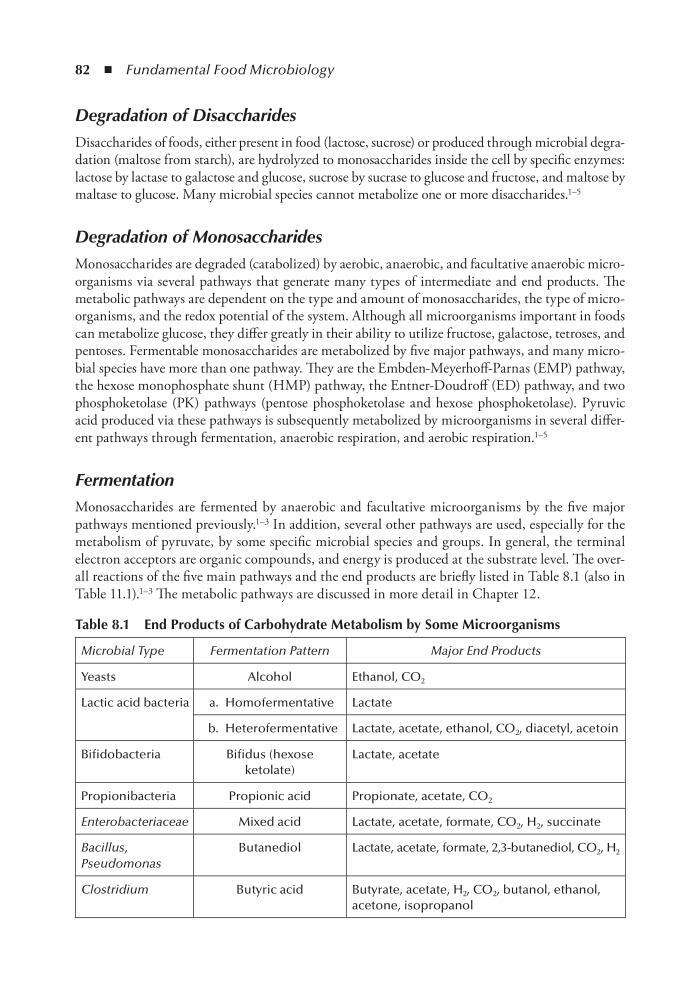
electron acceptors are organic compounds, and energy is produced at the substrate level. The overall reactions of the five main pathways and the end products are briefly listed in Table 8.1 (also in
Table 11.1). 1–3 The metabolic pathways are discussed in more detail in Chapter 12.
table 8.1 end Products of Carbohydrate Metabolism by Some Microorganisms
Microbial Type
Fermentation Pattern
Major End Products
Yeasts
Alcohol
Ethanol, CO 2
Lactic acid bacteria
a. Homofermentative Lactate
b. Heterofermentative Lactate, acetate, ethanol, CO 2 , diacetyl, acetoin
Bifidobacteria
Bifidus (hexose
ketolate)
Lactate, acetate
Propionibacteria
Propionic acid
Propionate, acetate, CO 2
Enterobacteriaceae
Mixed acid
Lactate, acetate, formate, CO 2 , H 2 , succinate
Bacillus,
Pseudomonas
Butanediol
Lactate, acetate, formate, 2,3-butanediol, CO 2 , H 2
Clostridium
Butyric acid
Butyrate, acetate, H 2 , CO 2 , butanol, ethanol,
acetone, isopropanol
Degradation of Disaccharides
Disaccharides of foods, either present in food (lactose, sucrose) or produced through microbial degradation (maltose from starch), are hydrolyzed to monosaccharides inside the cell by specific enzymes:
lactose by lactase to galactose and glucose, sucrose by sucrase to glucose and fructose, and maltose by
maltase to glucose. Many microbial species cannot metabolize one or more disaccharides. 1–5
Degradation of Monosaccharides
Monosaccharides are degraded (catabolized) by aerobic, anaerobic, and facultative anaerobic microorganisms via several pathways that generate many types of intermediate and end products. The
metabolic pathways are dependent on the type and amount of monosaccharides, the type of microorganisms, and the redox potential of the system. Although all microorganisms important in foods
can metabolize glucose, they differ greatly in their ability to utilize fructose, galactose, tetroses, and
pentoses. Fermentable monosaccharides are metabolized by five major pathways, and many microbial species have more than one pathway. They are the Embden-Meyerhoff-Parnas (EMP) pathway,
the hexose monophosphate shunt (HMP) pathway, the Entner-Doudroff (ED) pathway, and two
phosphoketolase (PK) pathways (pentose phosphoketolase and hexose phosphoketolase). Pyruvic
acid produced via these pathways is subsequently metabolized by microorganisms in several different pathways through fermentation, anaerobic respiration, and aerobic respiration. 1–5
Fermentation
Monosaccharides are fermented by anaerobic and facultative microorganisms by the five major
pathways mentioned previously. 1–3 In addition, several other pathways are used, especially for the
metabolism of pyruvate, by some specific microbial species and groups. In general, the terminal
electron acceptors are organic compounds, and energy is produced at the substrate level. The overall reactions of the five main pathways and the end products are briefly listed in Table 8.1 (also in
Table 11.1). 1–3 The metabolic pathways are discussed in more detail in Chapter 12.
table 8.1 end Products of Carbohydrate Metabolism by Some Microorganisms
Microbial Type
Fermentation Pattern
Major End Products
Yeasts
Alcohol
Ethanol, CO 2
Lactic acid bacteria
a. Homofermentative Lactate
b. Heterofermentative Lactate, acetate, ethanol, CO 2 , diacetyl, acetoin
Bifidobacteria
Bifidus (hexose
ketolate)
Lactate, acetate
Propionibacteria
Propionic acid
Propionate, acetate, CO 2
Enterobacteriaceae
Mixed acid
Lactate, acetate, formate, CO 2 , H 2 , succinate
Bacillus,
Pseudomonas
Butanediol
Lactate, acetate, formate, 2,3-butanediol, CO 2 , H 2
Clostridium
Butyric acid
Butyrate, acetate, H 2 , CO 2 , butanol, ethanol,
acetone, isopropanol