

74 ◾ Fundamental Food Microbiology
delayed following equipment use. Finally, microbial attachment and biofilm formation in the
food-processing environment, such as floors, walls, hoses, and drains, enable the cells to establish in the environment, and they become difficult to control effectively by the methods developed and designed to work against the unattached microorganisms from a culture broth. These
places, in turn, can be a constant source of undesirable microorganisms for foods handled in the
environment.
The concept and importance of microbial attachment and biofilm formation in solid food,
equipment, and food environments are now being recognized. 1–4 Limited studies have shown that
under suitable conditions, many of the microorganisms important in food can form a biofilm.
Several species and strains of Pseudomonas were found to attach to stainless steel surfaces, some
within 30 minutes at 25°C to within two hours at 4°C. Listeria monocytogenes was found to attach
to stainless steel, glass, and rubber surfaces within 20 minutes of contact. Attachment of several pathogenic and spoilage bacteria has also been demonstrated on meat and carcasses of poultry, beef, pork, and lamb. The microorganisms found to attach to meat surfaces include Listeria
monocytogenes, Micrococcus spp., Staphylococcus spp., Clostridium spp., Bacillus spp., Lactobacillus
spp., Brochothrix thermosphacta, Salmonella, Escherichia coli, Serratia spp., Campylobacter, and
Pseudomonas spp. It is apparent from the limited data that microbial attachment to solid food and
food contact surfaces is quite wide and needs to be considered in controlling the microbiological
quality of food.
Mechanisms of Attachment
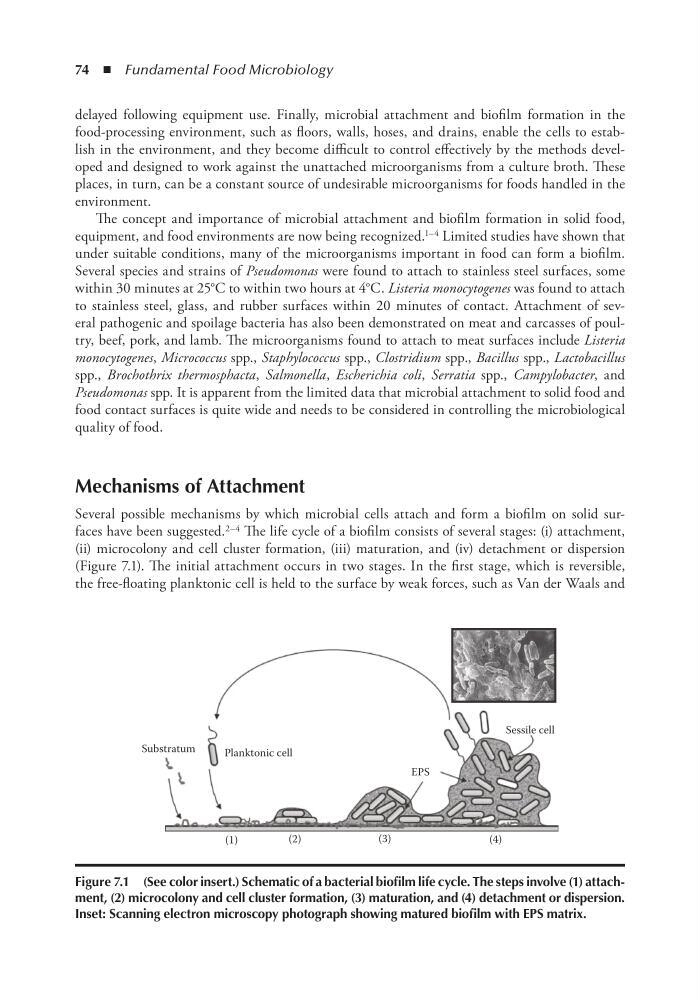
Several possible mechanisms by which microbial cells attach and form a biofilm on solid surfaces have been suggested. 2–4 The life cycle of a biofilm consists of several stages: (i) attachment,
(ii) microcolony and cell cluster formation, (iii) maturation, and (iv) detachment or dispersion
(Figure 7.1). The initial attachment occurs in two stages. In the first stage, which is reversible,
the free-floating planktonic cell is held to the surface by weak forces, such as Van der Waals and
Planktonic cell
Substratum
EPS
Sessile cell
(1)
(4)
(3)
(2)
Figure 7.1 (See color insert.) Schematic of a bacterial biofilm life cycle. the steps involve (1) attachment, (2) microcolony and cell cluster formation, (3) maturation, and (4) detachment or dispersion.
inset: Scanning electron microscopy photograph showing matured biofilm with ePS matrix.
delayed following equipment use. Finally, microbial attachment and biofilm formation in the
food-processing environment, such as floors, walls, hoses, and drains, enable the cells to establish in the environment, and they become difficult to control effectively by the methods developed and designed to work against the unattached microorganisms from a culture broth. These
places, in turn, can be a constant source of undesirable microorganisms for foods handled in the
environment.
The concept and importance of microbial attachment and biofilm formation in solid food,
equipment, and food environments are now being recognized. 1–4 Limited studies have shown that
under suitable conditions, many of the microorganisms important in food can form a biofilm.
Several species and strains of Pseudomonas were found to attach to stainless steel surfaces, some
within 30 minutes at 25°C to within two hours at 4°C. Listeria monocytogenes was found to attach
to stainless steel, glass, and rubber surfaces within 20 minutes of contact. Attachment of several pathogenic and spoilage bacteria has also been demonstrated on meat and carcasses of poultry, beef, pork, and lamb. The microorganisms found to attach to meat surfaces include Listeria
monocytogenes, Micrococcus spp., Staphylococcus spp., Clostridium spp., Bacillus spp., Lactobacillus
spp., Brochothrix thermosphacta, Salmonella, Escherichia coli, Serratia spp., Campylobacter, and
Pseudomonas spp. It is apparent from the limited data that microbial attachment to solid food and
food contact surfaces is quite wide and needs to be considered in controlling the microbiological
quality of food.
Mechanisms of Attachment
Several possible mechanisms by which microbial cells attach and form a biofilm on solid surfaces have been suggested. 2–4 The life cycle of a biofilm consists of several stages: (i) attachment,
(ii) microcolony and cell cluster formation, (iii) maturation, and (iv) detachment or dispersion
(Figure 7.1). The initial attachment occurs in two stages. In the first stage, which is reversible,
the free-floating planktonic cell is held to the surface by weak forces, such as Van der Waals and
Planktonic cell
Substratum
EPS
Sessile cell
(1)
(4)
(3)
(2)
Figure 7.1 (See color insert.) Schematic of a bacterial biofilm life cycle. the steps involve (1) attachment, (2) microcolony and cell cluster formation, (3) maturation, and (4) detachment or dispersion.
inset: Scanning electron microscopy photograph showing matured biofilm with ePS matrix.