

54 ◾ Fundamental Food Microbiology
nutrients into and byproducts out of the cell. To increase the (s/v) ratio, the cell initiates division
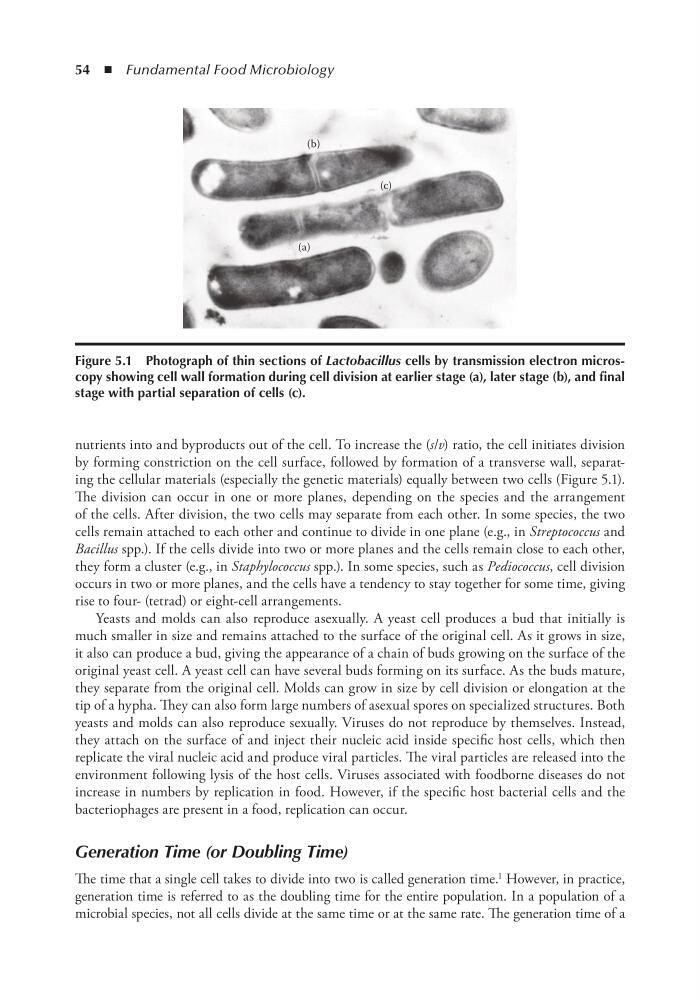
by forming constriction on the cell surface, followed by formation of a transverse wall, separating the cellular materials (especially the genetic materials) equally between two cells (Figure 5.1).
The division can occur in one or more planes, depending on the species and the arrangement
of the cells. After division, the two cells may separate from each other. In some species, the two
cells remain attached to each other and continue to divide in one plane (e.g., in Streptococcus and
Bacillus spp.). If the cells divide into two or more planes and the cells remain close to each other,
they form a cluster (e.g., in Staphylococcus spp.). In some species, such as Pediococcus, cell division
occurs in two or more planes, and the cells have a tendency to stay together for some time, giving
rise to four- (tetrad) or eight-cell arrangements.
Yeasts and molds can also reproduce asexually. A yeast cell produces a bud that initially is
much smaller in size and remains attached to the surface of the original cell. As it grows in size,
it also can produce a bud, giving the appearance of a chain of buds growing on the surface of the
original yeast cell. A yeast cell can have several buds forming on its surface. As the buds mature,
they separate from the original cell. Molds can grow in size by cell division or elongation at the
tip of a hypha. They can also form large numbers of asexual spores on specialized structures. Both
yeasts and molds can also reproduce sexually. Viruses do not reproduce by themselves. Instead,
they attach on the surface of and inject their nucleic acid inside specific host cells, which then
replicate the viral nucleic acid and produce viral particles. The viral particles are released into the
environment following lysis of the host cells. Viruses associated with foodborne diseases do not
increase in numbers by replication in food. However, if the specific host bacterial cells and the
bacteriophages are present in a food, replication can occur.
Generation Time (or Doubling Time)
The time that a single cell takes to divide into two is called generation time. 1 However, in practice,
generation time is referred to as the doubling time for the entire population. In a population of a
microbial species, not all cells divide at the same time or at the same rate. The generation time of a
(b)
(c)
(a)
Figure 5.1 Photograph of thin sections of Lactobacillus cells by transmission electron microscopy showing cell wall formation during cell division at earlier stage (a), later stage (b), and final
stage with partial separation of cells (c).
nutrients into and byproducts out of the cell. To increase the (s/v) ratio, the cell initiates division
by forming constriction on the cell surface, followed by formation of a transverse wall, separating the cellular materials (especially the genetic materials) equally between two cells (Figure 5.1).
The division can occur in one or more planes, depending on the species and the arrangement
of the cells. After division, the two cells may separate from each other. In some species, the two
cells remain attached to each other and continue to divide in one plane (e.g., in Streptococcus and
Bacillus spp.). If the cells divide into two or more planes and the cells remain close to each other,
they form a cluster (e.g., in Staphylococcus spp.). In some species, such as Pediococcus, cell division
occurs in two or more planes, and the cells have a tendency to stay together for some time, giving
rise to four- (tetrad) or eight-cell arrangements.
Yeasts and molds can also reproduce asexually. A yeast cell produces a bud that initially is
much smaller in size and remains attached to the surface of the original cell. As it grows in size,
it also can produce a bud, giving the appearance of a chain of buds growing on the surface of the
original yeast cell. A yeast cell can have several buds forming on its surface. As the buds mature,
they separate from the original cell. Molds can grow in size by cell division or elongation at the
tip of a hypha. They can also form large numbers of asexual spores on specialized structures. Both
yeasts and molds can also reproduce sexually. Viruses do not reproduce by themselves. Instead,
they attach on the surface of and inject their nucleic acid inside specific host cells, which then
replicate the viral nucleic acid and produce viral particles. The viral particles are released into the
environment following lysis of the host cells. Viruses associated with foodborne diseases do not
increase in numbers by replication in food. However, if the specific host bacterial cells and the
bacteriophages are present in a food, replication can occur.
Generation Time (or Doubling Time)
The time that a single cell takes to divide into two is called generation time. 1 However, in practice,
generation time is referred to as the doubling time for the entire population. In a population of a
microbial species, not all cells divide at the same time or at the same rate. The generation time of a
(b)
(c)
(a)
Figure 5.1 Photograph of thin sections of Lactobacillus cells by transmission electron microscopy showing cell wall formation during cell division at earlier stage (a), later stage (b), and final
stage with partial separation of cells (c).