

63
biodegradability of the composite also enhances (Kristo and Biliaderis 2007).
However there are safety issues related to nanomaterials as their size may allow
them to penetrate into cells, which can be toxic to human body but there is limited
scientific data about their eventual toxicological effects.
Encapsulation of Bioactive Compounds
Encapsulation is defined as a technology of packaging solids, liquids, or gaseous
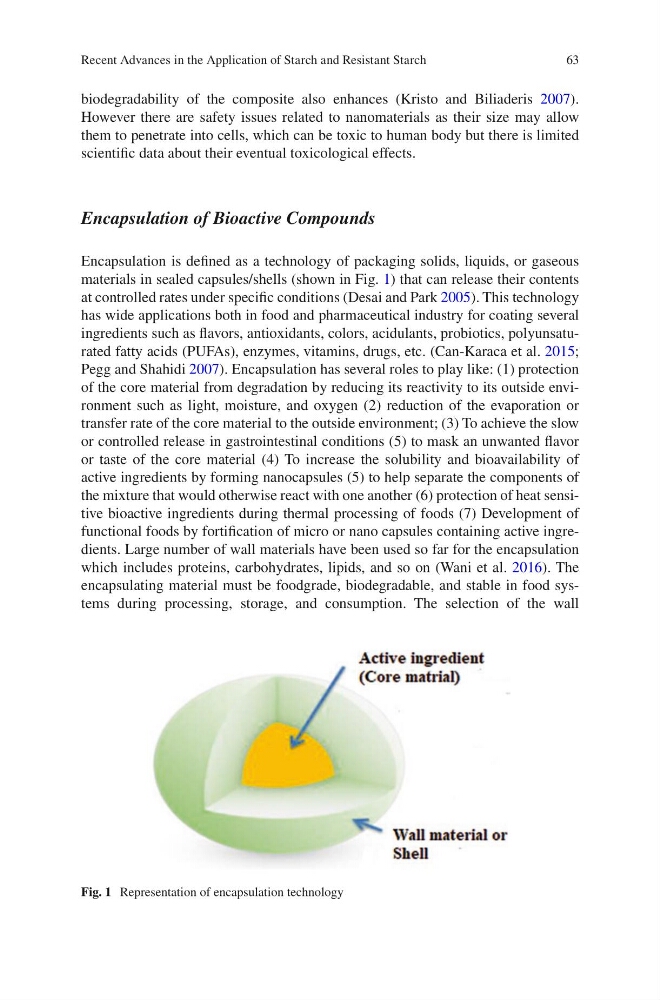
materials in sealed capsules/shells (shown in Fig. 1) that can release their contents
at controlled rates under specific conditions (Desai and Park 2005). This technology
has wide applications both in food and pharmaceutical industry for coating several
ingredients such as flavors, antioxidants, colors, acidulants, probiotics, polyunsaturated fatty acids (PUFAs), enzymes, vitamins, drugs, etc. (Can-Karaca et al. 2015;
Pegg and Shahidi 2007). Encapsulation has several roles to play like: (1) protection
of the core material from degradation by reducing its reactivity to its outside environment such as light, moisture, and oxygen (2) reduction of the evaporation or
transfer rate of the core material to the outside environment; (3) To achieve the slow
or controlled release in gastrointestinal conditions (5) to mask an unwanted flavor
or taste of the core material (4) To increase the solubility and bioavailability of
active ingredients by forming nanocapsules (5) to help separate the components of
the mixture that would otherwise react with one another (6) protection of heat sensitive bioactive ingredients during thermal processing of foods (7) Development of
functional foods by fortification of micro or nano capsules containing active ingredients. Large number of wall materials have been used so far for the encapsulation
which includes proteins, carbohydrates, lipids, and so on (Wani et al. 2016). The
encapsulating material must be foodgrade, biodegradable, and stable in food systems during processing, storage, and consumption. The selection of the wall
Fig. 1 Representation of encapsulation technology
Recent Advances in the Application of Starch and Resistant Starch
biodegradability of the composite also enhances (Kristo and Biliaderis 2007).
However there are safety issues related to nanomaterials as their size may allow
them to penetrate into cells, which can be toxic to human body but there is limited
scientific data about their eventual toxicological effects.
Encapsulation of Bioactive Compounds
Encapsulation is defined as a technology of packaging solids, liquids, or gaseous
materials in sealed capsules/shells (shown in Fig. 1) that can release their contents
at controlled rates under specific conditions (Desai and Park 2005). This technology
has wide applications both in food and pharmaceutical industry for coating several
ingredients such as flavors, antioxidants, colors, acidulants, probiotics, polyunsaturated fatty acids (PUFAs), enzymes, vitamins, drugs, etc. (Can-Karaca et al. 2015;
Pegg and Shahidi 2007). Encapsulation has several roles to play like: (1) protection
of the core material from degradation by reducing its reactivity to its outside environment such as light, moisture, and oxygen (2) reduction of the evaporation or
transfer rate of the core material to the outside environment; (3) To achieve the slow
or controlled release in gastrointestinal conditions (5) to mask an unwanted flavor
or taste of the core material (4) To increase the solubility and bioavailability of
active ingredients by forming nanocapsules (5) to help separate the components of
the mixture that would otherwise react with one another (6) protection of heat sensitive bioactive ingredients during thermal processing of foods (7) Development of
functional foods by fortification of micro or nano capsules containing active ingredients. Large number of wall materials have been used so far for the encapsulation
which includes proteins, carbohydrates, lipids, and so on (Wani et al. 2016). The
encapsulating material must be foodgrade, biodegradable, and stable in food systems during processing, storage, and consumption. The selection of the wall
Fig. 1 Representation of encapsulation technology
Recent Advances in the Application of Starch and Resistant Starch