

44
texture, appearance, and mouth feel compared with traditional high-fiber products;
they increase coating crispness of products and the bowl life of breakfast cereals.
They are functional food ingredients lowering the calorific value of foods and useful
in products for celiacs, as bulk laxatives and in products for oral rehydration therapy
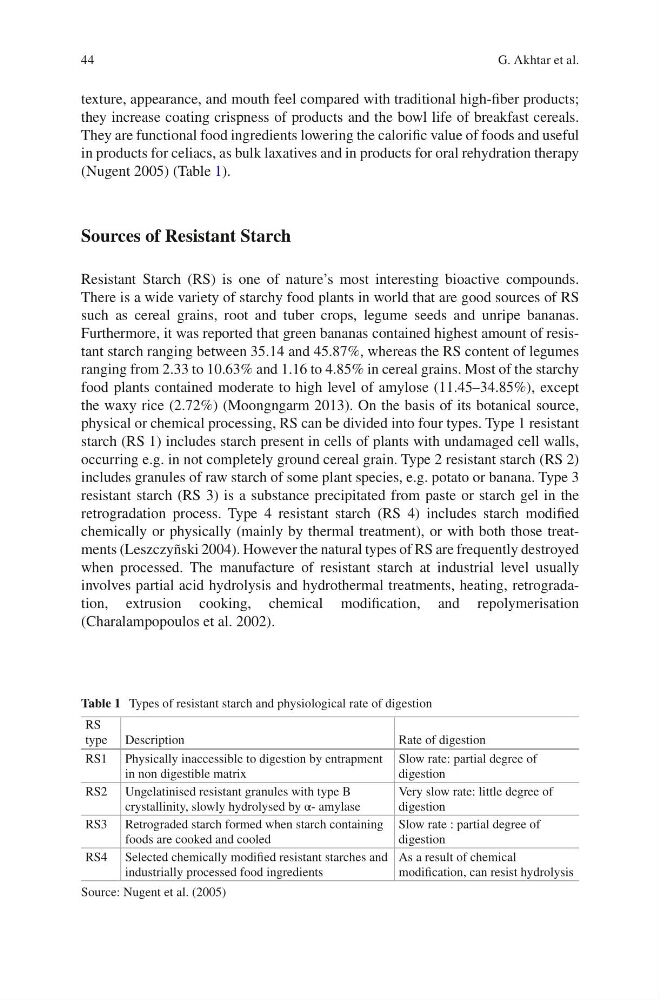
(Nugent 2005) (Table 1).
Sources of Resistant Starch
Resistant Starch (RS) is one of nature’s most interesting bioactive compounds.
There is a wide variety of starchy food plants in world that are good sources of RS
such as cereal grains, root and tuber crops, legume seeds and unripe bananas.
Furthermore, it was reported that green bananas contained highest amount of resistant starch ranging between 35.14 and 45.87%, whereas the RS content of legumes
ranging from 2.33 to 10.63% and 1.16 to 4.85% in cereal grains. Most of the starchy
food plants contained moderate to high level of amylose (11.45–34.85%), except
the waxy rice (2.72%) (Moongngarm 2013). On the basis of its botanical source,
physical or chemical processing, RS can be divided into four types. Type 1 resistant
starch (RS 1) includes starch present in cells of plants with undamaged cell walls,
occurring e.g. in not completely ground cereal grain. Type 2 resistant starch (RS 2)
includes granules of raw starch of some plant species, e.g. potato or banana. Type 3
resistant starch (RS 3) is a substance precipitated from paste or starch gel in the
retrogradation process. Type 4 resistant starch (RS 4) includes starch modified
chemically or physically (mainly by thermal treatment), or with both those treatments (Leszczyñski 2004). However the natural types of RS are frequently destroyed
when processed. The manufacture of resistant starch at industrial level usually
involves partial acid hydrolysis and hydrothermal treatments, heating, retrogradation, extrusion cooking, chemical modification, and repolymerisation
(Charalampopoulos et al. 2002).
Table 1 Types of resistant starch and physiological rate of digestion
RS
type Description
Rate of digestion
RS1 Physically inaccessible to digestion by entrapment
in non digestible matrix
Slow rate: partial degree of
digestion
RS2 Ungelatinised resistant granules with type B
crystallinity, slowly hydrolysed by α- amylase
Very slow rate: little degree of
digestion
RS3 Retrograded starch formed when starch containing
foods are cooked and cooled
Slow rate : partial degree of
digestion
RS4 Selected chemically modified resistant starches and
industrially processed food ingredients
As a result of chemical
modification, can resist hydrolysis
Source: Nugent et al. (2005)
G. Akhtar et al.
texture, appearance, and mouth feel compared with traditional high-fiber products;
they increase coating crispness of products and the bowl life of breakfast cereals.
They are functional food ingredients lowering the calorific value of foods and useful
in products for celiacs, as bulk laxatives and in products for oral rehydration therapy
(Nugent 2005) (Table 1).
Sources of Resistant Starch
Resistant Starch (RS) is one of nature’s most interesting bioactive compounds.
There is a wide variety of starchy food plants in world that are good sources of RS
such as cereal grains, root and tuber crops, legume seeds and unripe bananas.
Furthermore, it was reported that green bananas contained highest amount of resistant starch ranging between 35.14 and 45.87%, whereas the RS content of legumes
ranging from 2.33 to 10.63% and 1.16 to 4.85% in cereal grains. Most of the starchy
food plants contained moderate to high level of amylose (11.45–34.85%), except
the waxy rice (2.72%) (Moongngarm 2013). On the basis of its botanical source,
physical or chemical processing, RS can be divided into four types. Type 1 resistant
starch (RS 1) includes starch present in cells of plants with undamaged cell walls,
occurring e.g. in not completely ground cereal grain. Type 2 resistant starch (RS 2)
includes granules of raw starch of some plant species, e.g. potato or banana. Type 3
resistant starch (RS 3) is a substance precipitated from paste or starch gel in the
retrogradation process. Type 4 resistant starch (RS 4) includes starch modified
chemically or physically (mainly by thermal treatment), or with both those treatments (Leszczyñski 2004). However the natural types of RS are frequently destroyed
when processed. The manufacture of resistant starch at industrial level usually
involves partial acid hydrolysis and hydrothermal treatments, heating, retrogradation, extrusion cooking, chemical modification, and repolymerisation
(Charalampopoulos et al. 2002).
Table 1 Types of resistant starch and physiological rate of digestion
RS
type Description
Rate of digestion
RS1 Physically inaccessible to digestion by entrapment
in non digestible matrix
Slow rate: partial degree of
digestion
RS2 Ungelatinised resistant granules with type B
crystallinity, slowly hydrolysed by α- amylase
Very slow rate: little degree of
digestion
RS3 Retrograded starch formed when starch containing
foods are cooked and cooled
Slow rate : partial degree of
digestion
RS4 Selected chemically modified resistant starches and
industrially processed food ingredients
As a result of chemical
modification, can resist hydrolysis
Source: Nugent et al. (2005)
G. Akhtar et al.