

400
SFC
L
S
L
u
U U
U U
100
(1)
where ρ is the density of the lipid at a particular temperature, and ρ L and ρ S are the
densities of the lipid when liquid or solid at the same temperature.
Recent techniques such as differential scanning calorimetry (DSC), and nuclear
magnetic resonance (NMR) are used to replace density measurements for quick and
easy measurement of changes in SFC. DSC measure the heat evolved or absorbed
by a lipid when it crystallizes or melts. NMR basically involves the application of
radio frequency pulse, inducing a NMR signal on the sample with a decay rate
depending on whether the lipid is solid or liquid. The signal from the solid fat decays
much more rapidly than the signal from the liquid oil and therefore it is possible to
distinguish between these two components. Also, the melting point of fat can be
determined using this SFC-temperature profile measurement (Braipson-Danthine
and Deroanne 2006).
Melting Point
The melting profile of a fat plays a significant role in determining the mechanical
characteristics of fat rich product such butter, and ice cream. In most situations,
measuring the melting point (at which it starts and ends) gives needed information
instead of determining SFC over the whole range of temperature. Melting point
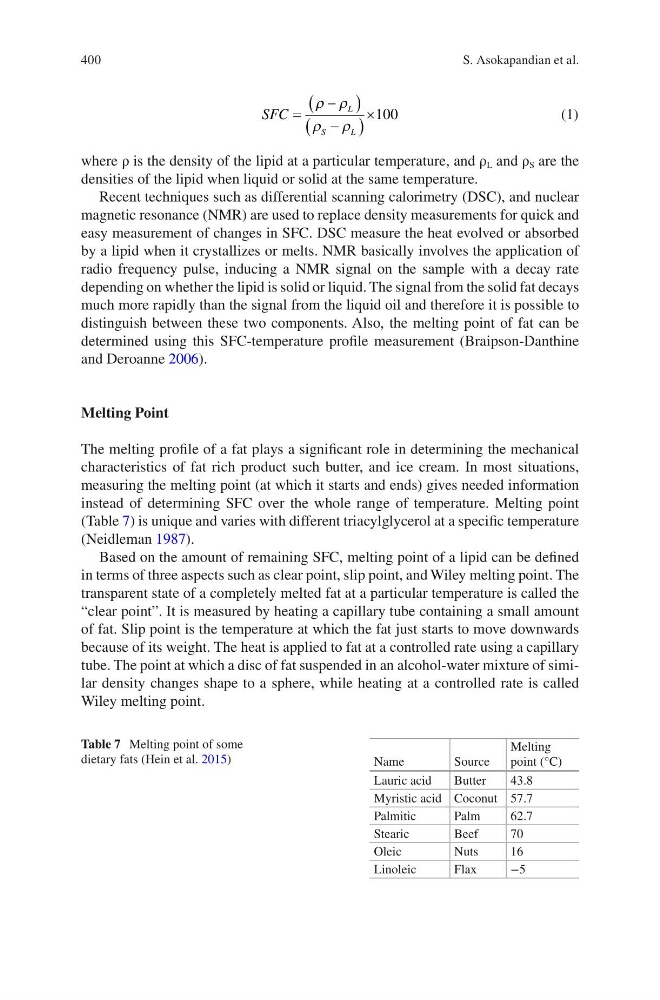
(Table 7) is unique and varies with different triacylglycerol at a specific temperature
(Neidleman 1987).
Based on the amount of remaining SFC, melting point of a lipid can be defined
in terms of three aspects such as clear point, slip point, and Wiley melting point. The
transparent state of a completely melted fat at a particular temperature is called the
“clear point”. It is measured by heating a capillary tube containing a small amount
of fat. Slip point is the temperature at which the fat just starts to move downwards
because of its weight. The heat is applied to fat at a controlled rate using a capillary
tube. The point at which a disc of fat suspended in an alcohol-water mixture of similar density changes shape to a sphere, while heating at a controlled rate is called
Wiley melting point.
Table 7 Melting point of some
dietary fats (Hein et al. 2015)
Name
Source
Melting
point (°C)
Lauric acid
Butter
43.8
Myristic acid Coconut 57.7
Palmitic
Palm
62.7
Stearic
Beef
70
Oleic
Nuts
16
Linoleic
Flax
−5
S. Asokapandian et al.
SFC
L
S
L
u
U U
U U
100
(1)
where ρ is the density of the lipid at a particular temperature, and ρ L and ρ S are the
densities of the lipid when liquid or solid at the same temperature.
Recent techniques such as differential scanning calorimetry (DSC), and nuclear
magnetic resonance (NMR) are used to replace density measurements for quick and
easy measurement of changes in SFC. DSC measure the heat evolved or absorbed
by a lipid when it crystallizes or melts. NMR basically involves the application of
radio frequency pulse, inducing a NMR signal on the sample with a decay rate
depending on whether the lipid is solid or liquid. The signal from the solid fat decays
much more rapidly than the signal from the liquid oil and therefore it is possible to
distinguish between these two components. Also, the melting point of fat can be
determined using this SFC-temperature profile measurement (Braipson-Danthine
and Deroanne 2006).
Melting Point
The melting profile of a fat plays a significant role in determining the mechanical
characteristics of fat rich product such butter, and ice cream. In most situations,
measuring the melting point (at which it starts and ends) gives needed information
instead of determining SFC over the whole range of temperature. Melting point
(Table 7) is unique and varies with different triacylglycerol at a specific temperature
(Neidleman 1987).
Based on the amount of remaining SFC, melting point of a lipid can be defined
in terms of three aspects such as clear point, slip point, and Wiley melting point. The
transparent state of a completely melted fat at a particular temperature is called the
“clear point”. It is measured by heating a capillary tube containing a small amount
of fat. Slip point is the temperature at which the fat just starts to move downwards
because of its weight. The heat is applied to fat at a controlled rate using a capillary
tube. The point at which a disc of fat suspended in an alcohol-water mixture of similar density changes shape to a sphere, while heating at a controlled rate is called
Wiley melting point.
Table 7 Melting point of some
dietary fats (Hein et al. 2015)
Name
Source
Melting
point (°C)
Lauric acid
Butter
43.8
Myristic acid Coconut 57.7
Palmitic
Palm
62.7
Stearic
Beef
70
Oleic
Nuts
16
Linoleic
Flax
−5
S. Asokapandian et al.