

392
Fats and Oils
Fats and oils are made of three elements such as carbon (C), hydrogen (H), and
oxygen (O). These three elements combine together to form fatty acid. These three
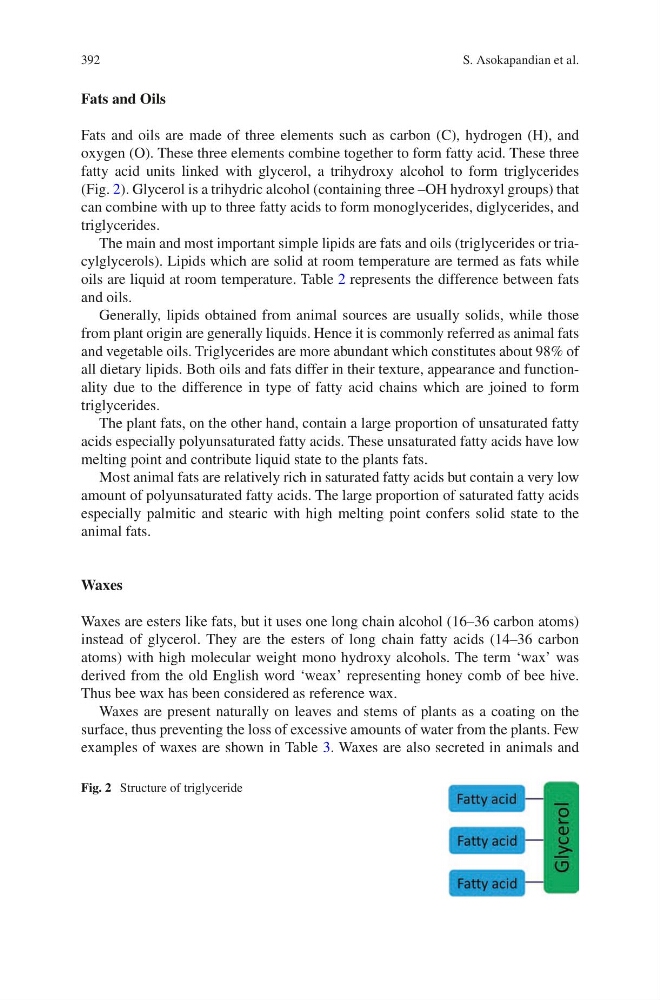
fatty acid units linked with glycerol, a trihydroxy alcohol to form triglycerides
(Fig. 2). Glycerol is a trihydric alcohol (containing three –OH hydroxyl groups) that
can combine with up to three fatty acids to form monoglycerides, diglycerides, and
triglycerides.
The main and most important simple lipids are fats and oils (triglycerides or triacylglycerols). Lipids which are solid at room temperature are termed as fats while
oils are liquid at room temperature. Table 2 represents the difference between fats
and oils.
Generally, lipids obtained from animal sources are usually solids, while those
from plant origin are generally liquids. Hence it is commonly referred as animal fats
and vegetable oils. Triglycerides are more abundant which constitutes about 98% of
all dietary lipids. Both oils and fats differ in their texture, appearance and functionality due to the difference in type of fatty acid chains which are joined to form
triglycerides.
The plant fats, on the other hand, contain a large proportion of unsaturated fatty
acids especially polyunsaturated fatty acids. These unsaturated fatty acids have low
melting point and contribute liquid state to the plants fats.
Most animal fats are relatively rich in saturated fatty acids but contain a very low
amount of polyunsaturated fatty acids. The large proportion of saturated fatty acids
especially palmitic and stearic with high melting point confers solid state to the
animal fats.
Waxes
Waxes are esters like fats, but it uses one long chain alcohol (16–36 carbon atoms)
instead of glycerol. They are the esters of long chain fatty acids (14–36 carbon
atoms) with high molecular weight mono hydroxy alcohols. The term ‘wax’ was
derived from the old English word ‘weax’ representing honey comb of bee hive.
Thus bee wax has been considered as reference wax.
Waxes are present naturally on leaves and stems of plants as a coating on the
surface, thus preventing the loss of excessive amounts of water from the plants. Few
examples of waxes are shown in Table 3. Waxes are also secreted in animals and
Fig. 2 Structure of triglyceride
S. Asokapandian et al.
Fats and Oils
Fats and oils are made of three elements such as carbon (C), hydrogen (H), and
oxygen (O). These three elements combine together to form fatty acid. These three
fatty acid units linked with glycerol, a trihydroxy alcohol to form triglycerides
(Fig. 2). Glycerol is a trihydric alcohol (containing three –OH hydroxyl groups) that
can combine with up to three fatty acids to form monoglycerides, diglycerides, and
triglycerides.
The main and most important simple lipids are fats and oils (triglycerides or triacylglycerols). Lipids which are solid at room temperature are termed as fats while
oils are liquid at room temperature. Table 2 represents the difference between fats
and oils.
Generally, lipids obtained from animal sources are usually solids, while those
from plant origin are generally liquids. Hence it is commonly referred as animal fats
and vegetable oils. Triglycerides are more abundant which constitutes about 98% of
all dietary lipids. Both oils and fats differ in their texture, appearance and functionality due to the difference in type of fatty acid chains which are joined to form
triglycerides.
The plant fats, on the other hand, contain a large proportion of unsaturated fatty
acids especially polyunsaturated fatty acids. These unsaturated fatty acids have low
melting point and contribute liquid state to the plants fats.
Most animal fats are relatively rich in saturated fatty acids but contain a very low
amount of polyunsaturated fatty acids. The large proportion of saturated fatty acids
especially palmitic and stearic with high melting point confers solid state to the
animal fats.
Waxes
Waxes are esters like fats, but it uses one long chain alcohol (16–36 carbon atoms)
instead of glycerol. They are the esters of long chain fatty acids (14–36 carbon
atoms) with high molecular weight mono hydroxy alcohols. The term ‘wax’ was
derived from the old English word ‘weax’ representing honey comb of bee hive.
Thus bee wax has been considered as reference wax.
Waxes are present naturally on leaves and stems of plants as a coating on the
surface, thus preventing the loss of excessive amounts of water from the plants. Few
examples of waxes are shown in Table 3. Waxes are also secreted in animals and
Fig. 2 Structure of triglyceride
S. Asokapandian et al.