

349
et al. 2014). Biodegradable films and coatings are produced from zein due to its
good film forming properties. Compared to other types of protein-based edible
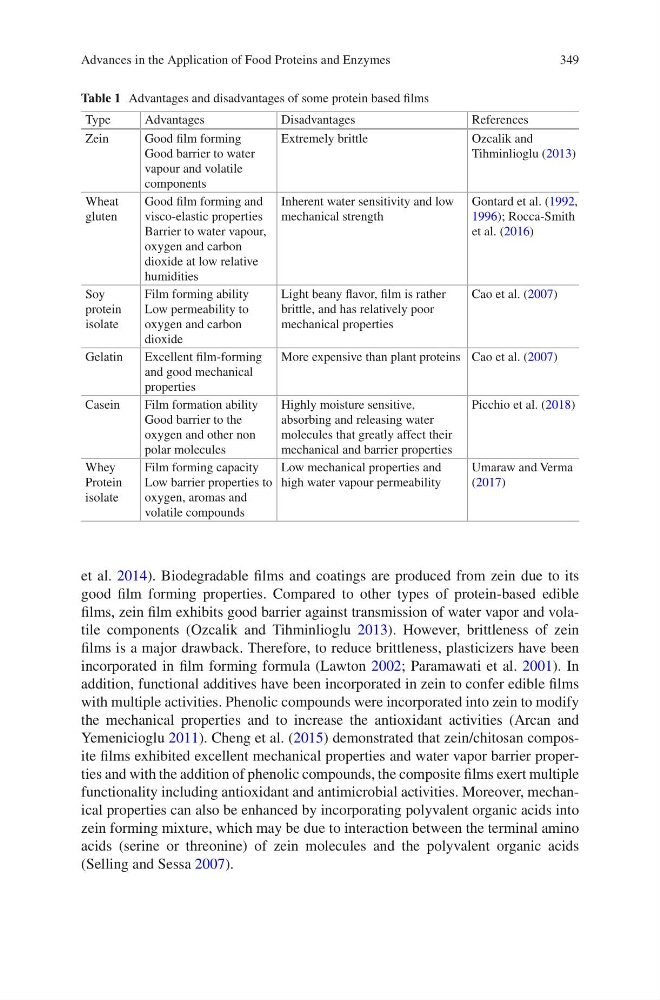
films, zein film exhibits good barrier against transmission of water vapor and volatile components (Ozcalik and Tihminlioglu 2013). However, brittleness of zein
films is a major drawback. Therefore, to reduce brittleness, plasticizers have been
incorporated in film forming formula (Lawton 2002; Paramawati et al. 2001). In
addition, functional additives have been incorporated in zein to confer edible films
with multiple activities. Phenolic compounds were incorporated into zein to modify
the mechanical properties and to increase the antioxidant activities (Arcan and
Yemenicioglu 2011). Cheng et al. (2015) demonstrated that zein/chitosan composite films exhibited excellent mechanical properties and water vapor barrier properties and with the addition of phenolic compounds, the composite films exert multiple
functionality including antioxidant and antimicrobial activities. Moreover, mechanical properties can also be enhanced by incorporating polyvalent organic acids into
zein forming mixture, which may be due to interaction between the terminal amino
acids (serine or threonine) of zein molecules and the polyvalent organic acids
(Selling and Sessa 2007).
Table 1 Advantages and disadvantages of some protein based films
Type
Advantages
Disadvantages
References
Zein
Good film forming
Good barrier to water
vapour and volatile
components
Extremely brittle
Ozcalik and
Tihminlioglu (2013)
Wheat
gluten
Good film forming and
visco-elastic properties
Barrier to water vapour,
oxygen and carbon
dioxide at low relative
humidities
Inherent water sensitivity and low
mechanical strength
Gontard et al. (1992,
1996); Rocca-Smith
et al. (2016)
Soy
protein
isolate
Film forming ability
Low permeability to
oxygen and carbon
dioxide
Light beany flavor, film is rather
brittle, and has relatively poor
mechanical properties
Cao et al. (2007)
Gelatin
Excellent film-forming
and good mechanical
properties
More expensive than plant proteins Cao et al. (2007)
Casein
Film formation ability
Good barrier to the
oxygen and other non
polar molecules
Highly moisture sensitive,
absorbing and releasing water
molecules that greatly affect their
mechanical and barrier properties
Picchio et al. (2018)
Whey
Protein
isolate
Film forming capacity
Low barrier properties to
oxygen, aromas and
volatile compounds
Low mechanical properties and
high water vapour permeability
Umaraw and Verma
(2017)
Advances in the Application of Food Proteins and Enzymes
et al. 2014). Biodegradable films and coatings are produced from zein due to its
good film forming properties. Compared to other types of protein-based edible
films, zein film exhibits good barrier against transmission of water vapor and volatile components (Ozcalik and Tihminlioglu 2013). However, brittleness of zein
films is a major drawback. Therefore, to reduce brittleness, plasticizers have been
incorporated in film forming formula (Lawton 2002; Paramawati et al. 2001). In
addition, functional additives have been incorporated in zein to confer edible films
with multiple activities. Phenolic compounds were incorporated into zein to modify
the mechanical properties and to increase the antioxidant activities (Arcan and
Yemenicioglu 2011). Cheng et al. (2015) demonstrated that zein/chitosan composite films exhibited excellent mechanical properties and water vapor barrier properties and with the addition of phenolic compounds, the composite films exert multiple
functionality including antioxidant and antimicrobial activities. Moreover, mechanical properties can also be enhanced by incorporating polyvalent organic acids into
zein forming mixture, which may be due to interaction between the terminal amino
acids (serine or threonine) of zein molecules and the polyvalent organic acids
(Selling and Sessa 2007).
Table 1 Advantages and disadvantages of some protein based films
Type
Advantages
Disadvantages
References
Zein
Good film forming
Good barrier to water
vapour and volatile
components
Extremely brittle
Ozcalik and
Tihminlioglu (2013)
Wheat
gluten
Good film forming and
visco-elastic properties
Barrier to water vapour,
oxygen and carbon
dioxide at low relative
humidities
Inherent water sensitivity and low
mechanical strength
Gontard et al. (1992,
1996); Rocca-Smith
et al. (2016)
Soy
protein
isolate
Film forming ability
Low permeability to
oxygen and carbon
dioxide
Light beany flavor, film is rather
brittle, and has relatively poor
mechanical properties
Cao et al. (2007)
Gelatin
Excellent film-forming
and good mechanical
properties
More expensive than plant proteins Cao et al. (2007)
Casein
Film formation ability
Good barrier to the
oxygen and other non
polar molecules
Highly moisture sensitive,
absorbing and releasing water
molecules that greatly affect their
mechanical and barrier properties
Picchio et al. (2018)
Whey
Protein
isolate
Film forming capacity
Low barrier properties to
oxygen, aromas and
volatile compounds
Low mechanical properties and
high water vapour permeability
Umaraw and Verma
(2017)
Advances in the Application of Food Proteins and Enzymes