

343
at the N– or C–termini of bitter peptides, releasing free hydrophobic amino acids
and further reducing the bitter taste (Raksakulthai and Haard 2003). Sequential
hydrolysis by endo- and exopeptidase of wheat gluten hydrolysates has been
reported to reduce the bitterness (Liu et al. 2016). Cheung et al. (2015) claimed that
whey protein hydrolysates produced by exopeptidase treatment decreased bitterness
and increased the umami taste. Umami is a savoury taste, corresponding to the flavour of glutamates, especially monosodium glutamate. Recently, umami peptides
suppressing bitterness via the human bitter taste receptor has been reported (Kim
et al. 2015), which may serve as an alternative strategy to reduce bitter taste and
raise consumer preference towards protein hydrolysates. Even though with the help
of exopeptidase treatment, some low bitter protein hydrolysates have been prepared
from dairy or plant proteins (FitzGerald and O’Cuinn 2006).
Bioactivity of Protein Hydrolysates
In vitro, animal or plant proteins release many peptides that are bioactive and have
regulatory functions in humans beyond normal and adequate nutrition. A wide range
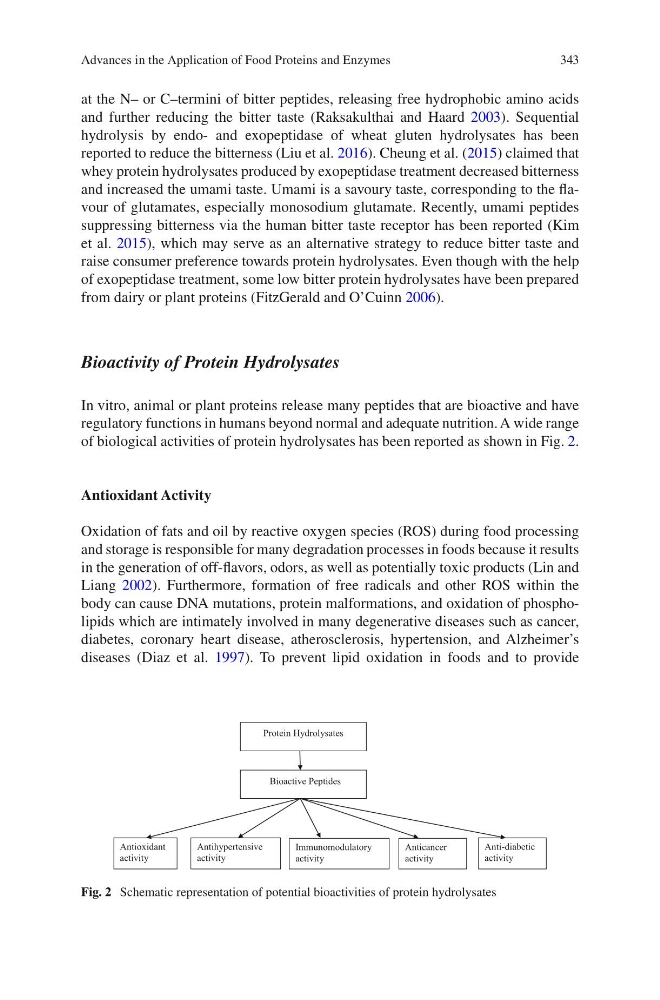
of biological activities of protein hydrolysates has been reported as shown in Fig. 2.
Antioxidant Activity
Oxidation of fats and oil by reactive oxygen species (ROS) during food processing
and storage is responsible for many degradation processes in foods because it results
in the generation of off-flavors, odors, as well as potentially toxic products (Lin and
Liang 2002). Furthermore, formation of free radicals and other ROS within the
body can cause DNA mutations, protein malformations, and oxidation of phospholipids which are intimately involved in many degenerative diseases such as cancer,
diabetes, coronary heart disease, atherosclerosis, hypertension, and Alzheimer’s
diseases (Diaz et al. 1997). To prevent lipid oxidation in foods and to provide
256
257
Protein Hydrolysates
Bioactive Peptides
Antioxidant
activity
Antihypertensive
activity
Immunomodulatory
activity
Anticancer
activity
Anti-diabetic
activity
Fig. 2 Schematic representation of potential bioactivities of protein hydrolysates
Advances in the Application of Food Proteins and Enzymes
at the N– or C–termini of bitter peptides, releasing free hydrophobic amino acids
and further reducing the bitter taste (Raksakulthai and Haard 2003). Sequential
hydrolysis by endo- and exopeptidase of wheat gluten hydrolysates has been
reported to reduce the bitterness (Liu et al. 2016). Cheung et al. (2015) claimed that
whey protein hydrolysates produced by exopeptidase treatment decreased bitterness
and increased the umami taste. Umami is a savoury taste, corresponding to the flavour of glutamates, especially monosodium glutamate. Recently, umami peptides
suppressing bitterness via the human bitter taste receptor has been reported (Kim
et al. 2015), which may serve as an alternative strategy to reduce bitter taste and
raise consumer preference towards protein hydrolysates. Even though with the help
of exopeptidase treatment, some low bitter protein hydrolysates have been prepared
from dairy or plant proteins (FitzGerald and O’Cuinn 2006).
Bioactivity of Protein Hydrolysates
In vitro, animal or plant proteins release many peptides that are bioactive and have
regulatory functions in humans beyond normal and adequate nutrition. A wide range
of biological activities of protein hydrolysates has been reported as shown in Fig. 2.
Antioxidant Activity
Oxidation of fats and oil by reactive oxygen species (ROS) during food processing
and storage is responsible for many degradation processes in foods because it results
in the generation of off-flavors, odors, as well as potentially toxic products (Lin and
Liang 2002). Furthermore, formation of free radicals and other ROS within the
body can cause DNA mutations, protein malformations, and oxidation of phospholipids which are intimately involved in many degenerative diseases such as cancer,
diabetes, coronary heart disease, atherosclerosis, hypertension, and Alzheimer’s
diseases (Diaz et al. 1997). To prevent lipid oxidation in foods and to provide
256
257
Protein Hydrolysates
Bioactive Peptides
Antioxidant
activity
Antihypertensive
activity
Immunomodulatory
activity
Anticancer
activity
Anti-diabetic
activity
Fig. 2 Schematic representation of potential bioactivities of protein hydrolysates
Advances in the Application of Food Proteins and Enzymes