

301
translated into an amino acid sequence and synthesizes a polypeptide chain. The
polypeptide chain is finally transformed into a three dimensional structure, called
native structure, which is having the biological functionality (Schumacher et al.
1986; Longo and Combes 1999). The secondary three-dimensional structure is the
result of interactions of amino acid residues in the primary structure, mainly by
hydrogen bonding of the amide groups. For the globular proteins, like enzymes,
these interactions dictate a predominantly ribbon-like coiled configuration termed
ɣ-helix. The tertiary three-dimensional structure is the result of interactions of
amino acid residues located apart in the primary structure that produce a compact
and twisted configuration in which the surface is rich in polar amino acid residues,
while the inner part is abundant in hydrophobic amino acid residues. This tertiary
structure is essential for the biological functionality of the protein. Some proteins
have a quaternary three-dimensional structure, which is common in regulatory proteins, that is the result of the interaction of different polypeptide chains constituting
subunits that can display identical or different functions within a protein complex
(Dixon and Webb 1979; Creighton 1993).
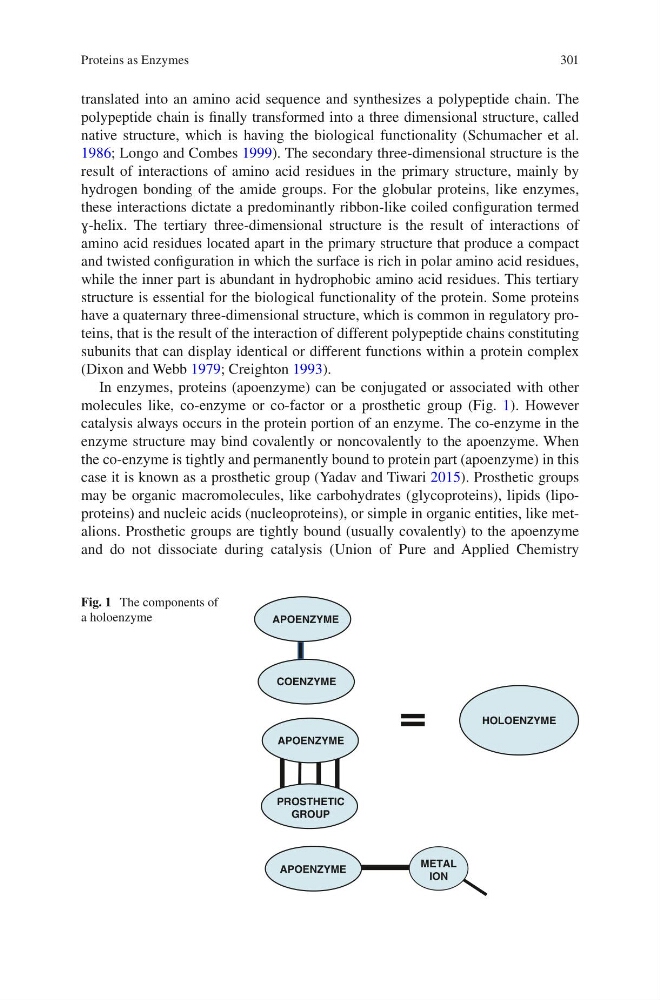
In enzymes, proteins (apoenzyme) can be conjugated or associated with other
molecules like, co-enzyme or co-factor or a prosthetic group (Fig. 1). However
catalysis always occurs in the protein portion of an enzyme. The co-enzyme in the
enzyme structure may bind covalently or noncovalently to the apoenzyme. When
the co-enzyme is tightly and permanently bound to protein part (apoenzyme) in this
case it is known as a prosthetic group (Yadav and Tiwari 2015). Prosthetic groups
may be organic macromolecules, like carbohydrates (glycoproteins), lipids (lipoproteins) and nucleic acids (nucleoproteins), or simple in organic entities, like metalions. Prosthetic groups are tightly bound (usually covalently) to the apoenzyme
and do not dissociate during catalysis (Union of Pure and Applied Chemistry
APOENZYME
COENZYME
APOENZYME
PROSTHETIC
GROUP
APOENZYME
METAL
ION
HOLOENZYME
Fig. 1 The components of
a holoenzyme
Proteins as Enzymes
translated into an amino acid sequence and synthesizes a polypeptide chain. The
polypeptide chain is finally transformed into a three dimensional structure, called
native structure, which is having the biological functionality (Schumacher et al.
1986; Longo and Combes 1999). The secondary three-dimensional structure is the
result of interactions of amino acid residues in the primary structure, mainly by
hydrogen bonding of the amide groups. For the globular proteins, like enzymes,
these interactions dictate a predominantly ribbon-like coiled configuration termed
ɣ-helix. The tertiary three-dimensional structure is the result of interactions of
amino acid residues located apart in the primary structure that produce a compact
and twisted configuration in which the surface is rich in polar amino acid residues,
while the inner part is abundant in hydrophobic amino acid residues. This tertiary
structure is essential for the biological functionality of the protein. Some proteins
have a quaternary three-dimensional structure, which is common in regulatory proteins, that is the result of the interaction of different polypeptide chains constituting
subunits that can display identical or different functions within a protein complex
(Dixon and Webb 1979; Creighton 1993).
In enzymes, proteins (apoenzyme) can be conjugated or associated with other
molecules like, co-enzyme or co-factor or a prosthetic group (Fig. 1). However
catalysis always occurs in the protein portion of an enzyme. The co-enzyme in the
enzyme structure may bind covalently or noncovalently to the apoenzyme. When
the co-enzyme is tightly and permanently bound to protein part (apoenzyme) in this
case it is known as a prosthetic group (Yadav and Tiwari 2015). Prosthetic groups
may be organic macromolecules, like carbohydrates (glycoproteins), lipids (lipoproteins) and nucleic acids (nucleoproteins), or simple in organic entities, like metalions. Prosthetic groups are tightly bound (usually covalently) to the apoenzyme
and do not dissociate during catalysis (Union of Pure and Applied Chemistry
APOENZYME
COENZYME
APOENZYME
PROSTHETIC
GROUP
APOENZYME
METAL
ION
HOLOENZYME
Fig. 1 The components of
a holoenzyme
Proteins as Enzymes