

299
© Springer Nature Switzerland AG 2021
A. Gani, B. A. Ashwar (eds.), Food biopolymers: Structural, functional
and nutraceutical properties, https://doi.org/10.1007/978-3-030-27061-2_13
Proteins as Enzymes
Sajad A. Rather, F. A. Masoodi, Jahangir A. Rather, Tariq A. Ganaie,
Rehana Akhter, and S. M. Wani
Introduction
Living cells have the cell factories operate as a collection of efficient molecular
characteristics. The success of these factories depends on the efficiency of a particular class of biomolecules-protein enzymes (Agarwal 2006). Enzymes are the complex protein molecules that catalyze chemical reactions, i.e. transformations from
one or more substrates to one or more products (Bugg 2004). An integrated view of
protein structure, dynamics and function is emerging, where proteins are considered
as dynamically active machines and internal protein motions are closely linked to
function such as enzyme catalysis (Agarwal 2006). Enzymes exhibit the physicochemical properties including solubility, electrophoretic properties, electrolytic
behaviors and chemical reactivity of proteins (Lee 2006; Bhatia 2018). The sequence
of amino acid of an enzyme also called as primary structure of enzyme plays an
important role in enzyme function including substrate/cofactor binding or release
(Yadav and Tiwari 2015). Thus the degree of biocatalytic activity chiefly depends
on the integrity of the enzymes structure as a protein. The complete biochemically
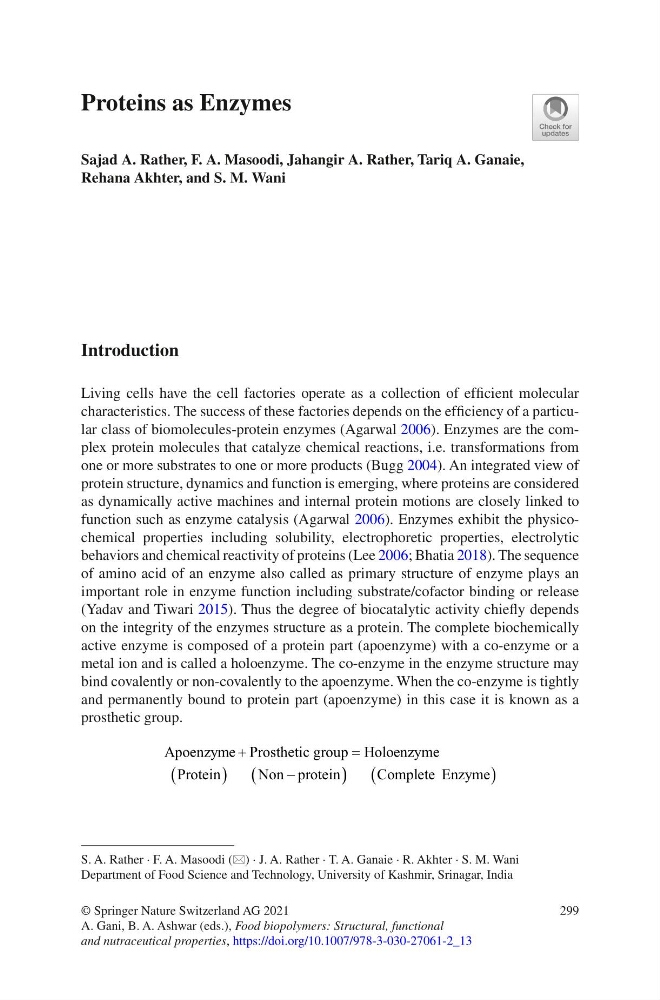
active enzyme is composed of a protein part (apoenzyme) with a co-enzyme or a
metal ion and is called a holoenzyme. The co-enzyme in the enzyme structure may
bind covalently or non-covalently to the apoenzyme. When the co-enzyme is tightly
and permanently bound to protein part (apoenzyme) in this case it is known as a
prosthetic group.
Apoenzyme Prosthetic group Holoenzyme
Protein
Non protein
Complete Enzyme
S. A. Rather · F. A. Masoodi (*) · J. A. Rather · T. A. Ganaie · R. Akhter · S. M. Wani
Department of Food Science and Technology, University of Kashmir, Srinagar, India
© Springer Nature Switzerland AG 2021
A. Gani, B. A. Ashwar (eds.), Food biopolymers: Structural, functional
and nutraceutical properties, https://doi.org/10.1007/978-3-030-27061-2_13
Proteins as Enzymes
Sajad A. Rather, F. A. Masoodi, Jahangir A. Rather, Tariq A. Ganaie,
Rehana Akhter, and S. M. Wani
Introduction
Living cells have the cell factories operate as a collection of efficient molecular
characteristics. The success of these factories depends on the efficiency of a particular class of biomolecules-protein enzymes (Agarwal 2006). Enzymes are the complex protein molecules that catalyze chemical reactions, i.e. transformations from
one or more substrates to one or more products (Bugg 2004). An integrated view of
protein structure, dynamics and function is emerging, where proteins are considered
as dynamically active machines and internal protein motions are closely linked to
function such as enzyme catalysis (Agarwal 2006). Enzymes exhibit the physicochemical properties including solubility, electrophoretic properties, electrolytic
behaviors and chemical reactivity of proteins (Lee 2006; Bhatia 2018). The sequence
of amino acid of an enzyme also called as primary structure of enzyme plays an
important role in enzyme function including substrate/cofactor binding or release
(Yadav and Tiwari 2015). Thus the degree of biocatalytic activity chiefly depends
on the integrity of the enzymes structure as a protein. The complete biochemically
active enzyme is composed of a protein part (apoenzyme) with a co-enzyme or a
metal ion and is called a holoenzyme. The co-enzyme in the enzyme structure may
bind covalently or non-covalently to the apoenzyme. When the co-enzyme is tightly
and permanently bound to protein part (apoenzyme) in this case it is known as a
prosthetic group.
Apoenzyme Prosthetic group Holoenzyme
Protein
Non protein
Complete Enzyme
S. A. Rather · F. A. Masoodi (*) · J. A. Rather · T. A. Ganaie · R. Akhter · S. M. Wani
Department of Food Science and Technology, University of Kashmir, Srinagar, India