

292
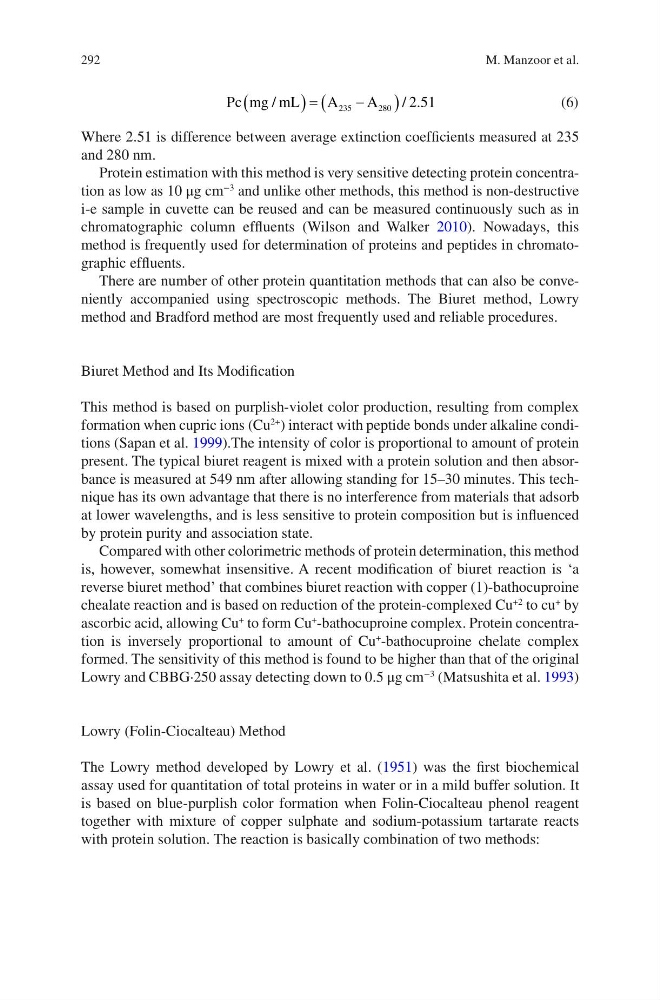
Pc mg mL
A
A
/
/.
235
280
2 51
(6)
Where 2.51 is difference between average extinction coefficients measured at 235
and 280 nm.
Protein estimation with this method is very sensitive detecting protein concentration as low as 10 μg cm
−3
and unlike other methods, this method is non-destructive
i-e sample in cuvette can be reused and can be measured continuously such as in
chromatographic column effluents (Wilson and Walker 2010). Nowadays, this
method is frequently used for determination of proteins and peptides in chromatographic effluents.
There are number of other protein quantitation methods that can also be conveniently accompanied using spectroscopic methods. The Biuret method, Lowry
method and Bradford method are most frequently used and reliable procedures.
Biuret Method and Its Modification
This method is based on purplish-violet color production, resulting from complex
formation when cupric ions (Cu
2+
) interact with peptide bonds under alkaline conditions (Sapan et al. 1999).The intensity of color is proportional to amount of protein
present. The typical biuret reagent is mixed with a protein solution and then absorbance is measured at 549 nm after allowing standing for 15–30 minutes. This technique has its own advantage that there is no interference from materials that adsorb
at lower wavelengths, and is less sensitive to protein composition but is influenced
by protein purity and association state.
Compared with other colorimetric methods of protein determination, this method
is, however, somewhat insensitive. A recent modification of biuret reaction is ‘a
reverse biuret method’ that combines biuret reaction with copper (1)-bathocuproine
chealate reaction and is based on reduction of the protein-complexed Cu
+2
to cu
+
by
ascorbic acid, allowing Cu
+
to form Cu
+
-bathocuproine complex. Protein concentration is inversely proportional to amount of Cu
+
-bathocuproine chelate complex
formed. The sensitivity of this method is found to be higher than that of the original
Lowry and CBBG·250 assay detecting down to 0.5 μg cm
−3
(Matsushita et al. 1993)
Lowry (Folin-Ciocalteau) Method
The Lowry method developed by Lowry et al. (1951) was the first biochemical
assay used for quantitation of total proteins in water or in a mild buffer solution. It
is based on blue-purplish color formation when Folin-Ciocalteau phenol reagent
together with mixture of copper sulphate and sodium-potassium tartarate reacts
with protein solution. The reaction is basically combination of two methods:
M. Manzoor et al.
Pc mg mL
A
A
/
/.
235
280
2 51
(6)
Where 2.51 is difference between average extinction coefficients measured at 235
and 280 nm.
Protein estimation with this method is very sensitive detecting protein concentration as low as 10 μg cm
−3
and unlike other methods, this method is non-destructive
i-e sample in cuvette can be reused and can be measured continuously such as in
chromatographic column effluents (Wilson and Walker 2010). Nowadays, this
method is frequently used for determination of proteins and peptides in chromatographic effluents.
There are number of other protein quantitation methods that can also be conveniently accompanied using spectroscopic methods. The Biuret method, Lowry
method and Bradford method are most frequently used and reliable procedures.
Biuret Method and Its Modification
This method is based on purplish-violet color production, resulting from complex
formation when cupric ions (Cu
2+
) interact with peptide bonds under alkaline conditions (Sapan et al. 1999).The intensity of color is proportional to amount of protein
present. The typical biuret reagent is mixed with a protein solution and then absorbance is measured at 549 nm after allowing standing for 15–30 minutes. This technique has its own advantage that there is no interference from materials that adsorb
at lower wavelengths, and is less sensitive to protein composition but is influenced
by protein purity and association state.
Compared with other colorimetric methods of protein determination, this method
is, however, somewhat insensitive. A recent modification of biuret reaction is ‘a
reverse biuret method’ that combines biuret reaction with copper (1)-bathocuproine
chealate reaction and is based on reduction of the protein-complexed Cu
+2
to cu
+
by
ascorbic acid, allowing Cu
+
to form Cu
+
-bathocuproine complex. Protein concentration is inversely proportional to amount of Cu
+
-bathocuproine chelate complex
formed. The sensitivity of this method is found to be higher than that of the original
Lowry and CBBG·250 assay detecting down to 0.5 μg cm
−3
(Matsushita et al. 1993)
Lowry (Folin-Ciocalteau) Method
The Lowry method developed by Lowry et al. (1951) was the first biochemical
assay used for quantitation of total proteins in water or in a mild buffer solution. It
is based on blue-purplish color formation when Folin-Ciocalteau phenol reagent
together with mixture of copper sulphate and sodium-potassium tartarate reacts
with protein solution. The reaction is basically combination of two methods:
M. Manzoor et al.