

290
Peptide bonds being stable at neutral pH are hydrolysed by strong acids and bases.
However, enzymatic hydrolysis is not so effective. The recent developments in technology are microwave assisted acid hydrolysis that speeds up the hydrolysis and
replacement of ion exchange chromatography by reverse phase high performance
liquid chromatographic technique (Fountoulakis and Lahm 1998). This is achieved
by supplementing the existing chromatographic techniques of HPLC and GC-MS
by number of new techniques such as development of new LC column, isotope dilution MS technique, Ultra HPLC combined with MS technique, capillary electrophoresis (Otter 2012).
Indirect Protein Determinations
Kjeldahl Method
This is a general chemical method of indirect total protein determination in sample
by direct nitrogen measurement and came into existence in 1883 by a brewer Johan
Kjeldahl, originally used for quantifying protein content of beer. The technique
measures sample nitrogen as ammonia and subsequently multiplied by nitrogen-toprotein conversion factor (F) to convert the measured nitrogen to crude protein.
Frequently it is given a default value of 6.25 or 5.7 (equivalent to 16% and 17.5%
nitrogen content respectively). The Kjeldahl method is a three step process including: (1) sample digestion (mineralization), (2) neutralization, and distillation and (3)
titration (ammonia determination) (Owusu-Apenten 2002; Sáez-Plaza et al. 2013).
This method first uses sulphuric acid that causes dehydration and charring in presence of catalysts and salts converting any organically bound nitrogen in food to
ammonium sulphate. The digest is then neutralized with alkali to form ammonia
which is then distilled and trapped using 4% of boric acid solution. Ammonium
borate ions produced are proportional to amount of nitrogen and are titrated against
standardized acid in presence of suitable indicator (methylene blue).
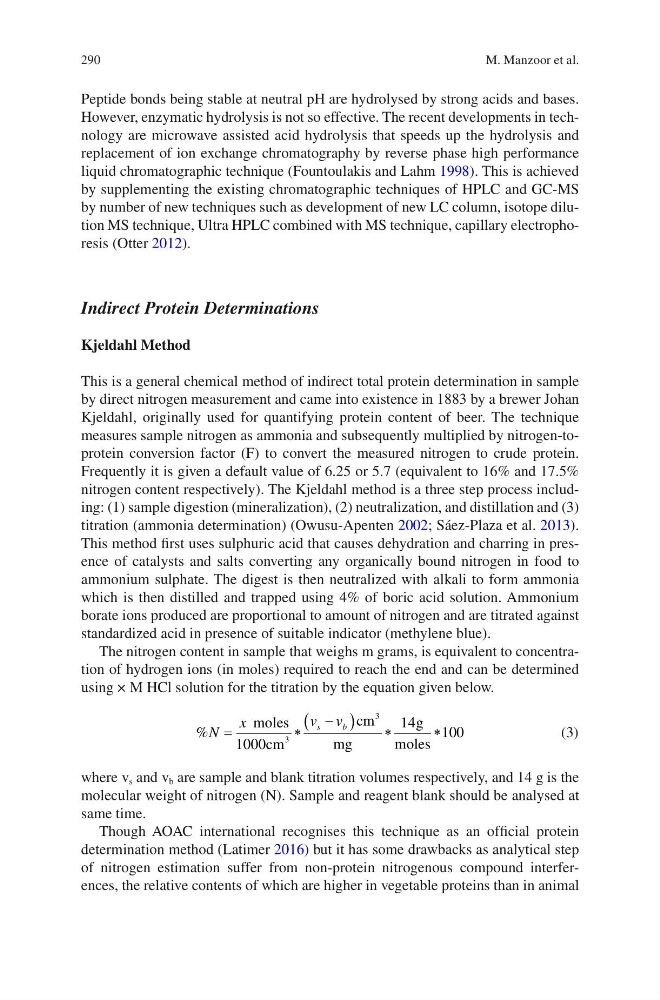
The nitrogen content in sample that weighs m grams, is equivalent to concentration of hydrogen ions (in moles) required to reach the end and can be determined
using × M HCl solution for the titration by the equation given below.
%N
x
v v
s
b
moles
cm
cm
mg
g
moles
1000
14
100
3
3
(3)
where v s and v b are sample and blank titration volumes respectively, and 14 g is the
molecular weight of nitrogen (N). Sample and reagent blank should be analysed at
same time.
Though AOAC international recognises this technique as an official protein
determination method (Latimer 2016) but it has some drawbacks as analytical step
of nitrogen estimation suffer from non-protein nitrogenous compound interferences, the relative contents of which are higher in vegetable proteins than in animal
M. Manzoor et al.
Peptide bonds being stable at neutral pH are hydrolysed by strong acids and bases.
However, enzymatic hydrolysis is not so effective. The recent developments in technology are microwave assisted acid hydrolysis that speeds up the hydrolysis and
replacement of ion exchange chromatography by reverse phase high performance
liquid chromatographic technique (Fountoulakis and Lahm 1998). This is achieved
by supplementing the existing chromatographic techniques of HPLC and GC-MS
by number of new techniques such as development of new LC column, isotope dilution MS technique, Ultra HPLC combined with MS technique, capillary electrophoresis (Otter 2012).
Indirect Protein Determinations
Kjeldahl Method
This is a general chemical method of indirect total protein determination in sample
by direct nitrogen measurement and came into existence in 1883 by a brewer Johan
Kjeldahl, originally used for quantifying protein content of beer. The technique
measures sample nitrogen as ammonia and subsequently multiplied by nitrogen-toprotein conversion factor (F) to convert the measured nitrogen to crude protein.
Frequently it is given a default value of 6.25 or 5.7 (equivalent to 16% and 17.5%
nitrogen content respectively). The Kjeldahl method is a three step process including: (1) sample digestion (mineralization), (2) neutralization, and distillation and (3)
titration (ammonia determination) (Owusu-Apenten 2002; Sáez-Plaza et al. 2013).
This method first uses sulphuric acid that causes dehydration and charring in presence of catalysts and salts converting any organically bound nitrogen in food to
ammonium sulphate. The digest is then neutralized with alkali to form ammonia
which is then distilled and trapped using 4% of boric acid solution. Ammonium
borate ions produced are proportional to amount of nitrogen and are titrated against
standardized acid in presence of suitable indicator (methylene blue).
The nitrogen content in sample that weighs m grams, is equivalent to concentration of hydrogen ions (in moles) required to reach the end and can be determined
using × M HCl solution for the titration by the equation given below.
%N
x
v v
s
b
moles
cm
cm
mg
g
moles
1000
14
100
3
3
(3)
where v s and v b are sample and blank titration volumes respectively, and 14 g is the
molecular weight of nitrogen (N). Sample and reagent blank should be analysed at
same time.
Though AOAC international recognises this technique as an official protein
determination method (Latimer 2016) but it has some drawbacks as analytical step
of nitrogen estimation suffer from non-protein nitrogenous compound interferences, the relative contents of which are higher in vegetable proteins than in animal
M. Manzoor et al.