

286
Mass Spectrometry Based Immunoprecipitation
Immunoprecipitation, eventually in combination with MS detection of precipitates,
is an alternative method that provide a sensitive and accurate way of characterising
protein complexes and their response to regulatory mechanisms, especially of minor
whey proteins or protein complexes when suitable antibodies are available. This has
been used for the study of proteins complexing with Lf (Sokolov et al. 2014), and
for identification of prolactin-binding protein in human milk (Kline and Clevenger
2001). Usually the majority of proteins identified in IP experiments are non-specific
binders. In biological processes, MS- based immunoprecipitation have greater
potential for studying protein complexes e.g., in the study of heat-induced protein
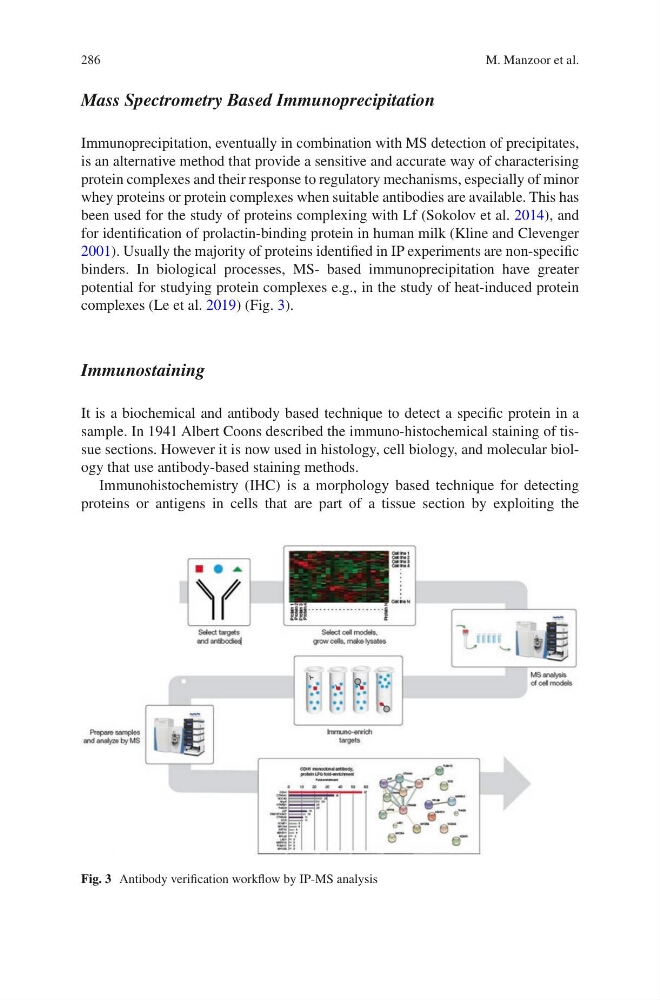
complexes (Le et al. 2019) (Fig. 3).
Immunostaining
It is a biochemical and antibody based technique to detect a specific protein in a
sample. In 1941 Albert Coons described the immuno-histochemical staining of tissue sections. However it is now used in histology, cell biology, and molecular biology that use antibody-based staining methods.
Immunohistochemistry (IHC) is a morphology based technique for detecting
proteins or antigens in cells that are part of a tissue section by exploiting the
Fig. 3 Antibody verification workflow by IP-MS analysis
M. Manzoor et al.
Mass Spectrometry Based Immunoprecipitation
Immunoprecipitation, eventually in combination with MS detection of precipitates,
is an alternative method that provide a sensitive and accurate way of characterising
protein complexes and their response to regulatory mechanisms, especially of minor
whey proteins or protein complexes when suitable antibodies are available. This has
been used for the study of proteins complexing with Lf (Sokolov et al. 2014), and
for identification of prolactin-binding protein in human milk (Kline and Clevenger
2001). Usually the majority of proteins identified in IP experiments are non-specific
binders. In biological processes, MS- based immunoprecipitation have greater
potential for studying protein complexes e.g., in the study of heat-induced protein
complexes (Le et al. 2019) (Fig. 3).
Immunostaining
It is a biochemical and antibody based technique to detect a specific protein in a
sample. In 1941 Albert Coons described the immuno-histochemical staining of tissue sections. However it is now used in histology, cell biology, and molecular biology that use antibody-based staining methods.
Immunohistochemistry (IHC) is a morphology based technique for detecting
proteins or antigens in cells that are part of a tissue section by exploiting the
Fig. 3 Antibody verification workflow by IP-MS analysis
M. Manzoor et al.