

280
or applied as a thin film to the inside wall of the metal or glass column. The extract
material or sample to be separated, is then applied and mobile phase (eluent), is
poured into column over the sample either by use of pumping system or applied gas
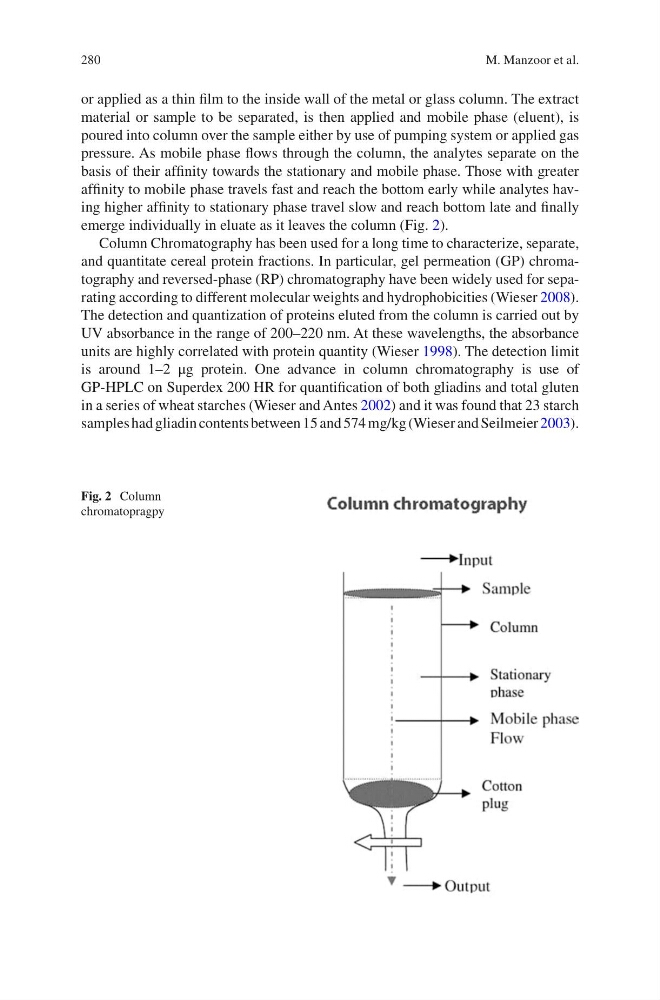
pressure. As mobile phase flows through the column, the analytes separate on the
basis of their affinity towards the stationary and mobile phase. Those with greater
affinity to mobile phase travels fast and reach the bottom early while analytes having higher affinity to stationary phase travel slow and reach bottom late and finally
emerge individually in eluate as it leaves the column (Fig. 2).
Column Chromatography has been used for a long time to characterize, separate,
and quantitate cereal protein fractions. In particular, gel permeation (GP) chromatography and reversed-phase (RP) chromatography have been widely used for separating according to different molecular weights and hydrophobicities (Wieser 2008).
The detection and quantization of proteins eluted from the column is carried out by
UV absorbance in the range of 200–220 nm. At these wavelengths, the absorbance
units are highly correlated with protein quantity (Wieser 1998). The detection limit
is around 1–2 μg protein. One advance in column chromatography is use of
GP-HPLC on Superdex 200 HR for quantification of both gliadins and total gluten
in a series of wheat starches (Wieser and Antes 2002) and it was found that 23 starch
samples had gliadin contents between 15 and 574 mg/kg (Wieser and Seilmeier 2003).
Fig. 2 Column
chromatopragpy
M. Manzoor et al.
or applied as a thin film to the inside wall of the metal or glass column. The extract
material or sample to be separated, is then applied and mobile phase (eluent), is
poured into column over the sample either by use of pumping system or applied gas
pressure. As mobile phase flows through the column, the analytes separate on the
basis of their affinity towards the stationary and mobile phase. Those with greater
affinity to mobile phase travels fast and reach the bottom early while analytes having higher affinity to stationary phase travel slow and reach bottom late and finally
emerge individually in eluate as it leaves the column (Fig. 2).
Column Chromatography has been used for a long time to characterize, separate,
and quantitate cereal protein fractions. In particular, gel permeation (GP) chromatography and reversed-phase (RP) chromatography have been widely used for separating according to different molecular weights and hydrophobicities (Wieser 2008).
The detection and quantization of proteins eluted from the column is carried out by
UV absorbance in the range of 200–220 nm. At these wavelengths, the absorbance
units are highly correlated with protein quantity (Wieser 1998). The detection limit
is around 1–2 μg protein. One advance in column chromatography is use of
GP-HPLC on Superdex 200 HR for quantification of both gliadins and total gluten
in a series of wheat starches (Wieser and Antes 2002) and it was found that 23 starch
samples had gliadin contents between 15 and 574 mg/kg (Wieser and Seilmeier 2003).
Fig. 2 Column
chromatopragpy
M. Manzoor et al.