

277
Modes of Mass Spectroscopy
Fast Atom Bombardment Mass Spectrometry (FAB-MS)
This is basically a desorption technique that significantly contributes to determination of peptides and proteins with masses larger than 10,000 on magnetic sector
instruments (Barber and Green 1987).This method is based on ionization of atoms
or ions (typically Xe or Cs at 8–40 keV) by bombardment with an energetic beam.
FAB has been successfully coupled to liquid chromatography for analysis of
peptides (Leonil et al. 2000). A related technique, Continuous Flow-FAB, although,
having certain persistent advantages like decreasing the ion suppression effect with
hydrophilic peptides, and the matrix-derived background peaks, however, FAB-MS
and these related techniques (CF-FAB and (stainless steel frit) frit-FAB) contribute
some drawbacks such as liability to generate good signal intensity with large molecular mass proteins (greater than about 15,000) (Nguyen et al. 1995). To overcome
drawbacks, an attractive alternative technique has been developed called the ESIMS, which is more easily interfaced to liquid chromatography (Leonil et al. 2000).
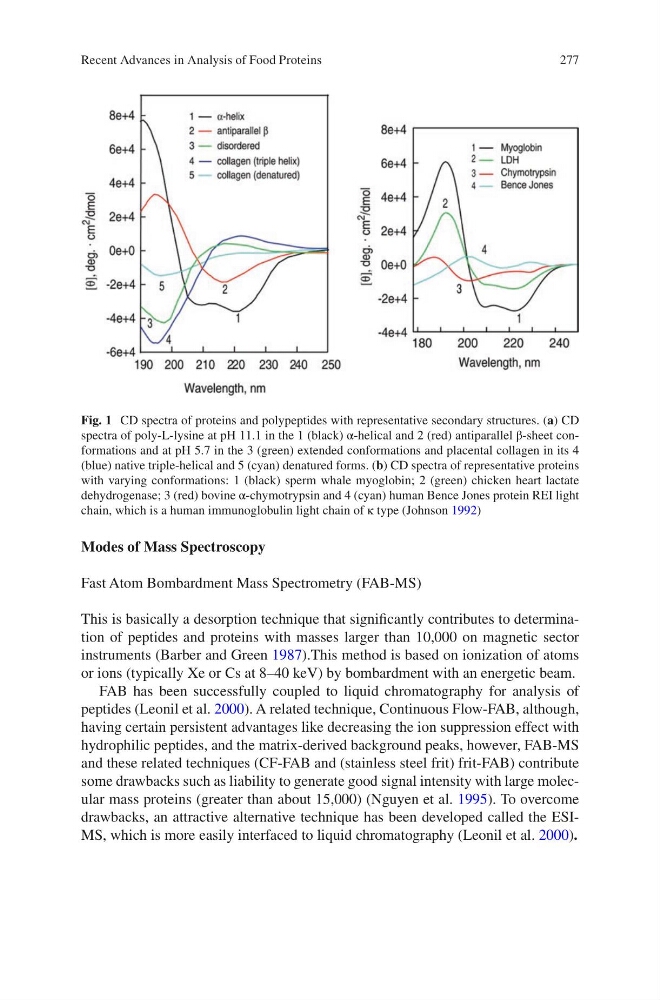
Fig. 1 CD spectra of proteins and polypeptides with representative secondary structures. (a) CD
spectra of poly-L-lysine at pH 11.1 in the 1 (black) α-helical and 2 (red) antiparallel β-sheet conformations and at pH 5.7 in the 3 (green) extended conformations and placental collagen in its 4
(blue) native triple-helical and 5 (cyan) denatured forms. (b) CD spectra of representative proteins
with varying conformations: 1 (black) sperm whale myoglobin; 2 (green) chicken heart lactate
dehydrogenase; 3 (red) bovine α-chymotrypsin and 4 (cyan) human Bence Jones protein REI light
chain, which is a human immunoglobulin light chain of κ type (Johnson 1992)
Recent Advances in Analysis of Food Proteins
Modes of Mass Spectroscopy
Fast Atom Bombardment Mass Spectrometry (FAB-MS)
This is basically a desorption technique that significantly contributes to determination of peptides and proteins with masses larger than 10,000 on magnetic sector
instruments (Barber and Green 1987).This method is based on ionization of atoms
or ions (typically Xe or Cs at 8–40 keV) by bombardment with an energetic beam.
FAB has been successfully coupled to liquid chromatography for analysis of
peptides (Leonil et al. 2000). A related technique, Continuous Flow-FAB, although,
having certain persistent advantages like decreasing the ion suppression effect with
hydrophilic peptides, and the matrix-derived background peaks, however, FAB-MS
and these related techniques (CF-FAB and (stainless steel frit) frit-FAB) contribute
some drawbacks such as liability to generate good signal intensity with large molecular mass proteins (greater than about 15,000) (Nguyen et al. 1995). To overcome
drawbacks, an attractive alternative technique has been developed called the ESIMS, which is more easily interfaced to liquid chromatography (Leonil et al. 2000).
Fig. 1 CD spectra of proteins and polypeptides with representative secondary structures. (a) CD
spectra of poly-L-lysine at pH 11.1 in the 1 (black) α-helical and 2 (red) antiparallel β-sheet conformations and at pH 5.7 in the 3 (green) extended conformations and placental collagen in its 4
(blue) native triple-helical and 5 (cyan) denatured forms. (b) CD spectra of representative proteins
with varying conformations: 1 (black) sperm whale myoglobin; 2 (green) chicken heart lactate
dehydrogenase; 3 (red) bovine α-chymotrypsin and 4 (cyan) human Bence Jones protein REI light
chain, which is a human immunoglobulin light chain of κ type (Johnson 1992)
Recent Advances in Analysis of Food Proteins