

256
effects like dry cough, loss of taste, skin rashes, proteinuria and blood dyscrasias
(Atkinson and Robertson 1979). Thus, the search for natural ACE inhibitors is
growing which can be safely consumed, with little to no side effects, and treat
hypertension.
Bioactive peptides with antihypertensive and ACE inhibitory activity have been
mainly isolated from enzymatic digestion of bovine and human caseins or fermented
foods (Yamamoto et al. 1999; Mohanty et al. 2016). Studies that have investigated
ACE inhibitors suggest that the tripeptide sequence of substrate at C-terminal
greatly affects the binding to ACE. Hence, a substrate or competitive inhibitor with
hydrophobic amino acid residues, be it branched or aromatic side chains, at the
three C-terminal position has greater affinity for ACE (Gobbetti et al. 2002; Sánchez
and Vázquez 2017). Antihypertensive action of bioactive peptides can be due to
competitive and/or non-competitive inhibition of ACE. Competitive inhibition is
competition of peptides with ACE substrate for the enzyme active sites (Sato et al.
2002). Non-competitive (Leu-Trp, Ile-Tyr) and uncompetitive (Ile-Trp, Phe-Tyr)
peptides are characterized by peptides binding to other enzyme sites which changes
enzyme conformation and decreases activity. Thus, the interaction between peptides
and ACE is greatly influenced by a single amino acid substitution as well as isomers
(Sato et al. 2002). For this, structure-activity studies are vital to understand more
(Udenigwe and Aluko 2012). Other possible mechanisms of action include increase
in activity of some vasodilating agents like endothelial NOS, inhibition of renin (by
mixed-type inhibition mode), induction of vasodilation and reducing the activity of
sympathetic system (Aluko 2015). A few examples of ACE-inhibitory peptides
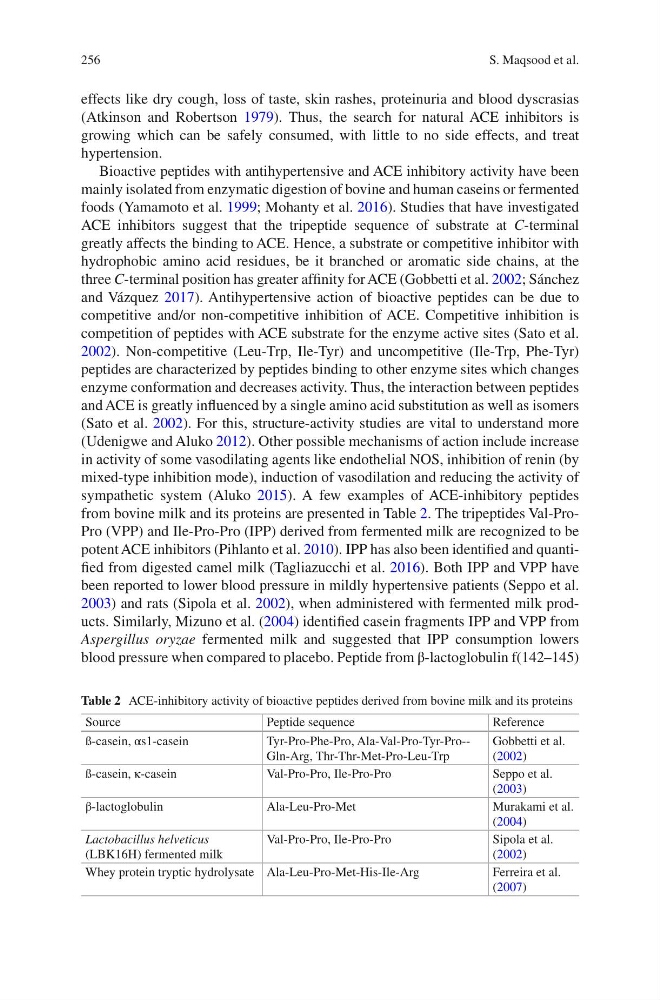
from bovine milk and its proteins are presented in Table 2. The tripeptides Val-ProPro (VPP) and Ile-Pro-Pro (IPP) derived from fermented milk are recognized to be
potent ACE inhibitors (Pihlanto et al. 2010). IPP has also been identified and quantified from digested camel milk (Tagliazucchi et al. 2016). Both IPP and VPP have
been reported to lower blood pressure in mildly hypertensive patients (Seppo et al.
2003) and rats (Sipola et al. 2002), when administered with fermented milk products. Similarly, Mizuno et al. (2004) identified casein fragments IPP and VPP from
Aspergillus oryzae fermented milk and suggested that IPP consumption lowers
blood pressure when compared to placebo. Peptide from β-lactoglobulin f(142–145)
Table 2 ACE-inhibitory activity of bioactive peptides derived from bovine milk and its proteins
Source
Peptide sequence
Reference
ß-casein, αs1-casein
Tyr-Pro-Phe-Pro, Ala-Val-Pro-Tyr-Pro- -
Gln-Arg, Thr-Thr-Met-Pro-Leu-Trp
Gobbetti et al.
(2002)
ß-casein, κ-casein
Val-Pro-Pro, Ile-Pro-Pro
Seppo et al.
(2003)
β-lactoglobulin
Ala-Leu-Pro-Met
Murakami et al.
(2004)
Lactobacillus helveticus
(LBK16H) fermented milk
Val-Pro-Pro, Ile-Pro-Pro
Sipola et al.
(2002)
Whey protein tryptic hydrolysate Ala-Leu-Pro-Met-His-Ile-Arg
Ferreira et al.
(2007)
S. Maqsood et al.
effects like dry cough, loss of taste, skin rashes, proteinuria and blood dyscrasias
(Atkinson and Robertson 1979). Thus, the search for natural ACE inhibitors is
growing which can be safely consumed, with little to no side effects, and treat
hypertension.
Bioactive peptides with antihypertensive and ACE inhibitory activity have been
mainly isolated from enzymatic digestion of bovine and human caseins or fermented
foods (Yamamoto et al. 1999; Mohanty et al. 2016). Studies that have investigated
ACE inhibitors suggest that the tripeptide sequence of substrate at C-terminal
greatly affects the binding to ACE. Hence, a substrate or competitive inhibitor with
hydrophobic amino acid residues, be it branched or aromatic side chains, at the
three C-terminal position has greater affinity for ACE (Gobbetti et al. 2002; Sánchez
and Vázquez 2017). Antihypertensive action of bioactive peptides can be due to
competitive and/or non-competitive inhibition of ACE. Competitive inhibition is
competition of peptides with ACE substrate for the enzyme active sites (Sato et al.
2002). Non-competitive (Leu-Trp, Ile-Tyr) and uncompetitive (Ile-Trp, Phe-Tyr)
peptides are characterized by peptides binding to other enzyme sites which changes
enzyme conformation and decreases activity. Thus, the interaction between peptides
and ACE is greatly influenced by a single amino acid substitution as well as isomers
(Sato et al. 2002). For this, structure-activity studies are vital to understand more
(Udenigwe and Aluko 2012). Other possible mechanisms of action include increase
in activity of some vasodilating agents like endothelial NOS, inhibition of renin (by
mixed-type inhibition mode), induction of vasodilation and reducing the activity of
sympathetic system (Aluko 2015). A few examples of ACE-inhibitory peptides
from bovine milk and its proteins are presented in Table 2. The tripeptides Val-ProPro (VPP) and Ile-Pro-Pro (IPP) derived from fermented milk are recognized to be
potent ACE inhibitors (Pihlanto et al. 2010). IPP has also been identified and quantified from digested camel milk (Tagliazucchi et al. 2016). Both IPP and VPP have
been reported to lower blood pressure in mildly hypertensive patients (Seppo et al.
2003) and rats (Sipola et al. 2002), when administered with fermented milk products. Similarly, Mizuno et al. (2004) identified casein fragments IPP and VPP from
Aspergillus oryzae fermented milk and suggested that IPP consumption lowers
blood pressure when compared to placebo. Peptide from β-lactoglobulin f(142–145)
Table 2 ACE-inhibitory activity of bioactive peptides derived from bovine milk and its proteins
Source
Peptide sequence
Reference
ß-casein, αs1-casein
Tyr-Pro-Phe-Pro, Ala-Val-Pro-Tyr-Pro- -
Gln-Arg, Thr-Thr-Met-Pro-Leu-Trp
Gobbetti et al.
(2002)
ß-casein, κ-casein
Val-Pro-Pro, Ile-Pro-Pro
Seppo et al.
(2003)
β-lactoglobulin
Ala-Leu-Pro-Met
Murakami et al.
(2004)
Lactobacillus helveticus
(LBK16H) fermented milk
Val-Pro-Pro, Ile-Pro-Pro
Sipola et al.
(2002)
Whey protein tryptic hydrolysate Ala-Leu-Pro-Met-His-Ile-Arg
Ferreira et al.
(2007)
S. Maqsood et al.